Principles of Biochemistry Volume 1 - A. Lehninger 1985
Biomolecules
Vitamins and Trace Elements: Their Role in Enzyme Function
Riboflavin (Vitamin B2) is a component of flavin nucleotides
Vitamin B2, or riboflavin, was first isolated from milk. In 1935, The Structure of this compound was established and its chemical synthesis was achieved. Due to the presence of a complex isoalloxazine polycyclic system in the riboflavin molecule (Fig. 10-4), it has a bright yellow color. It was later shown that riboflavin is a component of two related Coenzymes—flavin mononucleotide (FMN) and flavin adenine dinucleotide (FAD), the structures of which are shown in Fig. 10-4. These coenzymes function as tightly bound prosthetic groups of dehydrogenases belonging to the Class of Flavoproteins, or flavin dehydrogenases. In the Reactions Catalyzed by these Enzymes, the isoalloxazine ring of the flavin NUCLEOTIDES serves as an intermediate carrier of hydrogen atoms cleaved from the substrate molecule during the reaction (Fig. 10-5). Succinate dehydrogenase, mentioned earlier (Sec. 9.13), is one of the representatives of flavin dehydrogenases. This enzyme, containing a covalently bound FAD molecule as a prosthetic group, catalyzes the reaction:
Succinate + E—FAD —> Fumarate + E—FADH2,
where the symbol E—FAD denotes the enzyme molecule bound to FAD. In most other flavin dehydrogenases, FMN and FAD are non-covalently attached to the enzyme molecules. The active sites of some flavin dehydrogenases also contain iron or other Metal Ions.

Fig. 10-4. Riboflavin (vitamin B12) and its coenzyme forms.
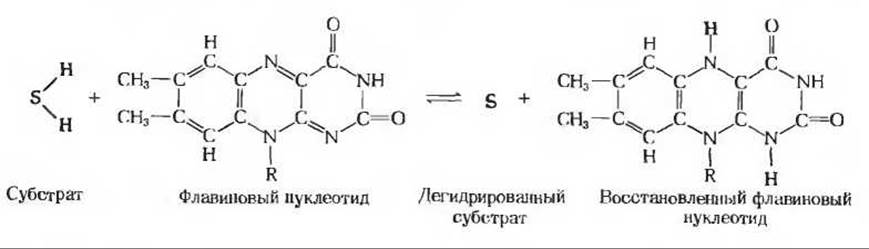
Fig. 10-5. Reversible transfer of two hydrogen atoms from a substrate molecule to the isoalloxazine ring of FMN or FAD, catalyzed by flavin dehydrogenase. The symbol R denotes the remainder of the flavin nucleotide.
Last update: 06/08/2026
Editorial and Educational Adaptation: This material has been compiled based on the primary/original source text. The project team performed an editorial review, corrected technical inaccuracies, structured sections, and adapted the content for an educational format.
What was processed:
- elimination of formatting defects (OCR errors, structural breaks, corrupted characters);
- editorial organization of content;
- standardization of terminology in accordance with academic sources;
- verification of factual statements against the original source text.
All mentions of the author, publication year, and origin of the primary text have been preserved in accordance with the source.