Principles of Biochemistry Volume 1 - A. Lehninger 1985
Biomolecules
Enzymes
Enzymes exhibit all the properties of proteins
All currently known Enzymes are Proteins, and their catalytic activity depends on the integrity of their native protein conformation. For example, the Cleavage of polypeptide chains resulting from boiling an enzyme in a strong acid solution or treating it with Trypsin typically leads to the loss of its catalytic activity. This indicates that the Introduction/19.html">Primary Structure of the protein is essential for its enzymatic activity. Moreover, if we disrupt the characteristic folding of the polypeptide chain(s) in the native enzyme molecule by heating the protein or exposing it to extreme pH values or Denaturing Agents, the catalytic activity of the enzyme is lost. Thus, the preservation of the primary, secondary, and tertiary structures of proteins is essential for their enzymatic activity.
The molecular weights of enzymes, like those of all other proteins, range from 12,000 to 1,000,000, so their sizes greatly exceed those of their substrates or the functional groups on which they act (Fig. 9-2). Some enzymes consist solely of polypeptide chains and contain no chemical groups other than those found in amino acid residues; pancreatic Ribonuclease is an example of such an enzyme. However, the catalytic activity of many enzymes requires an additional chemical component called a cofactor. Cofactors can be inorganic substances, such as Fe2+, Mn2+, or Zn2+ ions (Table 9-1), or complex organic molecules, which in this case are called Coenzymes (Table 9-2). The catalytic activity of some enzymes requires both a coenzyme and one or more Metal Ions. In some enzymes, coenzymes or metal ions are bound to the protein transiently and weakly, whereas in others, these bonds can be strong and permanent; in the latter case, the non-protein part of the enzyme is called a prosthetic group. The complete, catalytically active enzyme together with its coenzyme or metal ion is called a holoenzyme. Coenzymes and metal ions are heat-stable, whereas the protein portion of the enzyme, called the apoenzyme, denatures upon heating. Coenzymes, which we will discuss in Chapter 10, function as carriers of specific functional groups (Table 9-2).
Class="center">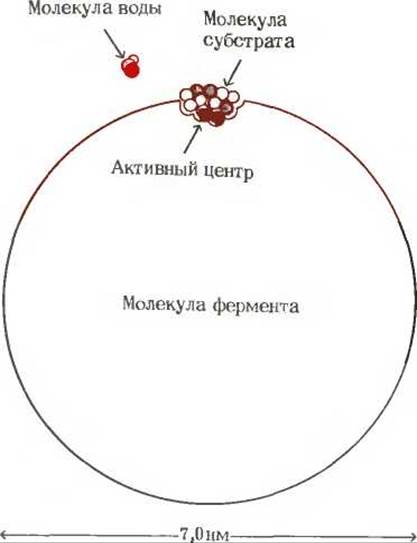
Fig. 9-2. Relative sizes of an enzyme molecule (mol. wt. 100,000, diameter 7 nm) and a typical substrate molecule (mol. wt. 250, length 0.8 nm). The Active Site occupies only a small fraction of the enzyme molecule's surface. A Water molecule is also shown for comparison.
Table 9-1. Some enzymes that require metal ions or atoms as cofactors for their activity
|
Fe2+ or Fe3+ |
Cytochrome oxidase Catalase Peroxidase |
|
Cu2+ |
Cytochrome oxidase |
|
Zn2+ |
DNA polymerase |
|
Mg2+ |
Hexokinase Glucose-6-phosphatase |
|
Mn2+ |
Arginase |
|
K+ |
Pyruvate kinase (also requires Mg2+ ions) |
|
Ni2+ |
Urease |
|
Mo |
Nitrate reductase |
|
Se |
Glutathione peroxidase |
Table 9-2. Coenzymes serving as transient carriers of specific atoms or functional groups1)
|
Coenzyme |
Groups transferred |
|
Thiamine pyrophosphate |
Aldehydes |
|
Flavin adenine dinucleotide |
Hydrogen atoms |
|
Nicotinamide adenine dinucleotide |
Hydride ions (H-) |
|
Coenzyme A |
Acyl groups |
|
Amino groups |
|
|
5'-Deoxyadenosylcobalamin |
Hydrogen atoms and alkyl groups |
|
Biocytin |
CO2 |
|
Tetrahydrofolate |
Other one-carbon groups |
1) Their structure and MECHANISM OF ACTION are described in Chapter 10.
Last update: 06/08/2026
Editorial and Educational Adaptation: This material has been compiled based on the primary/original source text. The project team performed an editorial review, corrected technical inaccuracies, structured sections, and adapted the content for an educational format.
What was processed:
- elimination of formatting defects (OCR errors, structural breaks, corrupted characters);
- editorial organization of content;
- standardization of terminology in accordance with academic sources;
- verification of factual statements against the original source text.
All mentions of the author, publication year, and origin of the primary text have been preserved in accordance with the source.