Principles of Biochemistry Volume 1 - A. Lehninger 1985
Biomolecules
Globular Proteins: Structure and Function of Hemoglobin
Erythrocytes are specialized oxygen-transporting cells
An adult human body contains 5-6 liters of Blood. Approximately one-third to one-half of the total blood volume consists of erythrocytes, which are suspended in protein-rich Blood Plasma. Every day, the blood must transport about 600 L of oxygen from the Lungs to the Tissues, but only a small fraction of this amount is carried by the blood plasma, as oxygen is poorly soluble In aqueous solutions. Nearly all the oxygen transported by blood is bound to the Hemoglobin of erythrocytes. The hemoglobin contained in 100 mL of blood binds approximately 20 mL of gaseous oxygen.
Normal human erythrocytes are small (6-9 µm) biconcave disks (Fig. 8-15). They lack a Nucleus, Cell/35.html">Mitochondria, Endoplasmic reticulum, or any other Organelles. Erythrocytes develop from precursor Cells called reticulocytes. During maturation, reticulocytes lose their typical intracellular organelles and synthesize large amounts of hemoglobin. Thus, erythrocytes are incomplete, rudimentary cells incapable of self-reproduction; they survive in The Human Body for only about 120 days. The primary function of these cells is to carry hemoglobin, which is dissolved in their aqueous Cytosol at a very high concentration of about 34%.
Class="center">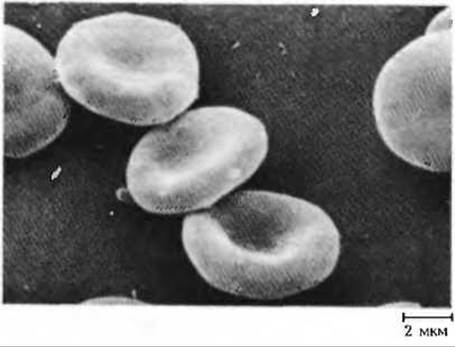
Fig. 8-15. Scanning electron micrograph of normal human erythrocytes.
In arterial blood flowing from the lungs to peripheral tissues, the hemoglobin of erythrocytes is approximately 96% saturated with oxygen. In venous blood returning to The Heart, however, hemoglobin is only about 64% saturated. Thus, every 100 mL of blood passing through tissues releases about one-third of its oxygen content, which equals approximately 6.5 mL of gaseous oxygen at atmospheric pressure and body Temperature.
Last update: 06/08/2026
Editorial and Educational Adaptation: This material has been compiled based on the primary/original source text. The project team performed an editorial review, corrected technical inaccuracies, structured sections, and adapted the content for an educational format.
What was processed:
- elimination of formatting defects (OCR errors, structural breaks, corrupted characters);
- editorial organization of content;
- standardization of terminology in accordance with academic sources;
- verification of factual statements against the original source text.
All mentions of the author, publication year, and origin of the primary text have been preserved in accordance with the source.