Fundamentals of Biochemistry - Filippovich, Y. B. 1999
Proteins
Assessment of Protein Homogeneity
The question of whether an isolated protein preparation represents a single individual protein or a mixture of Proteins is of critical importance. Because proteins are extracted from biological sources containing thousands or even tens of thousands of individual proteins (experimentally, more than 1,200 distinct proteins have been proven to exist in Eukaryotic Cells, though theoretically their number approaches 10,000), one can always expect that an isolated protein might be contaminated with other proteins, potentially leading to incorrect Conclusions and assumptions about The properties of the protein under study. Therefore, Protein Chemistry places great emphasis on assessing protein homogeneity, i.e., uniformity.
Nearly a dozen and a half Methods have been proposed for this purpose. A protein is considered homogeneous if increasing its amount in the solid phase does not lead to an increase in protein concentration in the solution (Fig. 14). The presence of a single protein band upon Polyacrylamide gel Electrophoresis, a single peak on the elution curve (or a single protein zone on a plate) during Chromatography or Gel filtration, a sharp boundary of the protein–solvent interface during protein ultracentrifugation are the most reliable indicators of protein preparation homogeneity. In most cases, crystalline proteins are homogeneous. If the distribution curve of protein particles along height using the free diffusion method conforms to the theoretical Gaussian distribution curve, the protein is homogeneous. Achieving a stable content of free HS-groups or a stable radioactive label content (when working with labeled proteins) during purification, as well as a constant level of biological (enzymatic, hormonal, etc.) activity, strongly Supports protein homogeneity. The identification of a single N-terminal and a single C-terminal amino acid upon analysis of a protein preparation is also indicative of the homogeneity of the isolated protein.
Recent studies have proven that each individual protein consists of molecules of only one single type, with strictly identical molecular weight, composition, and Structure. This is precisely why obtaining a homogeneous protein preparation is so crucial.
Class="center">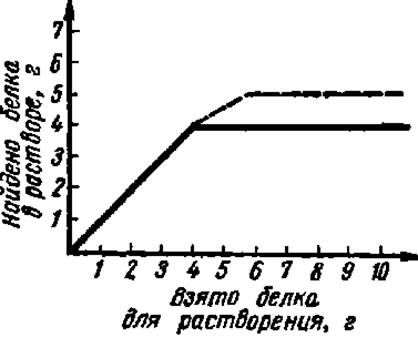
Fig. 14. Assessment of protein homogeneity based on the independence of solubility from The amount of the solid phase;
the solid line shows the curve for a homogeneous protein, and the dashed line indicates the presence of impurities
Last update: 06/08/2026
Editorial and Educational Adaptation: This material has been compiled based on the primary/original source text. The project team performed an editorial review, corrected technical inaccuracies, structured sections, and adapted the content for an educational format.
What was processed:
- elimination of formatting defects (OCR errors, structural breaks, corrupted characters);
- editorial organization of content;
- standardization of terminology in accordance with academic sources;
- verification of factual statements against the original source text.
All mentions of the author, publication year, and origin of the primary text have been preserved in accordance with the source.