Biochemical Engineering Fundamentals, Part 1 - Bailey J., Ollis D. 1989
Kinetics of Enzyme-Catalyzed Reactions
Determination of Rate Constants for Elementary Steps of Enzymatic Reactions
Relaxation Methods for Studying Kinetics
In this section, we will focus in somewhat greater detail on relaxation Methods based on a step change in reaction conditions. The theory and practice of relaxation methods have also been developed for oscillating perturbations of reaction conditions. First, let us consider the equilibrium solely between the substrate, the enzyme, and the enzyme-substrate complex:
Class="center">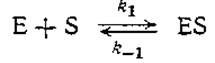

FIG. 3.13. In relaxation methods, a small step change in reaction conditions, such as Temperature, induces a rapid transition to a new equilibrium state.
We know that for this reaction
S + (es) =s0 and e + (es) = e0
Therefore, for a well-mixed reaction mixture in a batch Reactor, the material balance equation for s

takes the form

If we denote the concentration of s at The equilibrium state after a step change in reaction conditions by s*, then s* can be determined by solving the equation
f(s*)= 0 (3.30)
where f(s) is the right-hand side of Eq. (3.29), equal to dsjdt. In any relaxation experiment, s will be close to s*, and f(s) can be approximated by the first terms of a Taylor series expansion of the form
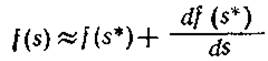 (s—s*)+terms of order (s—s*)2 and higher. (3.31)
Here f(s*), according to Eq. (3.30), is equal to zero. Denoting the deviation from the equilibrium concentration by χ
χ = s — s* (3.32)
and taking into account that s* is independent of time, by transforming Eqs. (3.29) – (3.32) we can obtain a linear equation of the following form [neglecting second- and higher-order terms in Eq. (3.31)]:

If the system is initially in the state of original equilibrium corresponding to the conditions preceding the step perturbation, then
χ(0) = ∆χ0 (3.34)
and then

where

In Eq. (3.36), e* represents the concentration of unbound enzyme at the final equilibrium state. Equation (3.35) indicates that τ can be determined from the slope of the line representing the semi-logarithmic dependence of χ(t) on ∆χ0. In other words, τ is the time during which χ(t) decreases to 37% of its initial value. Once τ, χ*, and e* (or e0 and s0) are determined, Eq. (3.36) can then be used to find the relationship between k1 and k-1, which is independent of the equilibrium equation. In this way, both k1 and k-1 can be calculated.
This method has found widespread application in chemical kinetics, including The kinetics of the Enzymatic Catalysis discussed here.
Last update: 06/08/2026
Editorial and Educational Adaptation: This material has been compiled based on the primary/original source text. The project team performed an editorial review, corrected technical inaccuracies, structured sections, and adapted the content for an educational format.
What was processed:
- elimination of formatting defects (OCR errors, structural breaks, corrupted characters);
- editorial organization of content;
- standardization of terminology in accordance with academic sources;
- verification of factual statements against the original source text.
All mentions of the author, publication year, and origin of the primary text have been preserved in accordance with the source.