Practical Protein Chemistry - A. Darbre 1989
Polypeptide Fragmentation by Chemical Methods
Cleavage of Disulfide Bonds
Cleavage of S-S Groups by Oxidation
Oxidative Cleavage of S—S groups in Proteins is usually carried out using performic acid. In this process, Cysteine and cystine residues are converted into cysteic acid with a yield of >90% (15). Cysteic acid is stable during acid Hydrolysis and elutes immediately before aspartic acid during Amino acid analysis [180]. This Procedure is used to determine the total cysteine and cystine content in proteins. Upon oxidation, Methionine is converted into S—S-dioxide (16), Tryptophan into N-formylkynurenine (17) and unidentified oxidation products [7, 192], and Tyrosine partially into halogen derivatives [77, 160]. Attempts to find conditions for the selective oxidation of cystine and cysteine aimed at minimizing Side Reactions of Other Amino Acids, or at least achieving The formation of well-identified oxidation products, have been unsuccessful. Performic acid oxidation was first used in studies of Insulin [157] and Ribonuclease [77, 84].
Class="center">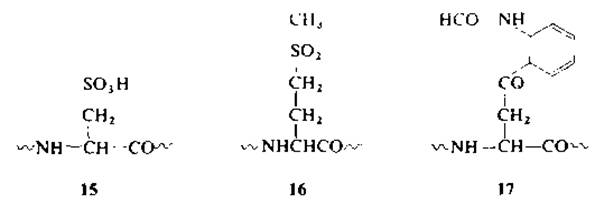
2.2.3.1. Performic acid oxidation. To prepare performic acid, 99% formic acid and 30% hydrogen peroxide are mixed in a 95:5 ratio and allowed to stand in a closed vessel at room Temperature for 2 h. By this time, the performic acid content in the reaction mixture reaches its maximum and then gradually decreases. A protein sample is dissolved in 99% formic acid, methanol is added (to a final concentration of 20%), the mixture is cooled to —5°C, and performic acid (1 mL per 5 mg of protein) is added in a 2:1 ratio. The final protein concentration in the reaction mixture is ∼ 0.5%. The mixture is incubated at —5 to —10°C for 2—3 h, diluted with Water, and lyophilized. Alternatively, the protein can be isolated from the solution by precipitation with trichloroacetic acid or an organic solvent. The reaction mixture can also be diluted twofold with ice-cold water, dialyzed in the cold against water (twice) and 1 mM 2-mercaptoethanol, and then lyophilized. See also Section 1.5.1.1.
Last update: 06/08/2026
Editorial and Educational Adaptation: This material has been compiled based on the primary/original source text. The project team performed an editorial review, corrected technical inaccuracies, structured sections, and adapted the content for an educational format.
What was processed:
- elimination of formatting defects (OCR errors, structural breaks, corrupted characters);
- editorial organization of content;
- standardization of terminology in accordance with academic sources;
- verification of factual statements against the original source text.
All mentions of the author, publication year, and origin of the primary text have been preserved in accordance with the source.