Vertebrate Zoology - V. M. Konstantinov 2011
Chordates
Terrestrial, or Tetrapod, Vertebrates — Vertebrates with Embryonic Membranes
Class Mammals — Subclass Theria — Suborder Higher Primates, or Anthropoids — Order Lagomorphs
Members of the Order Lagomorpha resemble rodents in their dental Structure: they lack canines, and their incisors are separated from the cheek Teeth by a wide, toothless gap (the diastema). They are readily distinguished from rodents by the bony palate, which forms a narrow transverse bridge between the left and right rows of cheek teeth (whereas in rodents, the bony palate forms an extensive plate). Furthermore, the upper jaw has two pairs of incisors rather than one; a second pair of highly reduced incisors is situated directly behind the main pair.
Unlike rodents, The Stomach of lagomorphs consists (physiologically rather than morphologically) of two distinct sections: the fundic region, where only bacterial Fermentation of food takes place, and the pyloric region, where Digestion occurs with the aid of the enzyme Pepsin. It is widely held that the similarities between rodents and lagomorphs are merely superficial (convergent). Phylogenetically, lagomorphs are closely related to primitive Paleogene-Neogene ungulates.
The order comprises two distinct families (Fig. 199).
The pika family, or Ochotonidae, encompasses small, short-eared and short-legged mammals found primarily in the mountainous regions of Asia. They inhabit the mountains of Central Asia and Siberia, as well as the steppes of Transbaikalia, Kazakhstan, and the Volga region. They live in burrows. For the winter, they gather food supplies in the form of dried grass, which steppe species, such as the Daurian pika (Ochotona daurica), stack into small hayricks, while mountain species, such as the northern pika (Och. hyperborea), tuck away in rock crevices.
Class="center">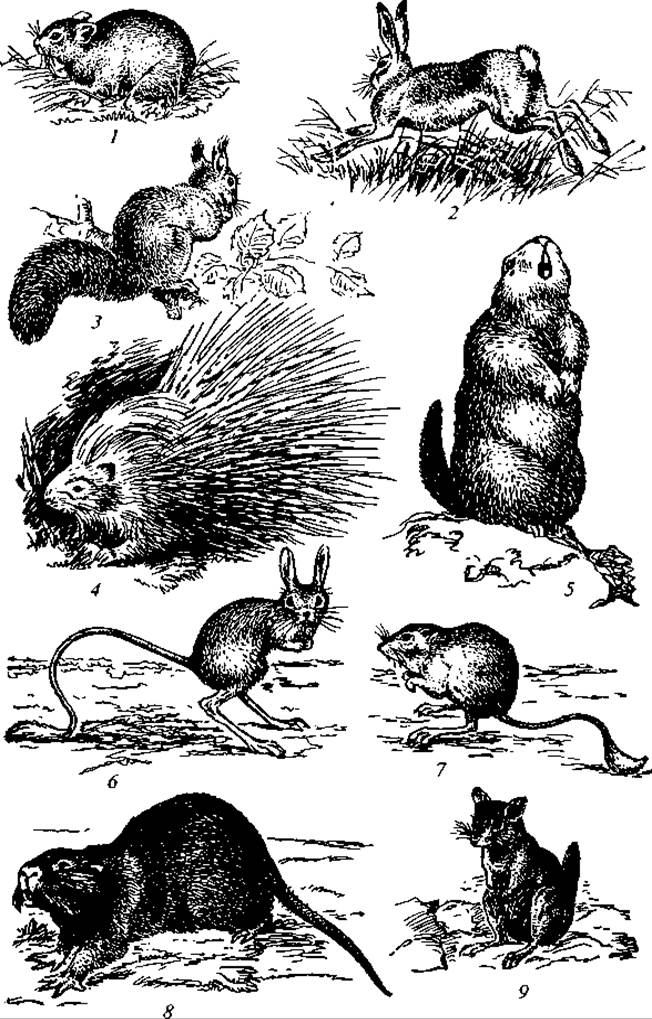
Fig. 199. Rodents and lagomorphs:
1 — pika; 2 — European hare; 3 — squirrel; 4 — porcupine; 5 — marmot; 6 — jerboa; 7 — kangaroo rat; 8 — nutria; 9 — chinchilla
Members of the family Leporidae (hares and rabbits) are characterized by elongated hind legs and very long ears. The mountain hare, or snowshoe hare (Lepus timidus), is the most widely distributed species in Russia, inhabiting the entire tundra, forest, and forest-steppe zones of Europe and Siberia. In winter, its coat turns snow-white. The European hare (L. europaeus) is widespread in the European part of Russia, the Caucasus, northern Kazakhstan, and the steppes of Western Siberia. Unlike the mountain hare, the European hare frequents treeless habitats. In winter, its coat turns white only partially, and in southern regions, such as Crimea, it does not whiten at all. The Tolai hare (L. tolai), a smaller species, inhabits the deserts of Central Asia.
Hares feed on the vegetative parts of plants: grass in the summer, and frequently tree bark and small shrub twigs in the winter. To cope with such coarse forage, their caecum is exceptionally well-developed, and their cheek teeth grow continuously. Unlike pikas, they do not store food for the winter. Hares generally do not construct special shelters (burrows or nests); instead, they rest and reproduce on the ground surface, among bushes or in tall grass. Their gestation period is relatively long (around 50 days), and leverets are born fully furred, with open eyes, and capable of running. They reproduce 2 to 3 times a year.
The European rabbit (Oryctolagus cuniculus) is widespread almost everywhere in Western Europe, as well as in Ukraine near Odessa and Kherson. Its ears and legs are comparatively shorter than those of hares. Unlike hares, rabbits live in colonies and construct burrows. Their gestation period is short—about 30 days—and their newborns are hairless and helpless.
In certain areas, hares hold significant commercial value.
Order Rodentia (Rodents)
Rodents constitute the largest (around 2,000 species) and most widely distributed order of mammals. They are found across all continents and in a remarkably diverse range of habitats. Most rodents are small to medium-sized animals that feed primarily or exclusively on plant matter. Consequently, their dental apparatus is highly specialized. Canines are absent. Conversely, the incisors—one pair in each half of the jaw—are exceptionally well-developed; rodents use them to cut grass, strip bark, or shell seeds. The cheek teeth feature a flat chewing surface devoid of distinct cusps or enamel loops. The incisors, and in some species the cheek teeth as well, are rootless and grow continuously throughout life. Due to their coarse plant diet, the intestinal tract is long. All species possess a caecum that Functions as a "fermentation vat," which is especially prominent in species that feed on grass and tree bark (such as voles). In contrast, in mice, which feed predominantly on seeds, the caecum is less developed.
Most species are characterized by a high reproductive capacity, driven by early sexual maturity and large litter sizes.
Their broad geographic distribution and ecological versatility have given rise to immense diversity within the order. Among them are terrestrial, subterranean, arboreal, and semiaquatic species (see Fig. 199).
Rodents are of great practical importance. Many species are major targets of the fur trade. Furthermore, rodents include numerous agricultural pests and vectors of dangerous diseases, such as plague. Only selected families are outlined below.
The extensive family Sciuridae (squirrels) includes chipmunks, ground squirrels, and marmots alongside true squirrels. Tree squirrels are arboreal Representatives of the family distributed throughout the forests of Eurasia and North America. The Eurasian red squirrel (Sciurus vulgaris) inhabits all forest regions of Russia. It has been artificially acclimatized in Crimea, the Caucasus, and the Tien Shan. Squirrels nest in trees or tree hollows. They do not hibernate in winter. Their diet consists mainly of conifer seeds, and less frequently of berries and mushrooms. They reproduce 2 to 3 times a year. Due to fluctuations in food availability, squirrel population numbers vary dramatically from year to year. During lean years, squirrels undertake extensive Migrations in search of food, frequently wandering into the outskirts of settlements, parks, and gardens. The red squirrel is a species of major importance in the fur trade.
Chipmunks, closely related to squirrels, are distinguished by their striped pelage and less bushy tails. They are primarily terrestrial, building their nests in burrows. They hibernate during the winter. In autumn, they store food provisions consisting of cedar nuts and the seeds of grasses and legumes. A single species, the Siberian chipmunk (Tamias sibiricus), inhabits Russia, spanning the forests of Siberia and eastern Europe (westward to the Arkhangelsk–Vologda–Kazan–Ufa line).
Numerous species of ground squirrels and marmots form the terrestrial group of the family. They inhabit steppe and mountain regions. All species live in burrows, typically in colonies. Unlike tree squirrels, they reproduce only once a year. They feed on grass and seeds, predominantly grasses (graminoids). Most species damage cereal crops and are subject to pest control. Additionally, ground squirrels and marmots act as vectors for dangerous diseases, such as plague and tularemia. They hibernate through the winter. For most species, hibernation begins In the second half of summer and is triggered by the desiccation of forage vegetation. Hibernation is particularly prolonged in the yellow ground squirrel (Citellus fulvus), which inhabits the Trans-Volga steppes, Kazakhstan, and the semi-deserts of Central Asia, leaving it with an active period of just 4 months. It typically lives far away from cultivated fields and is not considered a serious agricultural pest. Its fur is valued higher than that of other species.
The little ground squirrel (S. pygmaeus) is widespread in the steppes of the European part of Russia, the Caucasus, and Kazakhstan, while the spotted ground squirrel (S. suslicus) is common in the European part of the country (eastward to the Volga).
Marmots are distributed across the steppes of southeastern Europe, Kazakhstan, Western Siberia, and the mountains of Central Asia and Siberia. Systematically and biologically, they are closely related to ground squirrels, but are considerably larger in size. A typical representative is the bobak marmot (Marmota bobac).
The sandy deserts of Central Asia, as well as Iran and Afghanistan, are home to a highly unusual rodent commonly misreferred to as the slender-toed "ground squirrel" (Spermophilopsis leptodactylus). This is a representative of a distinct subfamily, Xerinae (ground squirrels). Unlike true ground squirrels, it does not hibernate in winter.
The family Pteromyidae (flying squirrels) is distributed mainly in the tropical zone. The forests of Europe and Siberia harbor a single species, the Siberian flying squirrel (Pteromys volans). Flying squirrels are nocturnal. By day, they rest inside tree hollows. Using a gliding membrane stretched between their fore and hind limbs, they execute gliding leaps from tree to tree spanning over 10 m. They are relatively rare animals and hold no commercial value.
Animals of the family Hystricidae (porcupines) have the upper parts of their bodies covered in long, stiff quills. The Indian crested porcupine (Hystrix indica) is found in eastern Transcaucasia and the foothill regions of Central Asia. It lives in burrows, frequently near orchards, and occasionally damages melon fields. It is nocturnal in habit. When cornered, a porcupine erects its long, sharp quills and makes a sharp lunge (usually backward or sideways), driving them deep into the attacker. A common misconception is that porcupines can voluntarily project their quills over a distance.
The family Castoridae (beavers) comprises only two species, one of which is native to North America, while the other (Castor fiber) is found in Russia. In the past, beavers were abundant and inhabited numerous areas across Europe and Siberia. Having been nearly exterminated almost everywhere by the last century, conservation efforts to restore their numbers were initiated only in the 1930s–1950s. Today, thanks to protection and artificial translocation, beaver populations have increased markedly, and they can be found in many regions of Russia. They live in colonies along forest rivers. Their dwellings consist of lodges built from branches and log segments, as well as burrows. By settling along a river, beavers construct dams that raise the Water level and maintain its relative stability. In summer, they feed on herbaceous plants; in winter, they consume tree bark and twigs. For the winter, they lay in stores of branch fodder, which they submerge in the water near their lodge. They reproduce once a year, producing 2 to 4 young. Sexual maturity is reached in their third year of life.
The Dormouse family (Gliridae) includes small mammals that somewhat resemble squirrels in appearance. They are mainly distributed in the broad-leaved forests of Europe, Central Asia, and South Asia. They lead an arboreal lifestyle. Unlike squirrels, they hibernate during the winter. The largest species is the edible dormouse (Glis glis), a small animal (body length 15 — 20 cm, weight 150 — 180 g) with a bushy tail, which often lives in gardens and causes damage by eating fruit.
The Jerboa family (Dipodidae) brings together distinctive desert and steppe rodents possessing (in most cases) very long hind legs and, conversely, very short front legs. The tail is long, often ending in a tuft. They move by bounding exclusively on their hind legs and are extremely capable of high-speed locomotion. The ability to move quickly over long distances is vital for survival in the desert with its sparse vegetation and scarce food supply. Some species damage plantings of melons, gourds, and industrial crops. They hibernate in winter. A typical representative is the greater jerboa, or earth hare (Allactaga major), the largest of all species in the family (body length 19 — 26 cm, tail — 30 cm).
The Mole-rat family (Spalacidae) unites highly peculiar, specialized rodents that lead a subterranean lifestyle. Their bodies are cylindrical without a clearly defined neck, the HEAD is flattened, the paws are short, the eyes are hidden beneath the Skin, external ears are absent, and the fur is short and velvety. Mole-rats dig the earth with their incisors and push it out with their heads. The lateral folds of the Lips behind the incisors close together, tightly sealing the Mouth. They feed on underground plant parts and construct highly complex systems of tunnels in search of food. In some areas, they cause damage to agriculture. They are distributed in the steppes of the European part of Russia and the Caucasus.
The Mouse family (Muridae) is the most numerous group of rodents, distributed across almost the entire globe. Most species in this family are small, burrow-dwelling mammals. Their diet is primarily plant-based, though some species occasionally eat small animals, such as insects. They are characterized by exceptionally high fertility and early sexual maturity. Under favorable conditions, certain species are capable of reproducing year-round.
The following main groups are found in Russia. Rats (Rattus) are represented chiefly by the brown rat, or Norway rat (R. norvegicus). They typically inhabit buildings, though in the south they are sometimes found far from human dwellings. The Damage caused by rats is well known. Several species of mice are distributed almost universally. Alongside the well-known house mouse (Mus musculus), one can find the striped field mouse (Apodemus agrarius) and the wood mouse (A. sylvaticus). Voles (Microtidae) differ from mice by their shorter tails and The structure of their molars. They are distributed everywhere. In the Arctic, peculiar little animals known as lemmings (genus Lemmus) live there, some of which turn white in winter.
The muskrat (Ondatra zibethicus) also belongs to the voles — it is a large rodent with valuable fur. The native home of the muskrat is North America. The muskrat has been acclimatized in our country almost everywhere. It is a semiaquatic animal living in overgrown water bodies. The muskrat settles in lodges constructed of grass and earth or in burrows. It feeds on aquatic vegetation. Like all members of the mouse family, the muskrat reproduces very rapidly, giving birth 2 to 4 times a year to 4 — 12 young at a time. It reaches sexual maturity at less than a year of age. Today, the muskrat has become one of the most important fur-bearing animals in Russia.
Gerbils inhabit deserts, distinguished by their relatively large size and long, lowered tails.
The rodents of South America are distinct and unique. Examples include guinea pigs (Caviidae), whose domesticated forms are widely used as laboratory animals. The capybara (Hydrochoerus hydrochaeris), the largest living rodent, belongs to the family Hydrochoeridae and inhabits the banks of rivers and lakes. Chinchillas (Chinchillidae) are inhabitants of mountain steppes and are valued as fur-bearing species; chinchillas are successfully bred in captivity. Hutias (Capromyidae) are also valuable fur-bearing animals leading a semiaquatic lifestyle and inhabiting river and lake floodplains. Among them, the coypu, or nutria (Myocastor coypus), has been acclimatized in Transcaucasia and Central Asia, and is successfully farmed in many regions of Russia.
Last update: 13/08/2026
Editorial and Educational Adaptation: This material has been compiled based on the primary/original source text. The project team performed an editorial review, corrected technical inaccuracies, structured sections, and adapted the content for an educational format.
What was processed:
- elimination of formatting defects (OCR errors, structural breaks, corrupted characters);
- editorial organization of content;
- standardization of terminology in accordance with academic sources;
- verification of factual statements against the original source text.
All mentions of the author, publication year, and origin of the primary text have been preserved in accordance with the source.