Vertebrate Zoology - V. M. Konstantinov 2011
Chordates
Terrestrial, or Four-Legged, Vertebrates — Vertebrates with Embryonic Membranes
Class Mammalia, or Mammals — Subclass Theria, or Viviparous Mammals — Suborder Higher Primates, or Anthropoids
Larger in size than the species of the suborder Prosimii, with a body length ranging from 15 to 200 cm. The tail is either absent or developed to varying degrees; in many South American species, the tail is prehensile. The first digit is distinctly opposable to the other digits. All digits are armed with Nails. The Brain is relatively larger than that of prosimians, and in the overwhelming majority of species, the cerebral hemispheres feature numerous sulci and gyri.
Currently, 139 species are known.
The family Cebidae (New World monkeys or capuchins) includes small and medium-sized species (body length 24 – 91 cm). The tail is well developed in all species; in four out of twelve genera, it is prehensile. The nasal septum is wide. Among the species of this family, mention should be made of the muriquis (Brachyteles).
The family Callitrichidae (marmosets) includes the smallest representatives of anthropoid monkeys (Fig. 197). Their body length is 15 – 50 cm. The tail is long, but not prehensile.
The species of both families are arboreal forest animals. Their diet is mixed, but predominantly plant-based. They usually live in family groups. Distributed in Central and South America. The family Cercopithecidae (Old World monkeys) is the most numerous group of catarrhine monkeys (see Fig. 197). A prominent feature is the high development of cheek pouches; a long tail and well-developed ischial callosities are usually present. They are biologically diverse. Typical guenons (Cercopithecus) lead a predominantly arboreal lifestyle. These are mostly African species inhabiting tropical forests and living in troops. They are herbivorous. Baboons (Papio) typically inhabit rocky mountains and arrange their shelters in caves. Their diet is mixed. Some species prey on mammals. Distributed in Africa. Macaques (Macaca) are predominantly South Asian monkeys. They lead both arboreal and terrestrial lifestyles; like baboons, they often inhabit mountains, keeping to rocky slopes. The best known is the rhesus macaque (M. mulatta), distributed in South Asia and the Himalayas (from Nepal to Burma). They live in large troops and are common in zoos worldwide.
Class="center">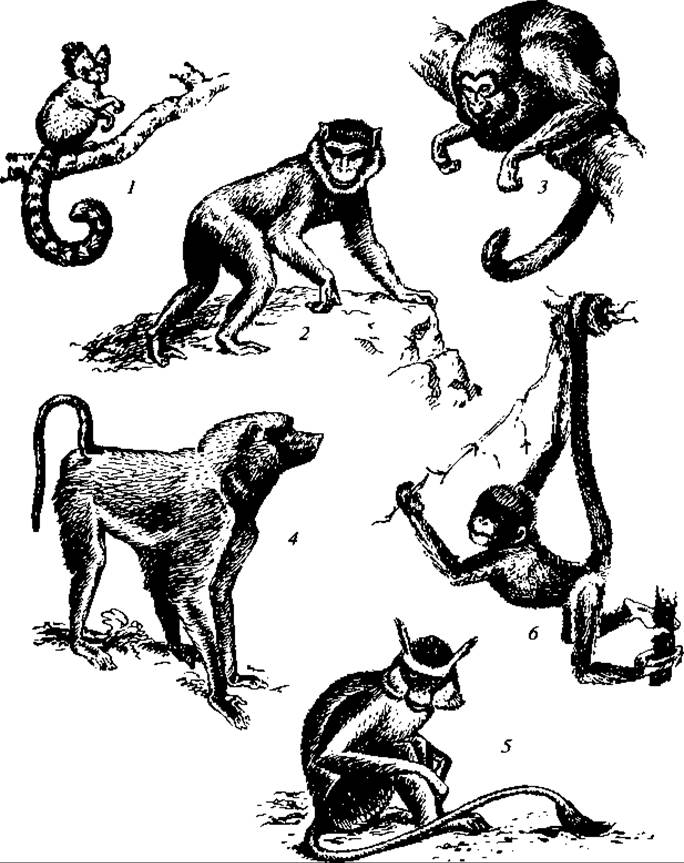
Fig. 197. Monkey species:
1 — common marmoset; 2 — Barbary macaque; 3 — black howler monkey; 4 — baboon; 5 — guenon; 6 — capuchin monkey
The family Hylobatidae (gibbons) comprises seven species characterized by very long forelimbs: in an upright position, they reach the ankles of the hind limbs. They are distributed in the tropical forests of northeastern India (Assam), Indochina, and the islands of Java, Sumatra, and Borneo. Typical arboreal inhabitants. Swinging by their forelimbs, they leap from tree to tree over distances of 10 m or more. A typical species is the hoolock gibbon (Hylobates hoolock).
The family Pongidae (apes) includes the highest Representatives of the order (Fig. 198). A tail, ischial callosities, and cheek pouches are absent (gibbons possess only rudimentary ischial callosities). The braincase of the Skull is particularly well developed. The cerebral hemispheres feature complex sulci and gyri.
The orangutan (Pongo pygmaeus) is a large (1.5 m tall), reddish-orange, hairy ape with elongated jaws, very long forelimbs, and small ears. It has an arboreal lifestyle, descending to the ground extremely rarely. Orangutans live solitary lives or in family groups. They give birth to their young in a nest built in a tree. They are distributed on the islands of Sumatra and Borneo. In recent years, their population has declined sharply and continues to decrease. It is included in the IUCN Red List. The chimpanzee (Pan troglodytes) is slightly under 1.5 m in height. Its overall coloration is black; the face is hairless; the ears are relatively large and very human-like. The forelimbs are relatively shorter than those of the orangutan. They inhabit the tropical forests of Africa. Their lifestyle is largely arboreal, but they regularly descend to the ground. Their diet is plant-based. They live in families, occasionally gathering into small troops.

Fig. 198. Ape species:
1 — gorilla; 2 — chimpanzee; 3 — orangutan
The gorilla (Gorilla gorilla) is the largest of the apes (up to 2 m in height). Its forelimbs, like those of the chimpanzee, are not very long. They walk on the ground in a stooped posture, relying (like chimpanzees) on all four limbs. They live in forests, but have a less exclusive association with trees than the previous species, very frequently spending time on the ground. They feed on fruit, nuts, and roots. Distributed in the forests of equatorial Africa.
The family Hominidae (humans) includes a single extant species — modern humans (Homo sapiens). Morphologically, it is distinguished by an enormous brain with a highly developed Cerebral Cortex. The human brain is more than 3 times larger than that of the great apes. Body Hair is reduced. The forelimbs are relatively short, not reaching the knees. The posture is upright, and the hands are completely freed from the function of body support. The hind limbs are straightened at the knee joint and have lost their prehensile function. In connection with the upright posture, the pelvis is wide, serving to support the Internal Organs. The chin features a characteristic prominence associated with a large and complexly structured Tongue. There are also numerous other traits that distinguish humans from anthropoid apes.
Last update: 13/08/2026
Editorial and Educational Adaptation: This material has been compiled based on the primary/original source text. The project team performed an editorial review, corrected technical inaccuracies, structured sections, and adapted the content for an educational format.
What was processed:
- elimination of formatting defects (OCR errors, structural breaks, corrupted characters);
- editorial organization of content;
- standardization of terminology in accordance with academic sources;
- verification of factual statements against the original source text.
All mentions of the author, publication year, and origin of the primary text have been preserved in accordance with the source.