Invertebrate Zoology: A Study Guide - T. A. Dauda 2014
Protozoa
Apicomplexa
Class Coccidiomorphea
Coccidian parasites inhabit the Cells of both invertebrates and vertebrates, including humans. The genera of greatest practical importance belong to two orders: Blood Sporidians (Haemosporidia) and Coccidia (Coccidiida).
Order Blood Sporidians (Haemosporidia)
The order of blood sporidians encompasses over 100 species of blood parasites infecting reptiles, birds, and mammals. Four species of blood sporidians belonging to the genus Plasmodium are pathogenic to humans, causing malaria, a severe and debilitating disease. Their life cycles follow a similar pattern. When an infected anopheles mosquito takes a blood meal, the causative agents enter the human bloodstream as sporozoites, which are abundant in the Salivary Glands of this blood-sucking insect (Fig. 5). Sporozoites are tiny (5-8 μm long), slender, worm-like, mononuclear cells. From the Blood Plasma, they migrate into the Blood Vessels of the Liver, where they multiply via schizogony to produce a vast number of merozoites. These merozoites invade not only the Cells of the affected organ but also red Blood Cells, or erythrocytes.
Inside the erythrocytes of malaria patients, the parasite appears as small, amoeboid cells. They feed on the Contents of the red blood Cell, grow, and eventually fill the entire erythrocyte. The Hemoglobin ingested by the parasite is partially assimilated, while the undigested residue converts into a dark pigment known as melanin. Having grown, the malaria parasite cell divides via schizogony, giving rise to new merozoites that are released into the blood plasma upon the rupture of the erythrocyte. This process also releases melanin into the bloodstream, which poisons The Human Body and triggers a sudden fever attack.
In addition to toxic poisoning, these parasites inflict severe damage by destroying vast numbers of erythrocytes. The released merozoites re-infect other red blood cells, repeating the developmental cycle. Fever attacks recur at regular intervals (every 48 or 72 hours), which corresponds to the precise duration of merozoite development inside erythrocytes in tertian and quartan malaria.
Class="center">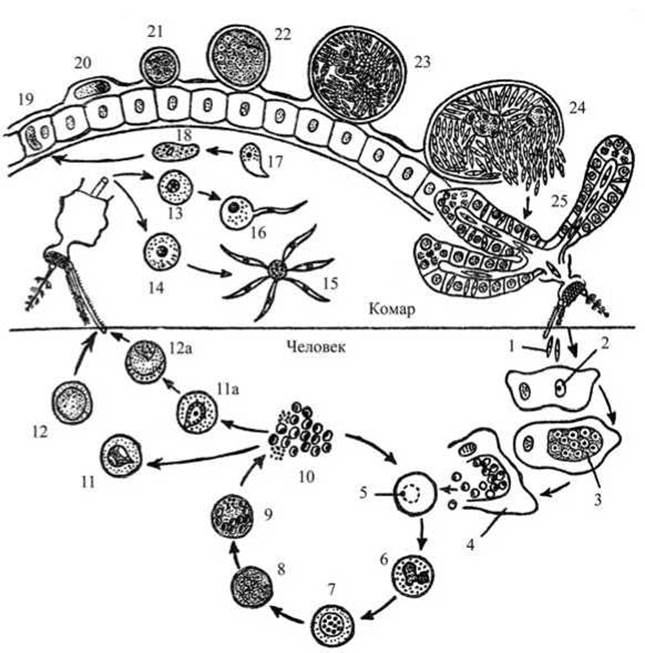
Fig. 5 Life Cycle of the malaria parasite:
1, 2 — sporozoites penetrating the endothelial cells of human liver blood vessels; 3, 4 — schizogony (formation of merozoites); 5 — penetration of a merozoite into an erythrocyte; 6-10 — growth of the merozoite and schizogony; 10 — release of merozoites from the erythrocyte (subsequent erythrocyte schizogony repeats); 11, 12 — Development of the macrogametocyte (a, b — development of the microgametocyte); 13 — macrogamete; 14 — microgametocyte; 15 — formation of microgametes; 16 — gamete copulation; 17 — zygote; 18 — ookinete; 19-23 — development of the ookinete in the mosquito Stomach wall; 24 — release of sporozoites; 25 — migration of sporozoites into the mosquito's salivary glands.
After several asexual generations, gametocytes (preparatory stages for sexual Cell Formation) appear in the patient's blood. Some merozoites, upon invading erythrocytes, differentiate into macro- and microgametocytes, which do not undergo further development within the human host. To continue their life cycle, these gametocytes must be ingested by an anopheles mosquito when it feeds on the blood of a malaria patient. Inside the mosquito's gut, macrogametocytes give rise to female Gametes (macrogametes), while each microgametocyte produces several male gametes (microgametes). The fusion of male and female gametes results in The formation of zygotes, which then penetrate the gut epithelium. Migrating through the gut wall, the zygotes undergo further development, ultimately producing sporozoites.
Thus, The life cycle of blood sporidians involves alternating hosts that mutually infect one another. In parasitology, the Organism in which the parasite undergoes sexual reproduction is designated as the definitive host, whereas the organism supporting asexual multiplication is termed the intermediate host.
Malaria is one of the most widespread and severe human diseases, manifested by regular attacks of debilitating fever.
Combating malaria received exceptional priority in the former USSR. A rigorously enforced control program successfully freed 99% of the country's territory from malaria by 1960, with only sporadic imported cases recorded from other countries. This eradication strategy relied on simultaneously eliminating the malaria parasite itself and its vector, the anopheles mosquito. Today, vast regions of Tropical Africa, Southeast Asia, and New Guinea remain heavily burdened by malaria.
Last update: 13/08/2026
Editorial and Educational Adaptation: This material has been compiled based on the primary/original source text. The project team performed an editorial review, corrected technical inaccuracies, structured sections, and adapted the content for an educational format.
What was processed:
- elimination of formatting defects (OCR errors, structural breaks, corrupted characters);
- editorial organization of content;
- standardization of terminology in accordance with academic sources;
- verification of factual statements against the original source text.
All mentions of the author, publication year, and origin of the primary text have been preserved in accordance with the source.