IMMUNOLOGY - Roitt I. - Mir 2000
Chapter 1. General properties of the immune system
DEFENCE AGAINST EXTRACELLULAR AND INTRACELLULAR INFECTION
Immunological responses to extracellular and intracellular infections differ fundamentally. In response to pathogens that multiply extracellularly, The Immune System aims to destroy the microorganisms themselves and neutralize the Toxic effects of their metabolic products. Conversely, when reacting to microbes that replicate within Cells, two alternative mechanisms are possible: cytotoxic action by T lymphocytes, leading to the destruction of infected cells, or activation of these cells by T lymphocytes to destroy the microbes residing within them. The latter occurs, for instance, when T lymphocytes release cytokines that stimulate macrophages to destroy engulfed microbes.
Since many pathogens exhibit both intracellular and extracellular stages of infection, different mechanisms of the Immune Response become effective at various stages. For example, poliovirus spreads via the bloodstream to infect target cells. At this early stage of infection, pathogen-specific Antibodies are particularly effective. However, to clear an established infection, every virus-infected Cell in the body must be eliminated by cytotoxic T lymphocytes. Consequently, The Role of antibodies is to limit the spread of infection and prevent reinfection by the same virus, whereas cytotoxic T cells are crucial for targeting infected cells (Fig. 1.18). This must be taken into account when designing effective Vaccines.
Class="center">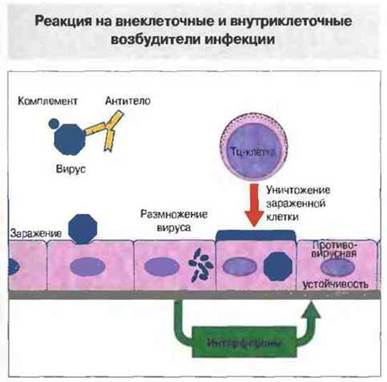
Fig. 1.18. Different types of infection require distinct effector mechanisms of the immune response, as illustrated here using a viral infection as an example. Antibodies and Complement can block the extracellular phase of the viral life cycle and promote viral phagocytosis. Interferons released by infected cells can signal uninfected cells to enter an antiviral state. Viruses replicate only within living cells. Cytotoxic T cells can recognize and destroy infected cells before massive viral Replication takes place.
Last update: 13/08/2026
Editorial and Educational Adaptation: This material has been compiled based on the primary/original source text. The project team performed an editorial review, corrected technical inaccuracies, structured sections, and adapted the content for an educational format.
What was processed:
- elimination of formatting defects (OCR errors, structural breaks, corrupted characters);
- editorial organization of content;
- standardization of terminology in accordance with academic sources;
- verification of factual statements against the original source text.
All mentions of the author, publication year, and origin of the primary text have been preserved in accordance with the source.