IMMUNOLOGY - Roït A. - Mir 2000
Chapter 12. Development of the Immune System in Ontogeny
THE COMPLEMENT SYSTEM
At Cytology/cytology/16.html">Early stages of Organism development, the Blood levels of Complement components are low
An integral part of the innate immune system is The Complement System, which plays a major role in protecting the body against microbes. Approximately 30 different Plasma Proteins belonging to the complement system have been identified (see Chapter 4). They appear during embryonic development and are detected in the blood earlier than IgM (Fig. 12.5). In neonatal serum, their level is 50-60% of that characteristic of an adult organism.
Class="center">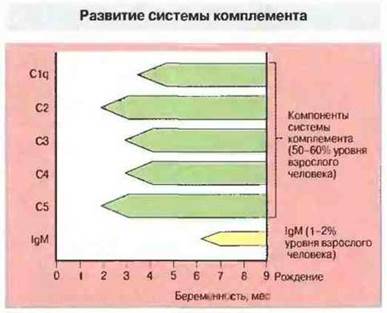
Fig. 12.5. The diagram shows the earliest dates of the initial appearance of complement system components in human fetal Tissues. By birth, the levels of most of these components exceed 50% of adult levels. In contrast, IMMUNOGLOBULINS begin to be produced by the fetus much later.
The earlier appearance of complement system components in serum compared to IgM reflects the fact that prior to the evolution of Antibodies, complement—along with phagocytes—served as the primary immune defense mechanism in animals. Thus, ontogeny recapitulates phylogeny to a certain extent.
Last update: 13/08/2026
Editorial and Educational Adaptation: This material has been compiled based on the primary/original source text. The project team performed an editorial review, corrected technical inaccuracies, structured sections, and adapted the content for an educational format.
What was processed:
- elimination of formatting defects (OCR errors, structural breaks, corrupted characters);
- editorial organization of content;
- standardization of terminology in accordance with academic sources;
- verification of factual statements against the original source text.
All mentions of the author, publication year, and origin of the primary text have been preserved in accordance with the source.