Biological Membranes - A. N. Ogurtsov 2012
Electrogenesis of Biomembranes
Secondary Transport via Cotransporters
Na+ symporters
Cotransporters are transport Proteins that move metabolite molecules (ions and small molecules, such as glucose or Amino Acids) against a concentration gradient without utilizing ATP Hydrolysis energy. To perform this work, cotransporters harness energy previously stored in the electrochemical gradient of Na+ or H+ ions to drive such translocation across the membrane.
For instance, the energetically favorable movement of Na+ ions into The Cell, driven by both the electrical field and the sodium concentration gradient, can be coupled to The transport of a substrate molecule, such as glucose, against its concentration gradient.
An essential feature of this cotransport is that neither molecule can cross the membrane independently; successful translocation requires their simultaneous movement, which is why this mechanism is termed coupled transport.
Symport refers to the process where a cotransporter protein transfers metabolites in the same direction as the ions whose concentration gradient provides the energy for the membrane protein's function (Figure 52(6)). Conversely, if the translocation of molecules and cotransported ions occurs in opposite directions, the process is known as antiport (Figure 52(b)).
Some cotransporters handle exclusively cations, whereas others transport only anions. A prominent example of a cationic cotransporter is the Na+/H+ exchanger (antiporter), which extrudes protons from the cell by utilizing the energy of the inward sodium ion stream. An example of an anionic cotransporter is the anion exchanger protein AE1, which mediates the counter-transport of Cl- and HCO-3 ions across the membrane.
Most animal tissue Cells import glucose from the bloodstream via GLUT-type transporters (Figure 55), with the direction of transmembrane glucose flux being dictated by the concentration gradient.
However, certain cells—such as those lining the Small Intestine lumen or renal tubules—must import glucose from the intestinal lumen or tubular fluid against a steep concentration gradient. These cells employ a 2-Na+/1-glucose symporter, a protein that couples the cellular import of a single glucose molecule to the cotransport of two Na+ ions.
Class="center">
The Free energy change for this case can be expressed as

Here, ∆G encompasses both the free energy change resulting from the chemical potential gradient during the transmembrane transfer of 1 mole of glucose (∆Gcglucose) and 2 moles of sodium ions (2∆GcNa+), as well as the free energy change due to the electrical potential gradient upon The transfer of 2 moles of sodium cations (2∆GNa+m). Figure 102 illustrates the scheme of ∆G formation during the inward transport of sodium ions.
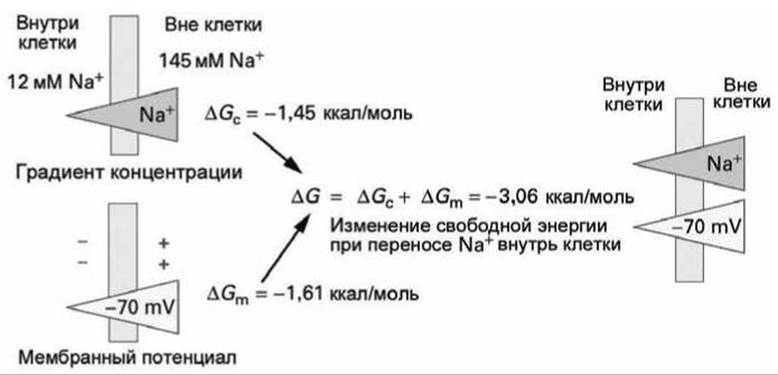
Figure 102 - Free energy change during the transport of one mole of Na+ into the cell
During the Transmembrane Transport of two moles of sodium ions, the energy yield is approximately 6 kcal/mol. At equilibrium, ∆G = 0; consequently, the equilibrium glucose concentration ratio (derived from the equation  -6 kcal/mol) equals
Therefore, the symporter-mediated transfer of two sodium ions establishes an intracellular glucose concentration that is 30,000 times higher than the extracellular concentration. If the symporter relied on the energy of a single sodium ion, the intracellular-to-extracellular glucose concentration ratio would be only 170.
Thus, coupling glucose import to the translocation of two (rather than one) sodium ions enables the cell to accumulate nearly 200 times more glucose than would be feasible with a 1-Na+/1-glucose transporter.
The 2-Na+/1-glucose symporter contains 14 transmembrane α-helices, and its transport cycle is depicted in Figure 103.
Unlike, for instance, the GLUT1 uniporter (Figure 55), the conformational transition in the 2-Na+/1-glucose symporter occurs exclusively when all substrates (two sodium ions and a glucose molecule) are bound to the exoplasmic domain of the protein.

Figure 103 - Scheme of the catalytic cycle of the 2-Na+/1-glucose symporter
Last update: 13/08/2026
Editorial and Educational Adaptation: This material has been compiled based on the primary/original source text. The project team performed an editorial review, corrected technical inaccuracies, structured sections, and adapted the content for an educational format.
What was processed:
- elimination of formatting defects (OCR errors, structural breaks, corrupted characters);
- editorial organization of content;
- standardization of terminology in accordance with academic sources;
- verification of factual statements against the original source text.
All mentions of the author, publication year, and origin of the primary text have been preserved in accordance with the source.