Biological Membranes - A. N. Ogurtsov 2012
Structure and Functions of Biomembranes
Intermolecular Interactions in Biomembranes
Lipid-Lipid Interactions
The term lipid-lipid interactions is generally used to highlight specific interactions that arise in membrane systems due to the heterogeneity of their Lipid Composition.
Among the various Factors Determining the state of Lipids in membranes, the following intermolecular interactions are of the utmost importance:
1) electrostatic forces of attraction and repulsion between charged polar HEAD groups,
2) steric factors, which take into account the shape of lipid molecules and the spatial arrangement of their head groups and hydrophobic hydrocarbon tails,
3) Hydration forces,
4) Hydrogen Bonds between lipid head groups.
Hydration forces play a crucial role in the interaction between phospholipid membranes. Maintaining a Water layer 10-30 Å thick near the outer polar surface of the membrane prevents membranes from approaching each other and coming into direct contact. To remove this water layer, its state must be disrupted by expending energy, which is precisely the basis for the manifestation of hydration forces.
The Nature of repulsive hydration forces is non-electrostatic; they manifest themselves against the Background of Coulombic interactions, increasing sharply at short distances.
For instance, when dihexadecyldimethylaminoacetate bilayers approach each other, this effect becomes dominant at an intersurface distance of about 11 Å. However, The addition of Calcium Ions to the system can lead to their interaction with polar groups, thereby disrupting hydration repulsion and, As a result, causing the bilayers to adhere into a water-free Structure.
Lipid hydration depends on their chemical nature and largely determines their physical properties. Typically, lower hydration is observed in lipids containing donor and acceptor groups involved in Hydrogen bond formation. Their reduced hydration is explained by the fact that the polar head groups of these lipids form hydrogen bonds with one another rather than with surrounding water molecules. For this to occur, the hydrogen bonds between the lipid groups and water must be broken to form "new" internal hydrogen bonds:
Class="center">А-Н...ОН2 + В...НОН→И-Н....В + НОН...ОН2,
where A-H is a hydrogen-donor group and B is a hydrogen-acceptor group of two lipid molecules. The A-H groups include NH+3, NH2, POH, COH, COOH, HNC-O, while B groups include PO-, COO-, OC-O, and COC.
Such a reaction will proceed if the total Stability of the newly formed hydrogen bonds on the right side of the equation exceeds that of the hydrogen bonds between water and the A-H and B groups.
The release of water molecules from the bilayer surface accompanying this process causes an increase in the Entropy of the system, which compensates for the energy cost required to break the hydrogen bonds between lipids and water.
Such Hydrogen bonds are easily broken and re-formed between other lipids within ~ 10-11-10-12 s. A unified system of labile hydrogen bonds promotes cooperative properties and, in particular, raises the gel-liquid crystal phase transition Temperature by counteracting the destabilizing electrostatic repulsion between polar head groups, which otherwise lowers the transition temperature.
The interaction energy of a system consisting of two lipid components, A and B, can be expressed in terms of pairwise potentials ФАА, ФВВ, and ФАВ. If the difference
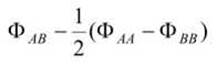
is small, a uniform distribution of components A and B will be observed in the system.
Conversely, when the interaction potentials differ significantly, it becomes possible to compensate for the entropy decrease caused by the increasing order of the system. In this case, a non-uniform Distribution of lipids and phase Separation should be expected.
Since the primary contribution to lipid interaction energy in membranes stems from dispersion forces between hydrocarbon chains, these effects are most pronounced in membranes formed from lipids with drastically different hydrocarbon chain lengths (Table 1).
For example, in membranes composed of DMPC (dimyristoylphosphatidylcholine, 14 carbon atoms) and DSPC (distearoylphosphatidylcholine, 18 carbon atoms), at any volumetric ratio of components (up to 75% DSPC), two separate phase transitions are observed (at 23 and 58°C, respectively), the amplitudes of which are proportional to the molar fraction of the components in the membrane. This indicates a lack of component mixing in the solid phase.
At 23°C<T<58°C, the system exists as a two-dimensional solution of DSPC crystalline domains within a liquid-crystalline DMPC matrix. Unsaturated lipids also generally fail to mix well with saturated lipids in the solid phase.
A different picture can be observed when membranes are formed entirely of saturated lipids with little difference in hydrocarbon chain length. In such cases, a uniform distribution is found across all component ratios in both the "solid" and "liquid" states.
For instance, in membranes made of DPPC (dipalmitoylphosphatidylcholine, 16 carbon atoms) and DSPC (18 carbon atoms), a single phase transition is recorded, which shifts gradually from 41 to 58°C as the proportion of DSPC in the mixture varies from 0 to 100%, respectively.
Last update: 13/08/2026
Editorial and Educational Adaptation: This material has been compiled based on the primary/original source text. The project team performed an editorial review, corrected technical inaccuracies, structured sections, and adapted the content for an educational format.
What was processed:
- elimination of formatting defects (OCR errors, structural breaks, corrupted characters);
- editorial organization of content;
- standardization of terminology in accordance with academic sources;
- verification of factual statements against the original source text.
All mentions of the author, publication year, and origin of the primary text have been preserved in accordance with the source.