IMMUNOLOGY TEXTBOOK - Mercury Podillia 2013
STRUCTURE AND FUNCTIONAL PRINCIPLES OF THE IMMUNE SYSTEM
Age-Related Immunology
The child's immune system. Features of The Immune System in children: 1) immaturity of the phagocytic system (incomplete phagocytosis); 2) immaturity of natural killer Cells; 3) reduced interferon synthesis; 4) elevated Lysozyme synthesis; 5) high functional activity of the Thymus.
The immune system of a newborn infant is characterized by the following features:
1. The fetus synthesizes its own Antibodies which, regardless of The Nature of antigenic stimulation, are polyreactive IgM. Newborn CD5+ B lymphocytes are capable of synthesizing immunoglobulin G subclasses G1 and G3, but not G2 or G4, to which antibodies against bacterial capsular polysaccharide belong. The infant receives the bulk of IgG from the mother transplacentally, starting from the 35th week of gestation. At that, IgG2 penetrates the placental barrier poorly.
2. Immature B lymphocytes predominate in the B-Cell repertoire of a newborn infant. Their phenotype is characterized by a high level of surface slgM molecule expression and the absence of slgD, whereas slgD predominates and only a minor amount of slgM is present on most adult B lymphocytes. In newborns, the binding of antigen to surface slgM leads to apoptosis of immature B lymphocytes, as it is not coupled with the Inositol phospholipid intracellular signal Transduction pathway.
3. Newborn B lymphocytes do not receive a second signal upon cooperation with neonatal T cells, since neonatal T lymphocytes are characterized by a very low level of CD40 Ligand (CD40L) expression. This reduces the capacity of newborn B lymphocytes for immunoglobulin isotype Class switching and also suppresses the ability of T lymphocytes to differentiate into type 1 T helper cells (Th1), which should otherwise enhance macrophage responses.
4. The lack of CD40 interaction with CD40L may lead to predominantly inappropriate antigen presentation by B cells to T lymphocytes due to impaired expression of B-7 molecules on antigen-presenting cells.
5. The ratio between the number of professional and non-professional antigen-presenting cells interacting with T lymphocytes influences the Nature of the Immune Response to an antigen: whether it culminates in priming (readiness of the T lymphocyte for the subsequent execution of an immune response) or tolerance. Non-professional antigen-presenting cells predominate in newborns, leading to a diminished strength of immune responses.
6. The peripheral Blood of a newborn contains a small number of mature B lymphocytes that display an adequate amount of slgD on their surface. Consequently, low doses of Antigens administered to newborns may be sufficient only to prime mature differentiated B lymphocytes and elicit a humoral response. However, if the antigen dose exceeds a certain threshold, the majority of immature pre-B lymphocytes die via apoptosis, while anergy develops in mature ones.
7. The T-helper cell subpopulation (CD4+) is heterogeneous. It is dominated by naive T lymphocytes with the CD45RA+ phenotype, which function as Inducers of suppressor mechanisms. They predominantly produce interleukin-2 (80% of naive T lymphocytes in newborns compared to 50% in adults). At the same time, the proportion of naive T lymphocytes is significantly higher in newborns who have experienced chronic intrauterine Hypoxia (increasing to 90–92%).
Such CHARACTERISTICS OF THE newborn's immune system render the infant vulnerable to The breakdown of defense mechanisms and the onset of infectious diseases.
Subsequently (as early as the first week of life), dramatic changes occur in the hemogram, known as "physiological crossovers in the blood formula" (Fig. 2). These changes reflect the immune remodeling processes taking place in the newborn's body As a result of adaptation to the external environment.
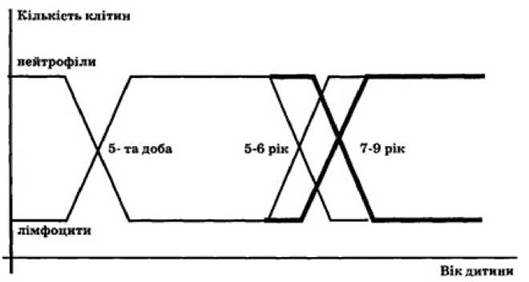
Fig. 2. Physiological crossovers of the blood formula in children (Kazmirchuk V. Ye., Kovalchuk L. V., 2006)
In newborn infants, the neutrophil-to-lymphocyte ratio is approximately the same as in adults, or neutrophils are slightly predominant (as in pregnant women). During the first days of extrauterine life, the neutrophil count begins to decline rapidly, while the lymphocyte count increases. By approximately the 4th–5th day of life, the percentage ratio of neutrophils and lymphocytes equalizes (averaging 45% each). This is the so-called "first physiological crossover" of leukocytes. Physiological role: an elevated leukocyte count (3–4 times higher than the adult norm) during the first days of extrauterine life ensures reliable Protection of the Skin and mucous membranes. Concurrently, A large number of diverse exogenous antigens are presented, providing a powerful stimulus for the antenatally formed lymphoid complex to sharply increase lymphocyte production.
From 10 months to 2.5 years of age, children exhibit maximal physiological lymphocytosis (about 65%). During this period, the child encounters specific antigenic influences (routine vaccinations, childhood infections, Viruses, Bacteria, etc.). A quantitative expansion of lymphoid tissue (adenoids, Tonsils, Lymph Nodes) is observed. Due to constant antigenic load, the body's immune system gradually acquires competence. In most children, a secondary immune response to certain infections develops by the end of the 2nd year of life.
By approximately the 4th–5th year of life, a renewed equilibrium between lymphocyte and neutrophil levels is observed. This is the so-called "second physiological crossover in the blood formula". The timing of the second crossover exhibits individual variations (from 4 to 7 years), depending on the child's phenotypic characteristics, the functional state of major Organs and systems, as well as the child's living conditions (material and domestic environment, individual and collective upbringing, ecology). Children aged 6–7 years with unexplained lymphocytosis are categorized as "late starters", who are characterized by delayed maturation of the immune system.
Subsequently, a gradual involution of lymphoid tissue occurs alongside the progressive refinement of its function. Concurrently, the percentage of lymphocytes begins to decline, while the neutrophil level rises, eventually reaching the adult norm.
Last update: 13/08/2026
Editorial and Educational Adaptation: This material has been compiled based on the primary/original source text. The project team performed an editorial review, corrected technical inaccuracies, structured sections, and adapted the content for an educational format.
What was processed:
- elimination of formatting defects (OCR errors, structural breaks, corrupted characters);
- editorial organization of content;
- standardization of terminology in accordance with academic sources;
- verification of factual statements against the original source text.
All mentions of the author, publication year, and origin of the primary text have been preserved in accordance with the source.