GENERAL MICROBIOLOGY - T.P. Pyrog - 2004
22. MICROORGANISMS AS SUBJECTS OF BIOTECHNOLOGY
22.5. MICROBIAL TRANSFORMATION OF SUBSTANCES
22.5.1. Microbial transformations of steroids
In 1948, a hydroxyl group was first introduced into a steroid molecule by a microbiological method. However, it was only after The production of hydroxyprogesterone from progesterone during Fermentation with a culture of Rhizopus nigricans that Microbial transformations of Steroids attracted widespread attention. This transformation demonstrated the advantages of microbiological Methods over chemical ones: introducing an oxygen function at a specific position of the steroid molecule (C-11) via chemical synthesis required multiple chemical steps, which significantly complicated the task, whereas using microorganisms replaced this with a single step. The discovery during the same period of the therapeutic value of cortisone, combined with the success of the microbiological hydroxylation process, sparked interest among microbiologists, chemists, and physicians. The Structure/175.html">Implementation of microbial synthesis in the production of steroid hormone drugs in the pharmaceutical industry immediately and significantly reduced the production costs of these valuable preparations.
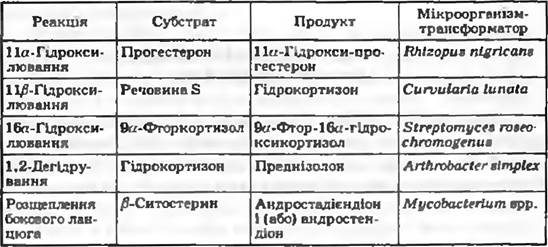
Some microbial transformations of steroids of industrial importance are presented in Table 22.10.
Methods for carrying out microbial transformations of sterols. Despite The Diversity of steroid biotransformations, the methods for conducting microbial reactions are quite simple. In screening studies (in laboratories), the reaction is typically limited to shake flasks, where 100-200 mg of steroid is added to a flask. For the transformation of 1-2 g of steroids, fermenters are used.
Class="center">Table 22.10
Microbial transformations of steroids of industrial importance
The solubility of sterols in Water is very low. Therefore, sterols at a concentration of approximately 1 g/L are added to the fermenter dissolved in low-toxicity, water-miscible Solvents (acetone, alcohol, dimethylformamide). At higher concentrations (above 1 g/L), sterols are added to the medium as a powder. A second method for introducing sterols into the medium involves dissolving the sterol, for example, β-sitosterol, in a heptane-Ethylene chloride mixture, adding water while stirring, and distilling off the solvent by heating the mixture to 95 ºС. With this method, the concentration of sitosterol in the aqueous suspension can reach 140 g/L.
Upon completion of the transformation, the culture broth, freed from biomass, is extracted with water-immiscible organic solvents in which the corresponding steroids are soluble (ethyl acetate, methylene chloride, chloroform). The extract is separated from the aqueous phase and purified (colored impurities are removed by Treatment with activated charcoal, which is then filtered off); it is then concentrated in vacuo, and the steroid precipitate is recrystallized from an appropriate solvent.
Ways to intensify microbial transformations. One way to intensify transformation processes is the pre-Induction of the transforming culture with the appropriate substrate or its analog. The most promising approach is the USE OF IMMOBILIZED viable microbial Cells. The advantages of using immobilized cells are obvious: no costs for enzyme Isolation and Purification, higher activity and stability
compared to immobilized Enzymes and free cells, reduced costs for the isolation and purification of reaction products, and the possibility of automation. Methods for immobilizing transforming cells include adsorption, covalent and cross-linking, entrapment in various polymers, and microencapsulation. Steroids were the first substrates successfully transformed using immobilized cells. These processes included: 1,2-dehydrogenation, 1,2-reduction, 20-reduction (Arthrobacter globiformis), stereospecific 17β-reduction (Saccharomyces cerevisiae), and 20α- and 20β-reduction (Bacillus megaterium).
Last update: 12/08/2026
Editorial and Educational Adaptation: This material has been compiled based on the primary/original source text. The project team performed an editorial review, corrected technical inaccuracies, structured sections, and adapted the content for an educational format.
What was processed:
- elimination of formatting defects (OCR errors, structural breaks, corrupted characters);
- editorial organization of content;
- standardization of terminology in accordance with academic sources;
- verification of factual statements against the original source text.
All mentions of the author, publication year, and origin of the primary text have been preserved in accordance with the source.