GENERAL MICROBIOLOGY - T.P. Pyrog - 2004
16. UTILIZATION OF INORGANIC HYDROGEN DONORS: AEROBIC CHEMOLITHOTROPHIC BACTERIA
16.4. OXIDATION OF MOLECULAR HYDROGEN
Molecular hydrogen is produced As a result of anaerobic decomposition of organic matter (Fermentation) in aquatic sediments and anaerobic soil zones. A significant portion of this hydrogen is oxidized by Bacteria that coexist with the microorganisms releasing it. The oxidation of H2 is coupled with the reduction of sulfate to sulfide, and CO2 to methane. Almost all groups of bacteria capable of synthesizing ATP via Anaerobic Respiration include forms that utilize hydrogen as an electron donor.
Aerobic hydrogen-oxidizing bacteria. Bacteria that oxidize molecular hydrogen under aerobic conditions using oxygen as the terminal electron acceptor are grouped together as hydrogen-oxidizing (hydrogen) bacteria. All of them are capable of both autotrophic fixation of CO2 and the utilization of organic substrates. Hydrogen bacteria are facultative chemolithoautotrophs.
Hydrogen bacteria grow on simple nutrient media containing only inorganic salts in a gas atmosphere consisting of 70% H2, 20% O2, and 10% CO2 (by volume).
Class="center">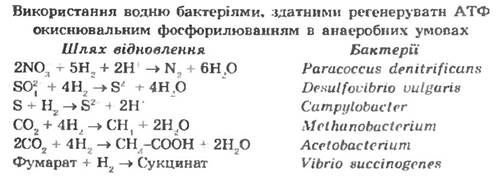
Taxonomically, hydrogen bacteria represent an exceptionally diverse group encompassing most Gram-negative bacteria (Pseudomonas, Alcaligenes, Aquaspirillum, Paracoccus, Xanthobacter, Rhizobium, Derxia), as well as some Gram-positive genera (Nocardia, Mycobacterium, Bacillus).
Molecular hydrogen is channeled into metabolic pathways via hydrogenases, which can be either soluble (cytoplasmic) or membrane-bound.
Many hydrogen bacteria can degrade hexoses and gluconate via the ED pathway (Entner-Doudoroff Pathway). They are also capable of utilizing other organic substrates. When both inorganic substrates (CO2 and H2) and Organic compounds are available, hydrogen bacteria can exhibit mixotrophic growth. They assimilate the organic substrate to synthesize Cell material while generating the required energy through the oxidation of H2. Mixotrophy is characteristic of many facultative autotrophs.
However, in some hydrogen bacteria, substrate utilization is strictly regulated. For instance, during autotrophic growth, Alcaligenes eutrophus lacks the Enzymes required for fructose Catabolism. When such Cells are transferred to a medium containing fructose and cultivated under aerobic conditions, the Enzymes of the ED pathway are synthesized, and the cells grow. Conversely, if incubation is carried out in a gas atmosphere (80% H2 and 20% O2), neither enzyme synthesis nor cell growth is observed. Thus, molecular hydrogen represses The formation of enzymes necessary for fructose catabolism.
Carboxydobacteria. This term refers to bacteria capable of oxidizing CO to CO2. CO is produced in nature under both aerobic and anaerobic conditions. However, only aerobic bacteria are able to grow using CO as their sole electron donor and sole carbon source. A prominent representative of carboxydobacteria is Pseudomonas carboxydovorans. It should be noted that carboxydobacteria possess a membrane-bound Hydrogenase and can also function as hydrogen bacteria.
Last update: 12/08/2026
Editorial and Educational Adaptation: This material has been compiled based on the primary/original source text. The project team performed an editorial review, corrected technical inaccuracies, structured sections, and adapted the content for an educational format.
What was processed:
- elimination of formatting defects (OCR errors, structural breaks, corrupted characters);
- editorial organization of content;
- standardization of terminology in accordance with academic sources;
- verification of factual statements against the original source text.
All mentions of the author, publication year, and origin of the primary text have been preserved in accordance with the source.