GENERAL MICROBIOLOGY - T.P. Pirog - 2004
16. USE OF INORGANIC HYDROGEN DONORS: AEROBIC CHEMOLITHOTROPHIC BACTERIA
16.5. CO2 FIXATION
The Calvin–Bassham cycle, also known as the ribulose diphosphate cycle. The ribulose diphosphate cycle is a reductive process in which CO2 is reduced to the level of CARBOHYDRATES. It Functions in all aerobic chemolithoautotrophs, almost all phototrophic Bacteria, cyanobacteria, and green plants. It is not involved in CO2 fixation in methanogenic and acetogenic bacteria.
The Key Enzymes of the cycle are phosphoribulokinase and ribulose diphosphate carboxylase. The cycle can be divided into three main stages (Figure): 1) the carboxylation reaction; 2) the reduction reactions; 3) the regeneration of CO2 acceptor molecules.
Class="center">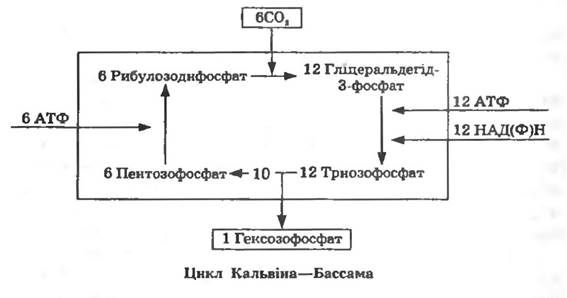
In the carboxylation reaction, CO2 is added to ribulose-1,5-diphosphate with the participation of the enzyme ribulose diphosphate carboxylase, yielding two molecules of 3-phosphoglycerate.
The reduction reactions involve the reduction of the carboxyl group of 3-phosphoglycerate to an aldehyde group. The glycolytic enzymes phosphoglycerate kinase and glyceraldehyde phosphate dehydrogenase take part in this process. This is the CO2 assimilation stage, which requires an input of energy and reducing equivalents. The resulting glyceraldehyde-3-phosphate is in equilibrium with dihydroxyacetone, and both triose phosphates are in equilibrium with fructose-1,6-diphosphate.
In the Third Stage, fructose diphosphate is dephosphorylated by the action of the enzyme fructose diphosphatase to form fructose-6-phosphate. Subsequently, three molecules of ribulose-5-phosphate are formed from one molecule of fructose-6-phosphate and three molecules of triose phosphate. The final reaction of the cycle is the phosphorylation of ribulose-5-phosphate at the expense of ATP (catalyzed by phosphoribulokinase) to yield ribulose-1,5-diphosphate, which serves as the CO7 acceptor.
Cycle balance:

Other pathways of autotrophic CO2 fixation. Anaerobic autotrophic bacteria utilize two alternative pathways for carbon dioxide assimilation. Methanogenic, acetogenic, and sulfate-reducing bacteria, which are capable of using H2 and CO2 as electron Donors, reduce CO2 via the anaerobic acetyl-CoA pathway to acetyl-CoA and Pyruvate. Through known reactions, pyruvate is then channeled into central biosynthetic pathways.
Green sulfur bacteria fix CO2 exclusively via the Reactions of the reductive Tricarboxylic Acid Cycle. In this cycle, CO2 is fixed through the reductive carboxylation of succinyl-CoA.
Last update: 12/08/2026
Editorial and Educational Adaptation: This material has been compiled based on the primary/original source text. The project team performed an editorial review, corrected technical inaccuracies, structured sections, and adapted the content for an educational format.
What was processed:
- elimination of formatting defects (OCR errors, structural breaks, corrupted characters);
- editorial organization of content;
- standardization of terminology in accordance with academic sources;
- verification of factual statements against the original source text.
All mentions of the author, publication year, and origin of the primary text have been preserved in accordance with the source.