GENERAL MICROBIOLOGY - T.P. Pirog - 2004
11. MAIN MECHANISMS OF METABOLISM AND ENERGY TRANSFORMATION IN MICROORGANISMS
11.1. CONSTRUCTIVE METABOLISM
Nutrients entering The Cell undergo significant transformations and changes. The conversion of substances within the cell is called METABOLISM. Initially, complex organic substrates (e.g., Polysaccharides) are degraded into simpler ones (Monosaccharides), from which microorganisms synthesize all cellular components. Such transformations of substances within the cell can be divided into three stages. Fig. 11.1 shows a General scheme of the pathways for The Biosynthesis of cellular material from glucose. Other Compounds (ethanol, acetate, methanol, methane, Fatty acids, organic acids, Hydrocarbons, etc.) can be used as growth substrates instead of glucose. However, regardless of the substrate used, the general scheme of cellular material biosynthesis remains the same. When using growth substrates other than glucose, alternative pathways are utilized to form the required metabolic intermediates.
Class="center">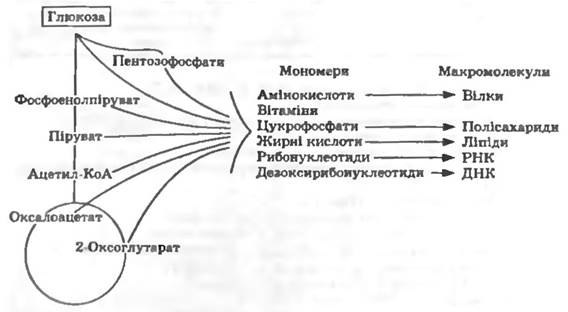
Fig. 11.1. General scheme of pathways for the biosynthesis of cellular material from glucose
At The First stage, nutrients are broken down into small fragments. Thus, phosphoenolpyruvate, Pyruvate, and acetyl-CoA are formed from glucose. This stage is called breakdown, or Catabolism.
At the Second Stage, these small fragments formed from the substrate are converted into a series of organic acids (e.g., as shown in Fig. 11.1, oxaloacetate and 2-oxoglutarate) and phosphoric esters. The second stage is called intermediate metabolism, or amphibolism. The First and Second stages seamlessly transition into one another.
At the Third Stage, the so-called "building blocks"—monomers (Amino Acids, sugar phosphates, fatty acids, NUCLEOTIDES) necessary for the synthesis of polymeric macromolecules (Proteins, amino acids, polysaccharides, Lipids, Nucleic Acids) that make up the microbial cell—are formed from intermediate compounds. This stage of cellular substance formation (synthesis of monomers and polymers) is called anabolism, constructive metabolism, or biosynthesis. In scientific literature, the term "constructive metabolism" is the most widely used.
Last update: 12/08/2026
Editorial and Educational Adaptation: This material has been compiled based on the primary/original source text. The project team performed an editorial review, corrected technical inaccuracies, structured sections, and adapted the content for an educational format.
What was processed:
- elimination of formatting defects (OCR errors, structural breaks, corrupted characters);
- editorial organization of content;
- standardization of terminology in accordance with academic sources;
- verification of factual statements against the original source text.
All mentions of the author, publication year, and origin of the primary text have been preserved in accordance with the source.