Fundamentals of Molecular Biology - V.I. Rezyapkin 2009
DNA Repair
DNA Lesions
Under the Influence of External and internal factors, structural damage—Mutations—constantly occurs in DNA molecules. Most of these are undesirable for The Cell, and their accumulation in large quantities can be fatal, leading to irreversible changes that prevent the cell from performing its Functions or cause it to perish altogether. Therefore, for a cell to function normally, any disruptions arising in the Introduction/20.html">DNA Structure must be repaired. The function of correcting DNA errors is entrusted to numerous systems known as DNA Repair systems.
Various types of DNA damage occur within the cell. Let us examine them.
Apurinization
Apurinization refers to the hydrolytic Cleavage of a purine from the polynucleotide chain:
Class="center">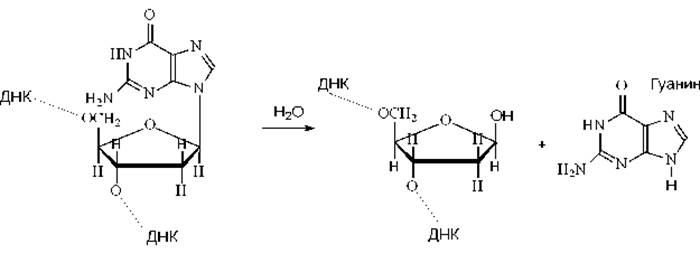
The result of apurinization is The formation of an AP site (Fig. 3.1).
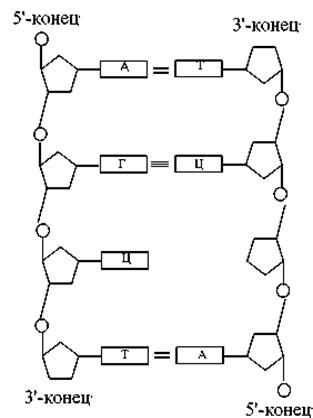
Fig. 3.1. AP site
Every day, a human cell loses about 5,000 to 10,000 Purines.
The formation of an AP site can also occur during the removal of Pyrimidines.
Deamination of Nitrogenous Bases
In the cell, cytosine, adenine, and guanine undergo deamination. Deamination of cytosine yields uracil:

that of guanine yields xanthine:
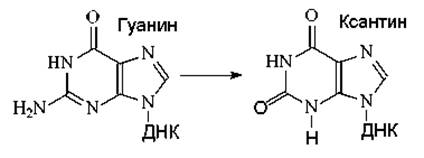
Cytosine undergoes deamination most frequently; in a human cell, about 100 of these nitrogenous bases are deaminated daily. Cytosine deamination leads to the appearance of unpaired bases in the DNA molecule (Fig. 3.2), since the resulting uracil is complementary to adenine rather than guanine.
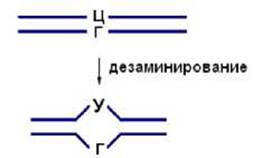
Fig. 3.2. Cytosine deamination leads to the appearance of unpaired bases in the DNA molecule
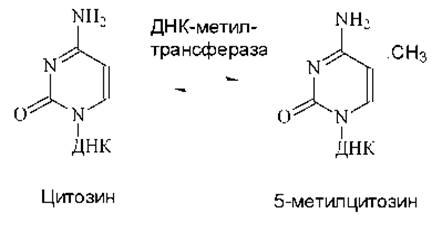
In Eukaryotic Cells, cytosine can undergo methylation, resulting in the formation of 5-methylcytosine:
Its deamination produces thymine:
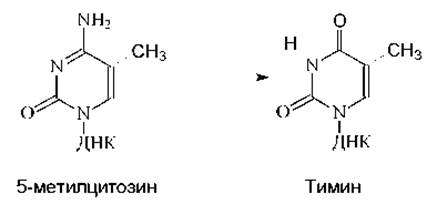
Deamination of 5-methylcytosine is hazardous because it can lead to mutation, as Replication results in the replacement of a CG base pair with a TA pair in one of the two daughter DNA molecules (Fig. 3.3)
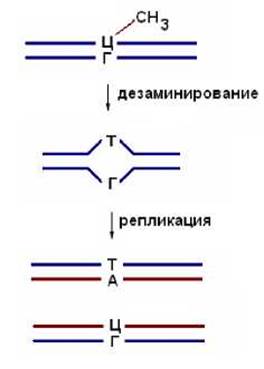
Fig. 3.3. Deamination of 5-methylcytosine can lead to mutation following METABOLISM/36.html">DNA replication
Alkylation
The action of alkylating agents can lead to the alkylation of nitrogenous bases. For instance, the alkylation of guanine may yield 6O-methylguanine or 7-ethylguanine:

Alkylated nitrogenous bases can form non-canonical pairs—such as 7-ethylguanine paired with thymine—and also promote apurinization.
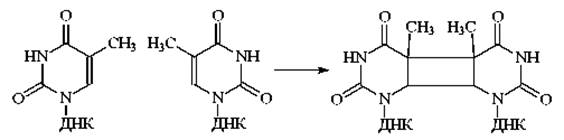
The formation of thymine dimers can be induced by ultraviolet irradiation:
Oxidation of nitrogenous bases occurs in the presence of reactive oxygen species (such as the superoxide anion radical O2-, the hydroxyl radical OH, etc.). For example, The oxidation of cytosine yields 5-hydroxycytosine and 5-hydroxyuracil:
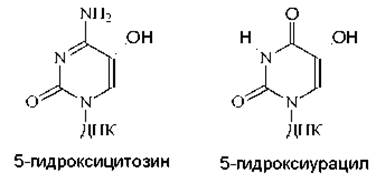
Oxidized nitrogenous bases are capable of forming non-canonical pairs.
The oxidation of nitrogenous bases can lead to the opening of the purine ring:
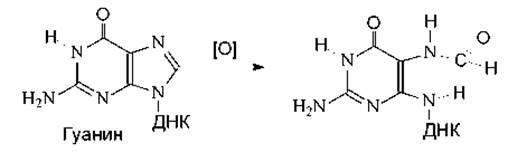
Furthermore, single- and double-strand breaks in DNA, as well as interstrand cross-links, can also occur.
Last update: 12/08/2026
Editorial and Educational Adaptation: This material has been compiled based on the primary/original source text. The project team performed an editorial review, corrected technical inaccuracies, structured sections, and adapted the content for an educational format.
What was processed:
- elimination of formatting defects (OCR errors, structural breaks, corrupted characters);
- editorial organization of content;
- standardization of terminology in accordance with academic sources;
- verification of factual statements against the original source text.
All mentions of the author, publication year, and origin of the primary text have been preserved in accordance with the source.