Fundamentals of Molecular Biology. Part 2: Molecular Genetic Mechanisms - A. N. Ogurtsov 2011
Alleles and Mutations
Segregation of Mutations in Breeding
The dominance or recessiveness of alleles is determined through The life cycle of organisms.
Two Types of Cell Division are distinguished: Mitosis and Meiosis.
Most Cells (somatic cells) in an Organism divide mitotically.
Meiosis is characteristic of Germ Cells, which undergo meiosis to form Gametes (referred to as sperm and egg cells in animals). Similar to somatic cells, premeiotic germ (embryonic) cells are diploid, containing two homologs of each morphological chromosome type.
The two homologs forming each pair of homologous Chromosomes are inherited from different parents and, consequently, their genes may exist in different allelic forms.
The MAIN STAGES OF mitosis and meiosis are presented in Figure 74.
In both cases—for both the somatic cell and the premeiotic embryonic cell—the initial cell has two copies of each chromosome (2n), one maternal and one paternal.
During mitosis, replicated chromosomes, each consisting of two sister chromatids, align at the center of The Cell so that both daughter cells receive the maternal and paternal homologs of each chromosome.
During the first division of meiosis, each replicated chromosome pairs up with its homologous partner at the center of the cell; this pairing process is called synapsis. Then, the two replicated chromosomes (from the pair) segregate into different daughter cells during division I. These daughter cells, in turn,
divide a second time (division II) without intervening METABOLISM/36.html">DNA Replication. During this step, each cell receives one sister chromatid. Thus, each diploid cell yields four haploid (ln) cells (gametes) As a result of meiosis.
Class="center">
Figure 74 - Stages of mitosis and meiosis
In mitosis, DNA replication is always followed by cell division, yielding two diploid daughter cells.
In meiosis, a single round of DNA replication is followed by two successive cell divisions, resulting in four haploid (ln) cells, each containing only one chromosome from each homologous pair.
This proportional distribution (or segregation) of replicated chromosomes into daughter cells during the first meiotic division is random, leading to The formation of daughter cells with a random assortment of paternal and maternal chromosomes.
To keep experiments straightforward, researchers usually restrict themselves to breeding strains that are homozygous for the Gene under study. In such "true-breeding strains," every individual receives the identical allele from each parent, meaning the allele combination remains unchanged from one generation to the next.
When a true-breeding (homozygous) mutant strain is crossed with a true-breeding wild-type strain, the first generation of offspring (F1) will be heterozygous (Figure 75).
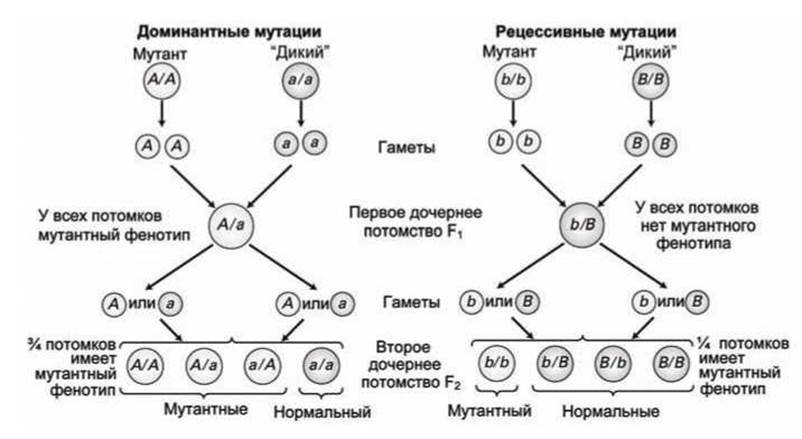
Figure 75 - Segregation of dominant and recessive Mutations
If the F1 offspring exhibit the mutant phenotype, the original mutation is dominant; if the F1 offspring exhibit the wild-type phenotype, the original mutation is recessive.
When heterozygous F1 individuals carrying a dominant mutant allele are crossed, three-quarters of their F2 offspring will display the mutant traits. Conversely, when heterozygous F1 individuals carrying a recessive mutant allele are crossed, only one-quarter of their F2 offspring will display the mutant traits.
Saccharomyces Yeast exist in both Haploid and Diploid forms.
In these Unicellular Eukaryotes, crosses between haploid cells make it possible to determine whether mutant alleles are dominant or recessive. Haploid yeast cells, which contain a single set of chromosomes, can exist in one of two mating types designated as a and α (Figure 76).

Figure 76 - Segregation of alleles in yeast
Haploid cells of these two opposite mating types can be crossed to generate a/a diploids that are heterozygous for the mutant allele.
If these diploids exhibit mutant phenotypes, the mutant allele is dominant; however, if the diploids display the parental wild-type phenotype, the mutant allele is recessive.
When an a/a diploid experiences nutrient deprivation (starvation), the cell undergoes meiosis, resulting in a tetrad of four haploid spores: two of mating type a and two of mating type a. Sporulation of a heterozygous diploid cell produces two spores carrying the mutant allele and two bearing the parental wild-type allele (Figure 76).
Under favorable conditions, yeast spores germinate, giving rise to vegetative haploid strains of both mating types.
Last update: 12/08/2026
Editorial and Educational Adaptation: This material has been compiled based on the primary/original source text. The project team performed an editorial review, corrected technical inaccuracies, structured sections, and adapted the content for an educational format.
What was processed:
- elimination of formatting defects (OCR errors, structural breaks, corrupted characters);
- editorial organization of content;
- standardization of terminology in accordance with academic sources;
- verification of factual statements against the original source text.
All mentions of the author, publication year, and origin of the primary text have been preserved in accordance with the source.