BIOTECHNOLOGY - V. G. Herasymenko - 2006
Part II. Special Biotechnologies
Chapter 23. BIOTECHNOLOGY OF ORGANIC WASTE MANAGEMENT BY VERMICULTURE
23.3. PREPARATION OF SUBSTRATE (FEED) FOR EARTHWORMS
Earthworm feed consists of various organic wastes with a high Cellulose content that have undergone a Fermentation process. The mainstay of the earthworm diet is manure biomass, supplemented with a certain amount of other organic wastes.
To obtain high-quality feed for earthworms, the initial organic substrate (waste) must meet specific requirements: a moisture content of 70-80 %, a pH of 6.8-7.2, an iron oxide content of no more than 10 %, and the complete absence of hard particles such as metal, wood, stones, and Glass.
For fermentation, organic wastes are formed into windrows on a flat surface with a permissible slope of 1-3°. Windrows can vary in size: 1.7-2 m wide, 15-80 m long, and 1.5-2 m high, depending on available labor and mechanization facilities. The windrows should be oriented from north to south to ensure optimal substrate heating.
Under conditions of Water and oxygen availability, aerobic microorganisms present in the substrate (Fungi, actinomycetes, Bacteria) break down the organic wastes. As a result of the hydrolytic Cleavage of high-molecular-weight compounds (Proteins, fats, CARBOHYDRATES), intermediate and final low-molecular-weight products are formed, which are then consumed by earthworms.
The substrate fermentation process proceeds under two Temperature regimes. Initially, after the windrows are formed, the temperature inside the substrate rises to thermophilic levels (50-60 оС), then gradually drops to mesophilic values (25-35 оС), and after several months decreases to ambient temperature. The stabilization of this parameter indicates the completion of fermentation and the readiness of the substrate for earthworm feeding. Biothermal processes occurring at 50-60 оС have a lethal effect on pathogenic microflora, helminth eggs and larvae, and weed seeds, while urea and hippuric acid contained in manure are broken down into ammonia, carbon dioxide, and water. In addition to ammonia, a certain amount of methane is also released, which is likewise toxic to earthworms.
During the summer months at high temperatures, the windrows are periodically sprinkled with water, liquid manure, or wastewater to maintain moisture levels around 70 %.
Throughout the fermentation process, the pH of the substrate is closely monitored. Even slight deviations of the pH from the optimum range (6.8-7.2) negatively affect the GROWTH AND DEVELOPMENT of aerobic microflora, and consequently the intensity of fermentation. Excessive acidity is neutralized by adding the required amount of lime, chalk, defecation mud, shale ash, marl, or other substances that simultaneously serve as mineral supplements. High alkalinity is mitigated through excessive watering.
Class="center">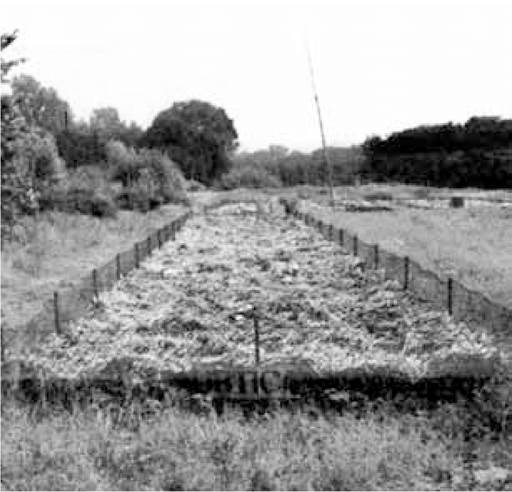
Fig. 23.4. Vermiculture in trenches
(according to Sulzberger R., 1998)
To ensure sufficient aeration of the fermenting substrate, stimulate microbiological processes, equalize moisture distribution throughout the entire volume, and eliminate anaerobic rotting zones deep within the windrow, it is periodically turned. The unevenness of substrate mixing should not exceed 10 % in terms of the moisture variation coefficient within the mass.
The total duration of substrate fermentation in windrows under natural conditions depends on the type of organic waste and can last up to 6-12 months. This process can be accelerated to 1-3 months by blowing hot steam through pipes directly into the substrate.
Visually, substrate ready for earthworm consumption appears either as semi-decomposed mass (straw has a dark brown color and tears easily) or fully decomposed mass (resembling a dark, oily mixture where straw is no longer distinguishable). An essential indicator of substrate readiness is the carbon-to-nitrogen ratio (C : N), which should be around 20.
Earthworm feed must be free of pesticides, excessive protein (no more than 25-30 %), ammonia, methane, pathogenic microflora, and helminth eggs and larvae. A protein content of 40 % in the feed is fatal to earthworms.
As practice shows, various organic wastes from both agricultural and industrial production can serve as earthworm feed. However, it is best for any earthworm diet to be based on manure combined with other organic components in specific proportions. Large organic waste particles must be crushed (to no more than 1 mm), as they cannot be ingested by earthworms.
Horse manure is an excellent feed for earthworms because it contains a significant amount of cellulose. Fermentation processes in it last for 5-6 months.
Cow manure has high alkalinity and, after 6-8 months of fermentation in a mixture with 25-25 % chopped straw, makes a good feed for earthworms.
Depending on feeding practices, calf manure may have an elevated protein content due to incomplete Digestion by the animals. To reduce protein levels in the manure biomass, chopped straw or cardboard is added, and the fermentation period is extended from 7-8 to 13 months.
Sheep manure is highly alkaline and tends to be compacted by the animals in the barns. Before use, it is cut into blocks, heavily watered and loosened, and then formed into windrows for fermentation (up to 8 months).
Pig manure has high acidity and contains a significant amount of protein. Therefore, 30-40 % straw or cardboard is added to it, and it is fermented for 9-10 months. It has been established that the solid fraction of hydraulic-flush pig manure can be added to earthworm feed fresh without prior fermentation, while the liquid fraction can be used to moisten the windrows. When Processing liquid manure via vermiculture, it is first subjected to mechanical Separation, after which the solid fraction is formed into windrows, trenches, or trays.
Rabbit manure can be fed to earthworms fresh, provided that the feces are separated from the urine. Otherwise, it must be fermented for 5-7 months.
In some rabbit-breeding farms, manure disposal via vermiculture is implemented as follows: boxes are placed under the rabbit cages with a bottom layer consisting of a mixture of soil, shredded paper, and sand, into which earthworms are introduced. Fresh excrement falling from the cages is then processed by the worms. Adding sand is essential for the earthworms' normal digestion.
Chicken manure is a highly acidic substrate; therefore, it requires mixing with plant residues or cardboard in a 1:1 ratio, followed by fermentation for 15–16 months.
When utilizing manure biomass, certain conditions must be met: unfermented manure must not be used as a base substrate, nor should manure that has been stored for more than two years post-fermentation and mixed with urine, due to the high content of ammonia, hydrogen sulfide, and other toxic compounds. It has been established that unfermented manure can be used for supplemental feeding provided it is thoroughly tested for suitability (acidity, temperature, moisture, and a 50-earthworm survival test). Since it is applied in a layer of only 5 cm, there is no risk of secondary fermentation.
Regardless of the type of substrate being fermented, the feed must contain 20–25% cellulose in the form of chopped straw, paper, cardboard, or similar Materials.
Last update: 11/08/2026
Editorial and Educational Adaptation: This material has been compiled based on the primary/original source text. The project team performed an editorial review, corrected technical inaccuracies, structured sections, and adapted the content for an educational format.
What was processed:
- elimination of formatting defects (OCR errors, structural breaks, corrupted characters);
- editorial organization of content;
- standardization of terminology in accordance with academic sources;
- verification of factual statements against the original source text.
All mentions of the author, publication year, and origin of the primary text have been preserved in accordance with the source.