BIOTECHNOLOGY - V. H. Gerasymenko - 2006
Part II. Special Biotechnologies
Chapter 23. BIOTECHNOLOGY FOR ORGANIC WASTE DISPOSAL THROUGH VERMICULTURE
23.2. METHODS OF EARTHWORM CULTIVATION
Industrial earthworm cultivation can be carried out both outdoors and in enclosed facilities. All calculations related to site preparation for vermiculture, earthworm stocking and feeding, maintenance, and other operations are based on a standard bed referred to as a "bed unit" or "bed." A bed is a measurement unit originally used by American researchers, representing a plot with an area of 2 m2 (2 × 1 m).
The stocking density of a single bed can range from 30,000 to 100,000 earthworms (adults, juveniles, and egg cocoons). Each bed requires 10–12 cwt (quintals) of organic waste per year. Of this amount, 40% is consumed to sustain the earthworms' life processes, while 60% is excreted as coprolites, commonly known as vermicompost (biohumus). A single bed yields annually 4–6 cwt of vermicompost and about 30–100 kg of earthworm biomass.
Year-round vermiculture using open-air beds is feasible only in regions with mild winters, as low temperatures significantly decrease earthworm activity and complicate management. In other regions, cultivation is seasonal, running from April through October.
Beds are best established on sloping terrain to ensure proper Water drainage during rainfall and prevent puddles. In addition, it is preferable for the underlying soil to be sandy or stony. Earthworms are highly sensitive to wind, so sheltered locations should be chosen for bed installation. To protect against pests, beds should be set up on metal mesh frames with upturned edges (25 cm high), concrete troughs with brick walls, etc. (Fig. 23.3).
Class="center">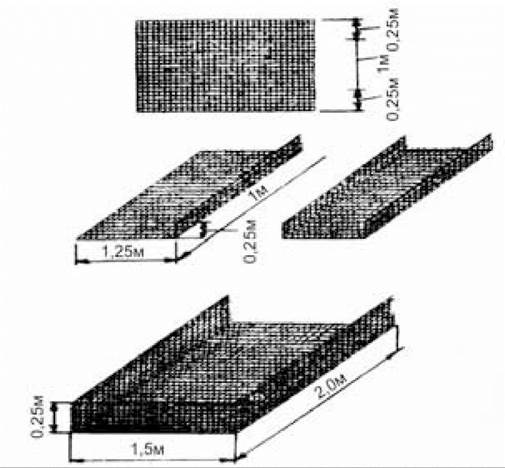
Fig. 23.3. Beds for vermiculture
(according to Horodnii M. M. et al., 1996)
According to some researchers' designs, earthworms are kept on concrete pads or in trenches 2 m wide and 0.3–0.4 m deep. The length of the pad or trenches depends on the total area allocated for vermiculture (Fig. 23.4). The beds are made of galvanized wire mesh with 15 × 15 mm openings. Each bed has an area of 2 m2 (2 × 1 m) and a height of 15–30 cm. Beds are arranged in sections up to 50 m long, with a spacing of 0.5–0.8 m between them. Each section contains 25 beds. Two sections form a sector. The distance between sectors is 2.5–3 m. Domestic researchers recommend constructing beds 2 m wide and 50 m long, maintaining adequate spacing between them to allow machinery access.
In enclosed facilities (including disused agricultural buildings), earthworms can be cultivated year-round using beds on concrete floors or tiered shelving units holding wooden, metal, or plastic boxes. Research has shown that indoor systems yield twice as much earthworm biomass and organic fertilizer (vermicompost) per 1 m2 of area compared to outdoor systems.
The optimal scale for a commercial vermiculture enterprise is 1,200 beds covering an area of at least 1 ha.
The French company Green Frere has designed a specialized unit for waste vermicomposting. It is a cylindrical tower consisting of 24 stacked plastic trays, each 230 cm in diameter. The trays are filled with waste and inoculated with earthworms. The entire composting process is fully automated.
Last update: 11/08/2026
Editorial and Educational Adaptation: This material has been compiled based on the primary/original source text. The project team performed an editorial review, corrected technical inaccuracies, structured sections, and adapted the content for an educational format.
What was processed:
- elimination of formatting defects (OCR errors, structural breaks, corrupted characters);
- editorial organization of content;
- standardization of terminology in accordance with academic sources;
- verification of factual statements against the original source text.
All mentions of the author, publication year, and origin of the primary text have been preserved in accordance with the source.