BIOTECHNOLOGY - V. H. Herasymenko - 2006
Part II. Special Biotechnologies
Chapter 20. BIOTECHNOLOGY OF ENZYME PRODUCTION
In modern biotechnology, Enzymes occupy a leading position. All living matter contains enzymes; without them, METABOLISM would be impossible. The preparative production of enzymes and their application in various sectors of industry, agriculture, and scientific research make it possible to fundamentally transform technological processes and Analytical Methods, ensure higher performance and yields in industry and agriculture, and introduce radically new techniques.
Enzymes (from the Latin fermentum, meaning leaven, or enzymes) are biological catalysts, most of which are soluble Globular Proteins (Actin and Myosin being structural proteins that jointly participate in ATP Hydrolysis) found in all living Cells. By facilitating the Transformation of substances (substrates), enzymes regulate the metabolism of the Organism.
Enzymes exhibit maximum activity at optimal values of pH, Temperature, solution Ionic strength, in the presence of Coenzymes and Cofactors, and the absence of inhibitors—with these parameters being strictly individual for each specific enzyme. A drastic deviation of temperature or medium pH from optimal values can cause Enzyme inactivation As a result of irreversible Denaturation (conformational changes and unfolding). Enzymes are not consumed during catalysis, and enzymatic reactions are characterized by a product yield approaching 100 %.
Unlike many chemical engineering processes that require high pressures and temperatures, reactions proceeding with the participation of enzymes as biocatalysts take place at temperatures not exceeding 60-70 оС, under normal atmospheric pressure, and within a pH range of 4.5-9.0.
In contrast to chemical catalysts, enzymatic biocatalysts possess A number of unique properties. First and foremost is their exceptionally high catalytic activity: The addition of minute amounts of an enzyme (10-7-10-9 mol) can accelerate a catalyzed reaction by up to 1018 times. Another essential property is high selectivity or substrate Specificity. Furthermore, The ability to selectively induce required chemical alterations in a specific substance without affecting Other components of the substrate offers tremendous advantages in numerous technological processes involving the Processing of PLANT AND ANIMAL raw Materials.
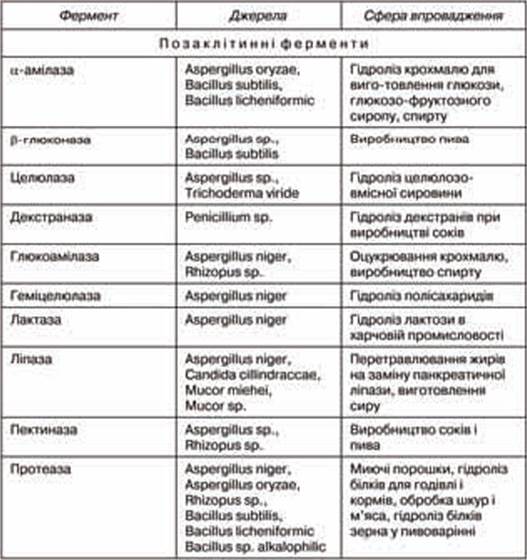
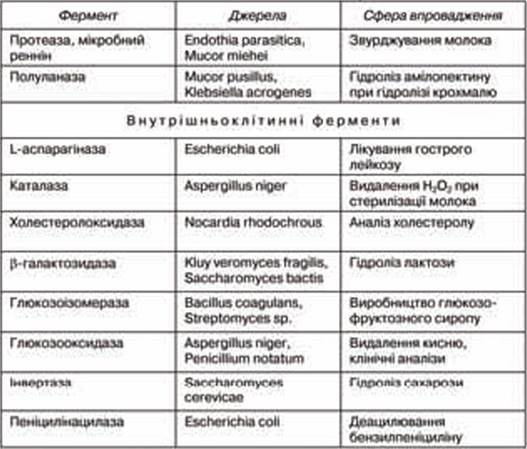
To date, scientific literature describes over 2,000 enzymes, nearly 50 of which are currently used or slated for industrial production (Table 20.1).
Class="center">Table 20.1
Main industrially produced enzymes and their sources
(according to M. V. Hernet and A. M. Egorov, 1982)
The production of enzymes and their application in various technological processes currently constitute one of the most vital areas of modern biotechnology.
Last update: 11/08/2026
Editorial and Educational Adaptation: This material has been compiled based on the primary/original source text. The project team performed an editorial review, corrected technical inaccuracies, structured sections, and adapted the content for an educational format.
What was processed:
- elimination of formatting defects (OCR errors, structural breaks, corrupted characters);
- editorial organization of content;
- standardization of terminology in accordance with academic sources;
- verification of factual statements against the original source text.
All mentions of the author, publication year, and origin of the primary text have been preserved in accordance with the source.