Medical Genetics - V. M. Zaporozhan 2005
Introduction to Medical Genetics
Molecular Basis of Heredity
Structure of the Eukaryotic Gene
During METABOLISM/31.html">Transcription, DNA strands differ fundamentally in their functional roles. One strand serves as the coding, or sense, strand, while the other acts as the template strand. Messenger RNA is synthesized via complementarity along the template strand and, consequently, mirrors The nucleotide sequence of the coding strand (Fig. 1.5).
A structural Gene comprises a transcribed sequence and regulatory regions (Fig. 1.6).
1. Transcribed sequence. The first transcribed nucleotide (the transcription start site) is designated as +1, and all subsequent NUCLEOTIDES during transcription are assigned a positive sign («+»). Nucleotides upstream of the transcription start site are designated with a negative sign («-»).
The transcribed sequence consists of a leader region, the polypeptide-coding region proper, and a trailer region. The leader and trailer are essential for mRNA-ribosome interaction, yet they are not translated. The polypeptide-coding sequence begins with the start codon ATG—the universal signal for Translation initiation (polypeptide synthesis)—and terminates with a stop codon located near the 3' end of the gene: TAA, TAG, or TGA. A gene sequence that begins with the start codon, encodes a single polypeptide, and contains no internal stop codons is referred to as an Open Reading Frame.
Table 1.2. Classification of genes
|
Gene groups by function |
Examples of genes |
Gene Functions |
|
Structural genes — encode Proteins and RNA |
Housekeeping genes |
Ensure vital cellular functions; active in all Cells |
|
Terminal differentiation genes («luxury» genes) |
Function only in specific Cell types or at specific stages of ontogenesis |
|
|
Regulatory genes |
Promoter |
A DNA region to which RNA polymerase binds to initiate transcription |
|
Terminator |
A region that signals the termination of transcription |
|
|
Enhancer |
A DNA sequence that enhances transcription by binding transcription factors |
|
|
Silencer |
A DNA sequence that represses or silences transcription by binding transcription factors |
Class="center">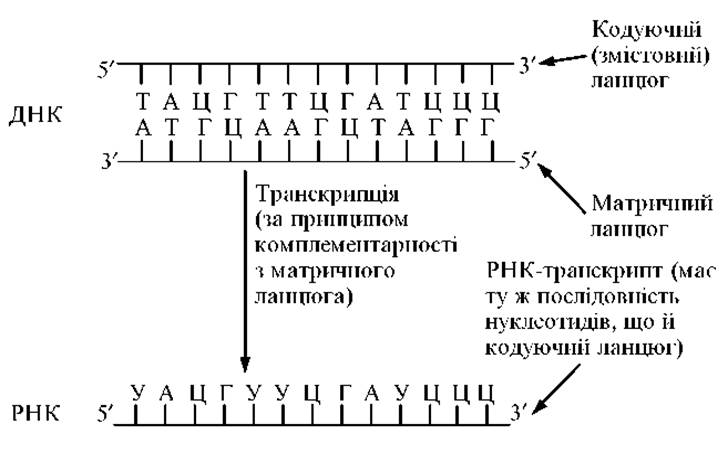
Fig. 1.5. Template and coding strands of DNA
In most eukaryotic structural genes (Fig. 1.6), the polypeptide-coding sequence consists of alternating coding regions, known as exons (expressed), and non-coding regions, known as introns (intervening). Exons carry the information for the Amino Acid Sequence, whereas introns are excised during the maturation of mRNA (splicing). The number and size of introns vary across different genes and can exceed the total length of exons several times over. Introns are located at precisely defined sites within the gene, typically adjacent to regions encoding critical functional Protein domains. This genomic Organization may be related to the evolutionary fusion of multiple intronless prokaryotic genes into a single functional unit. All introns begin with a GT sequence and end with an AG sequence. Mutations in these regions disrupt splicing and can cause hereditary disorders.
A typical human gene consists on average of 28,000 Base Pairs and contains 8 exons. It encodes a polypeptide comprising an average of 447 Amino Acids. The longest gene identified in The Human Genome is the gene for the Muscle protein dystrophin, which spans 2.4·106 bp.
2. Regulatory regions of a gene. Upstream of the coding strand's 5' end, several dozen nucleotide pairs ahead of the transcribed sequence, lies the promoter. The promoter is a DNA nucleotide sequence to which the RNA polymerase enzyme binds to initiate Transcription of the structural gene. In most genes, the promoter region contains conserved sequences: the TATA box (-20) and the CAAT box (-70-80). A GC motif (-100) is often located upstream of the promoter. These conserved regions, rich in specific nucleotide pairs, are essential for accurate transcription and participate in its regulation. A terminator (the region where transcription ends) is located at the 3' end of the gene. In eukaryotes, it may be part of the transcribed sequence.
Last update: 11/08/2026
Editorial and Educational Adaptation: This material has been compiled based on the primary/original source text. The project team performed an editorial review, corrected technical inaccuracies, structured sections, and adapted the content for an educational format.
What was processed:
- elimination of formatting defects (OCR errors, structural breaks, corrupted characters);
- editorial organization of content;
- standardization of terminology in accordance with academic sources;
- verification of factual statements against the original source text.
All mentions of the author, publication year, and origin of the primary text have been preserved in accordance with the source.