Genetics - A. V. Sivolob 2008
Human Genetics
Determination of inheritance types in humans. Pedigree analysis
Alongside Molecular Genetics techniques, traditional approaches to human genetic analysis remain highly relevant. Genetic analysis of any trait must begin by determining whether the trait of interest is heritable. If it is, the next question is its mode of inheritance. Pedigree construction and analysis has been and remains the nearly universal method for addressing these questions in Human Genetics. This approach involves keeping detailed records of every family member and their degree of relatedness. The family data are then visualized using standardized symbols (Fig. 7.3) to construct a pedigree tree.
Class="center">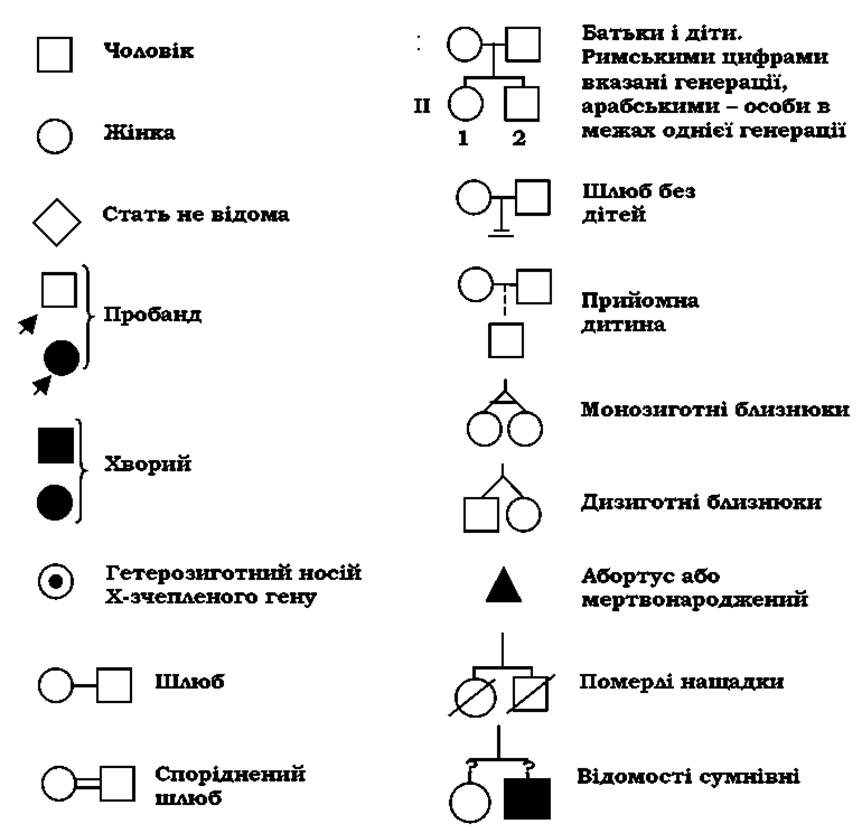
Fig. 7.3. Standard symbols used in pedigree construction
The genealogical method can be applied when reliable data are available for the direct maternal and paternal relatives of the proband—the individual whose pedigree is being constructed—across multiple generations, provided There is a sufficient number of offspring in each generation. Otherwise, data are collected from a sufficiently large number of distinct families exhibiting the trait under investigation. Based on these pedigrees, Conclusions are drawn regarding whether the trait is heritable and what its mode of inheritance is (dominant or recessive, autosomal or sex-linked, etc.). This formal analysis relies on fundamental genetic principles of inheritance (see Chapter 3).
Pedigrees exhibiting an autosomal dominant mode of inheritance (for an example, see Fig. 7.4, a) are characterized by the presence of the trait in every generation—so-called "vertical" transmission. If neither parent expresses the trait, the likelihood of having an affected child is extremely low (barring a de novo germline mutation, see Chapter 4). The trait appears with equal frequency in males and women, indicating that the responsible Gene is located on an autosome.
Naturally, this latter pattern also applies to Autosomal Recessive Inheritance (Fig. 7.4, b), which in other respects represents the "inverse" of an autosomal dominant pedigree. Notably, such pedigrees feature one or more generations in which the trait does not appear. When the trait does manifest, it is often clustered among multiple full or half-sibs (brothers and sisters)—a pattern known as "horizontal" transmission. When unaffected parents (carrying a dominant phenotype) have an affected child (recessive phenotype), the parents are very frequently closely related (consanguineous).

Fig. 7.4. Examples of pedigrees with autosomal dominant (a) and autosomal recessive (b) modes of inheritance
Examples of several human dominant and recessive traits are listed in Table 7.1.
Table 7.1. Selected dominant and recessive traits in humans
|
Dominant |
Recessive |
|
Dark Hair |
Light hair |
|
Curly hair |
Straight hair |
|
Brown eyes |
Blue or gray eyes |
|
Green eyes |
Blue or gray eyes |
|
Presence of epicanthus (vestige of the third eyelid) |
Absence of epicanthus |
|
Congenital cataract |
Normal Vision |
|
Myopia |
Normal vision |
|
Aniridia (absence of the iris) |
Normal eye |
|
Round face |
Elongated face |
|
Unattached earlobes |
Attached earlobes |
|
Thick Lips |
Thin lips |
|
Ability to roll the Tongue |
Inability to roll the tongue |
|
into a tube |
into a tube |
|
Long eyelashes |
Short eyelashes |
|
Epicanthic fold (Asian eye shape) |
European eye shape |
|
Rh-positive |
Rh-negative |
|
(disproportionate dwarfism) |
Normal height |
|
Brachydactyly (short fingers) |
Normal fingers |
|
Ability to taste |
Inability to taste |
|
phenylthiocarbamide (PTC) |
phenylthiocarbamide (PTC) |
|
Normal condition |
Amaurotic idiocy (Tay-Sachs disease) |
|
Normal condition |
Albinism (lack of pigmentation) |
|
Normal condition |
Phenylketonuria (inability to metabolize phenylalanine) |
|
Huntington's chorea (neurodegenerative disorder) |
Normal condition |
|
Hypercholesterolemia (elevated Blood Cholesterol) |
Normal condition |
|
Glaucoma (progressive Optic nerve atrophy) |
Normal condition |
Analyzing pedigrees is straightforward when a trait is sex-linked (Fig. 7.5, a–c). Several human sex-linked traits are listed in Table 7.2 (recall that pseudoautosomal traits (see Chapter 6) follow an inheritance pattern similar to genes located on autosomes).
Table 7.2. Selected sex-linked traits in humans
|
Trait |
Mode of inheritance |
|
Hypertrichosis (hairy ears) |
Y-linked |
|
Ichthyosis (scaly Skin) |
Y-linked |
|
Webbed toes |
Y-linked |
|
Hemophilia A (deficiency of blood clotting factor VIII) |
X-linked recessive |
|
Color blindness (red-green color blindness) |
X-linked recessive |
|
Duchenne muscular dystrophy (progressive muscular dystrophy) |
X-linked recessive |
|
Vitamin D-resistant Rickets |
X-linked dominant |
|
Hypophosphatemia (impaired phosphate transport) |
X-linked dominant |
|
Total color blindness |
Pseudoautosomal |
Holandric traits (Y-chromosome-linked) are the easiest to identify: the trait appears exclusively in males and is transmitted from father to son with 100% probability (Fig. 7.5, a).
In X-linked recessive inheritance (Fig. 7.5, b), the trait is observed almost exclusively in males; it is never transmitted from father to son, but instead passes through a daughter to a grandson (or great-grandson).
X-linked dominant inheritance can sometimes be confused with Autosomal dominant inheritance during pedigree analysis. Key indicators of X-linkage include differing frequencies of the trait between males and females—it is more common in females—and the fact that an affected father passes the trait to all of his daughters and never to his sons (Fig. 7.5, c).
Certain traits may be determined by Mitochondrial Genes. As is well known, children inherit Cell/35.html">Mitochondria exclusively from the mother, resulting in maternal inheritance: while both males and women may exhibit the trait, only women pass it on to their offspring (Fig. 7.5, d). Examples of mitochondrially inherited conditions in humans include Leber's hereditary optic neuropathy (loss of vision in the central visual field) and oncocytoma (a benign renal tumor).

Fig. 7.5. Examples of pedigrees with Y-linked (a), X-linked recessive (b), X-linked dominant (c), and mitochondrial (d) modes of inheritance
The genealogical method allows for the determination of much more than just the basic modes of inheritance. Analyzing more complex cases (e.g., traits with incomplete penetrance, variable expressivity, sex-influenced, or sex-limited inheritance) also presents no fundamental difficulties.
In addition to identifying modes of inheritance, pedigree analysis across multiple traits is used to establish gene linkage and calculate map distances. When a large pedigree is available, the algorithm for detecting linkage and computing genetic distance is nearly identical to the one described in Chapter 3. However, large pedigrees are relatively rare in practice. More commonly, researchers deal with numerous small pedigrees that are analyzed using specialized computer software.
Last update: 11/08/2026
Editorial and Educational Adaptation: This material has been compiled based on the primary/original source text. The project team performed an editorial review, corrected technical inaccuracies, structured sections, and adapted the content for an educational format.
What was processed:
- elimination of formatting defects (OCR errors, structural breaks, corrupted characters);
- editorial organization of content;
- standardization of terminology in accordance with academic sources;
- verification of factual statements against the original source text.
All mentions of the author, publication year, and origin of the primary text have been preserved in accordance with the source.