Genetics - A. V. Sivolob 2008
Genetics of Multicellular Eukaryotes
Eukaryotic Genomes
Programmed Genomic Rearrangements: V(D)J Recombination of Immunoglobulin Genes
Genomic rearrangements are not always spontaneous. As mentioned in Chapter 5, programmed rearrangements of genetic material do exist. An important example of such programmed (yet largely chaotic) changes within a specific genomic region is the maturation of immunoglobulin genes.
The basis of the body's Immune Response to the appearance of a foreign molecule or particle—an antigen—is the synthesis of a specific type of immunoglobulin that exhibits a high specific affinity for this antigen. The number of immunoglobulin types, much like that of Antigens, is practically unlimited. Naturally, it is impossible to encode such diversity in the form of individual immunoglobulin genes. The evolutionary solution to this problem was a special recombination process responsible for immunoglobulin Gene maturation.
An immunoglobulin molecule consists of two heavy and two light polypeptide chains (Fig. 6.7). Each chain has a constant C-terminal region (common to all IMMUNOGLOBULINS) and a variable N-terminal region. The variable regions of each heavy-light chain pair form two antigen-binding sites on the molecular surface.
Class="center">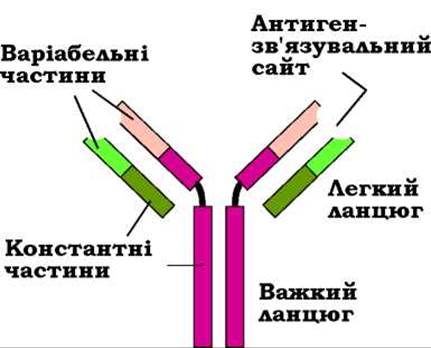
Fig. 6.7. Cytology/cytology/92.html">SCHEMATIC Structure OF an immunoglobulin
Immature immunoglobulin genes appear as clusters of discrete nucleotide sequence elements—blocks from which an active immunoglobulin gene is constructed via recombination within an immunocompetent Cell. The heavy chain cluster contains ~100 tandemly repeating V-segments (derived from variable, with the sequences of all segments differing from one another), ~30 D-segments (derived from diversity), 6 J-segments (derived from joining), and a C-region encoding the constant part of the chain (Fig. 6.8). The light chain cluster is structured similarly, containing only Two Types of variable segments (~100 V- and 4 J-segments). The active gene is assembled from segments of three (or two) types, much like building blocks, through so-called V(D)J recombination: a random D-segment joins a random J-segment (with the intervening DNA excised), and one of the V-segments is then attached to them (Fig. 6.4). Similarly, for the light chain, a V-segment joins one of the J-segments. A promoter is located upstream of each V-segment, and an enhancer resides in the spacer preceding the C-region. Their approximation following recombination activates METABOLISM/31.html">Transcription, while excess spacers and constant region introns are removed from the mRNA via splicing.
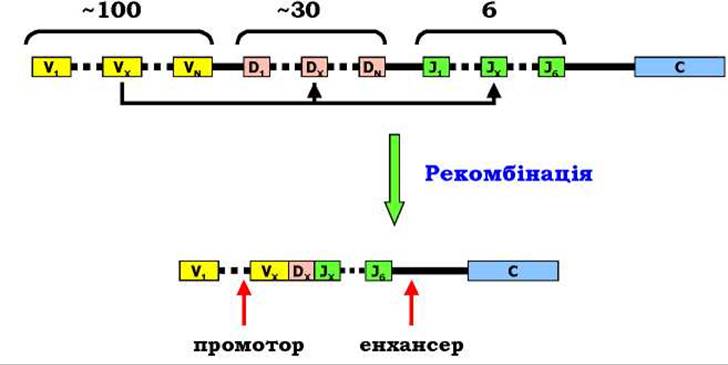
Fig. 6.8. STRUCTURE OF THE immunoglobulin heavy chain gene cluster and assembly scheme of the active gene. The constant region (C) contains introns, which are not shown
Consequently, ~18,000 combinations between the Three types of segments can be realized for the heavy chain, and 400 combinations for the light chain, resulting in a total of ~7 million sequence variants generated through recombination for both chains. Additional Variability is provided by the Induction of Mutations within the V-segments, as well as through The Use of special mechanisms during segment joining.
Recombination depends on signal sequences flanking both sides of each segment, which act as actual recombination sites. These signal sequences are recognized by specific Proteins (transposase homologs) that excise the region between two segments. Subsequently, the 3'-ends of both segments are extended through the random addition of NUCLEOTIDES—clearly, this process further significantly increases The Diversity of mature immunoglobulin gene sequences. Some of these genes will be inactive due to stop codons that inevitably appear with a certain probability during such random synthesis, but this is an acceptable price to pay for the overall increase in variants.
Finally, the ends of the segments are joined using the NHEJ double-strand break repair system (see Fig. 1.25): at the final stages of recombination, the joining process of immunoglobulin gene segments is intentionally "roughened" to enhance variability.
Last update: 11/08/2026
Editorial and Educational Adaptation: This material has been compiled based on the primary/original source text. The project team performed an editorial review, corrected technical inaccuracies, structured sections, and adapted the content for an educational format.
What was processed:
- elimination of formatting defects (OCR errors, structural breaks, corrupted characters);
- editorial organization of content;
- standardization of terminology in accordance with academic sources;
- verification of factual statements against the original source text.
All mentions of the author, publication year, and origin of the primary text have been preserved in accordance with the source.