Human Anatomy Part 1 - K. A. Diubenko, A. K. Kolomiitsev, Iu. B. Chaikovsky 2002
Special Part
Joints of the bones of the upper limb, juncturae membri superioris - Joints of the bones of the forearm
The BONES OF THE forearm are connected at their proximal and distal ends by a combined joint. The proximal radioulnar joint has been discussed previously.
The distal radioulnar joint, articulatio radioulnaris distalis, is formed by the HEAD of the ulna and the ulnar notch of the radius (Fig. 92). An additional Structure within the joint is the articular disc, whose base attaches to the ulnar notch of the radius, while its apex attaches to the ulnar styloid process. The joint is cylindrical in shape. The Joint Capsule attaches along the margins of the articulating surfaces of both bones and the articular disc.
Class="center">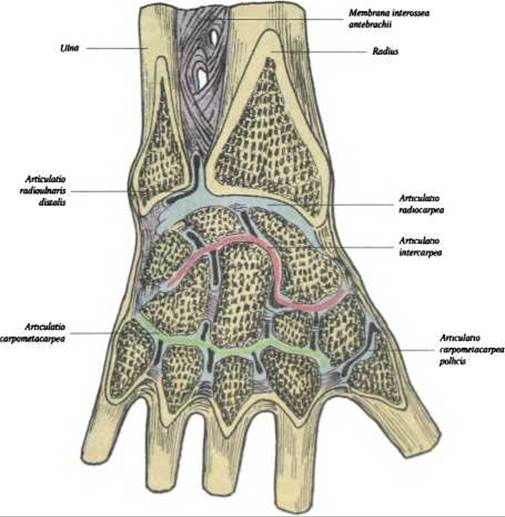
Fig. 92. Joints and ligaments of the hand (section of the hand) (after R. D. Sinelnikov)
Within the cleft between the two bones, the capsule forms a pouch-like recess, the recessus sacciformis, directed upward. Movements in the joint (pronation and supination) also occur around a vertical axis passing through the head of the radius superiorly and through the head of the ulna inferiorly. Stretched between the interosseous borders of the radius and ulna is the tendinous interosseous membrane of the forearm, membrana interossea antebrachii, which contains apertures for the passage of Vessels and nerves.
The articular disc, discus articularis, which covers the head of the ulna, together with the dorsal and palmar radioulnar ligaments, the ulnar collateral ligament of the wrist, and the tendon Sheath of the extensor carpi ulnaris, forms a unified triangular fibrocartilage complex, the triangular fibrocartilage complex (TFCC) (A. Palmer, F. Werner, 1981). Fractures of the radius at a typical site, dislocations of the ulnar head, and fracture-dislocations of the forearm bones result in damage to this complex, leading to restricted pronation and supination Movements of the forearm.
Last update: 08/08/2026
Editorial and Educational Adaptation: This material has been compiled based on the primary/original source text. The project team performed an editorial review, corrected technical inaccuracies, structured sections, and adapted the content for an educational format.
What was processed:
- elimination of formatting defects (OCR errors, structural breaks, corrupted characters);
- editorial organization of content;
- standardization of terminology in accordance with academic sources;
- verification of factual statements against the original source text.
All mentions of the author, publication year, and origin of the primary text have been preserved in accordance with the source.