MEDICAL BIOLOGY, HUMAN ANATOMY, PHYSIOLOGY AND PATHOLOGY - Ya.I. Fedoniuk 2010
BIOLOGY
SECTION 1. BIOLOGICAL BASES OF HUMAN VITAL ACTIVITY
1.3. MOLECULAR-GENETIC AND CELLULAR LEVELS OF LIFE ORGANIZATION
1.3.4. Temporal Organization of Cells
Cell Cycle
The Cell cycle is the lifespan of a cell from one division to the next or from division to cell death. It comprises four distinct periods: three interphase periods (presynthetic G1, synthetic S, and postsynthetic G2) and a fourth period—mitosis, M (Fig. 1.48).
Class="center">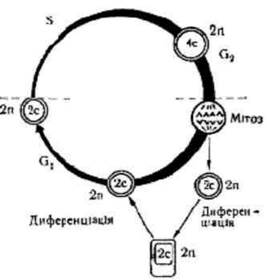
Fig. 1.48 Cell cycle
Interphase (from Latin inter, meaning between) is the interval between two successive mitoses. It is the preparatory period for the cell's next division, during which intensive synthetic processes occur, the most fundamental being DNA Synthesis. Interphase begins with the presynthetic G1 period. The cell undergoes active growth, synthesizes Proteins, accumulates energy, increases its organelle count, and prepares for METABOLISM/36.html">DNA Replication. The cell contains a diploid set of Chromosomes (2n) and a corresponding amount of DNA (2c). The chromosomes are single-chromatid, with each containing a single DNA molecule. During the synthetic S period, DNA synthesis (replication, duplication of the DNA molecule) and chromosome doubling take place. The amount of DNA doubles (2c→4c). The chromosome number remains 2n, but each chromosome becomes duplicated, now consisting of two identical sister chromatids and, consequently, two identical DNA molecules. The amount of histone proteins associated with the newly synthesized DNA also reliably doubles. The onset of the S phase is termed the restriction point. DNA synthesis triggers a true cycle upon the appearance of specialized signaling proteins known as activator proteins, which are degraded at the end of the S phase, allowing the cell to enter the postsynthetic period. In the postsynthetic G2 period, DNA synthesis ceases, but the cell continues to synthesize RNA and proteins, including the tubulins required for the mitotic spindle. The cell volume doubles. Fully prepared for division, the cell enters mitosis. The genetic formula of the cell during this period is 2n4c. A key event triggering the transition of the cell into mitosis is the Activation of a specific protein kinase which, upon interacting with cyclin, forms a catalytically active complex that phosphorylates numerous cellular proteins essential for executing the mitotic process.
Last update: 08/08/2026
Editorial and Educational Adaptation: This material has been compiled based on the primary/original source text. The project team performed an editorial review, corrected technical inaccuracies, structured sections, and adapted the content for an educational format.
What was processed:
- elimination of formatting defects (OCR errors, structural breaks, corrupted characters);
- editorial organization of content;
- standardization of terminology in accordance with academic sources;
- verification of factual statements against the original source text.
All mentions of the author, publication year, and origin of the primary text have been preserved in accordance with the source.