HUMAN MEDICAL BIOLOGY, ANATOMY, PHYSIOLOGY AND PATHOLOGY - Ya.I.Fedoniuk 2010
ANATOMY, PHYSIOLOGY, PATHOLOGY
SECTION 3. ANATOMICAL AND PHYSIOLOGICAL ASPECTS OF BODY FUNCTION SELF-REGULATION
FUNCTIONAL ANATOMY OF THE PERIPHERAL NERVOUS SYSTEM
SPINAL NERVES
2. ANTERIOR BRANCHES
2.2. Brachial Plexus
The brachial plexus (plexus brachialis) is formed by the Anterior branches of the four lower cervical Spinal Nerves and a part of the 1st thoracic spinal nerve. Initially, it is located in the supraclavicular fossa region within the scalene hiatus (between the anterior and middle scalene Muscles), then it descends into the axillary fossa and forms three cords surrounding the axillary artery (Fig. 3.40). The Long branches of the brachial plexus originate from these cords, while the short branches are located in the supraclavicular part. Among the short branches, the largest is the axillary nerve, which innervates the capsule of the shoulder joint, the deltoid and teres minor muscles, and the Skin overlying them.
Class="center">
Fig. 3.40. NERVES OF THE brachial plexus
The remaining short branches primarily innervate the Muscles of the Pectoral Girdle.
The long Branches of the brachial plexus include the following nerves:
1) medial cutaneous nerve of the arm - supplies the skin of the Medial surface of the arm;
2) medial cutaneous nerve of the forearm - supplies the skin of the medial surface of the forearm;
3) musculocutaneous nerve - supplies the muscles of the anterior compartment of the arm and the skin of the lateral surface of the forearm;
4) median nerve - supplies the muscles of the anterior compartment of the forearm (except for the flexor carpi ulnaris and the medial half of the flexor digitorum profundus), the thenar muscles (except for the adductor pollicis and part of the flexor pollicis brevis), the 1st and 2nd lumbrical muscles, and the skin of the palmar surface of the 1st, 2nd, and half of the 4th digits;
5) ulnar nerve - supplies the muscles of the anterior compartment of the forearm not innervated by the median nerve, the hypothenar muscles, the 3rd and 4th lumbrical muscles, and the skin of the palmar surface of the 5th and half of the 4th digits, as well as the skin of the 5th, 4th, and half of the 3rd digits on the dorsal surface of the hand;
6) radial nerve - supplies the muscles of the posterior compartments of the arm and forearm and the skin of the dorsal surface of the 1st, 2nd, and half of the 3rd digits.
The anterior branches of the thoracic spinal nerves do not form plexuses, but instead run within the intercostal spaces. Known as intercostal nerves, they innervate the intrinsic chest muscles, the muscles of the anterolateral abdominal wall, and the skin overlying these muscles (Fig. 3.41).
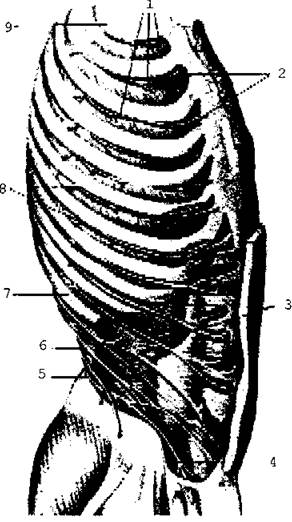
Fig. 3.41. Intercostal nerves
Last update: 08/08/2026
Editorial and Educational Adaptation: This material has been compiled based on the primary/original source text. The project team performed an editorial review, corrected technical inaccuracies, structured sections, and adapted the content for an educational format.
What was processed:
- elimination of formatting defects (OCR errors, structural breaks, corrupted characters);
- editorial organization of content;
- standardization of terminology in accordance with academic sources;
- verification of factual statements against the original source text.
All mentions of the author, publication year, and origin of the primary text have been preserved in accordance with the source.