MEDICAL BIOLOGY, HUMAN ANATOMY, PHYSIOLOGY AND PATHOLOGY - Ya.I. Fedoniuk 2010
BIOLOGY
CHAPTER 2. BIOGEOCENOTIC LEVEL OF ORGANIZATION OF LIFE AND HUMAN PLACE IN IT
2.6. ORGANISMS POISONOUS TO HUMANS
Venomous Reptiles
Class Reptilia (Reptiles). Venomous reptiles belong to the suborder Serpentes (Snakes). Among lizards, only Gila monsters (North America) are venomous. There are about 2,000 species of snakes on Earth, 270 of which are considered venomous. Venomous snakes are actively venomous animals equipped with specialized weaponry. They inject venom using fangs. Venom glands are located behind the eyes; these are modified Salivary Glands. There are two fangs (Fig. 2.66). They have internal channels or grooves for venom delivery. The grooves run along the anterior side of the Teeth and open just short of the tooth tip. The canals also open on the anterior surface of the teeth, near the apex. The ducts of the venom glands open into the upper opening of the canals and grooves. Venom fangs differ from other teeth in their greater length. At rest, they are folded back under the edge of the upper jaws and occupy a relatively horizontal position. Preparing to strike, the snake opens its Mouth, the fangs assume a vertical position and are driven into the victim's body upon biting. At this moment, the temporal Muscles contract, compressing the venom glands and forcing the venom into the ducts.
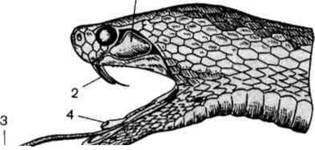
Fig. 2.66. Venom apparatus of a viper:
1 - venom gland; 2 - fangs; 3 - Tongue; 4 - laryngeal opening.
The Indian cobra or spectacled cobra (Naja naja) is a venomous snake exceeding 2 m in length. In southern Turkmenistan, the Central Asian cobra (Naja oxiana) is found, reaching up to 1.5 m in length. Cobras are characterized by The ability to raise the upper part of their body and expand their neck by spreading the Cervical Ribs. Cobras assume this posture when agitated. Cobra venom contains a neurotoxin. Death results from paralysis of the respiratory center.
The family Viperidae (vipers) also includes venomous snakes. The common adder (Vipera berus) is found in Ukraine, reaching up to 75 cm in length.
The coloration is grayish with a dark zigzag stripe along the dorsal side (Fig. 2.67).
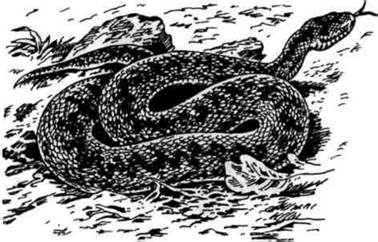
Fig. 2.67. Common adder (Vipera berus).
Ovoviviparous, it frequently basks in the sun, and at night hunts rodents, frogs, and insects. For the winter, vipers gather in underground shelters (hibernacula).
An agitated adder hisses, makes threatening lunges, and attacks instantly. Adder bites are painful, but fatalities are rare.
In Central Asia and the Caucasus lives the blunt-nosed viper or gurza (Vipera lebetina), a species very closely related to the adder. Its length reaches 2 m. It is found in dry steppes and low mountains. Its bite is extremely dangerous. Distributed in the southern part of Central Asia as well as in Africa is the saw-scaled viper (Echis carinatus), a small viper up to 70 cm long (Fig. 2.68). The bite of the saw-scaled viper is dangerous.
The pit viper or halys viper (Ancistrodon halys) ranges from the Volga region to the Far East, including Central Asia and Southern Siberia. Body length is up to 75 cm. It inhabits dense vegetation thickets. The tail is sharply shortened. The American rattlesnake (Crotalus horridus) also belongs to the vipers. It got its name due to the presence of a special "rattle," which consists of movably joined horny segments on the tail. The snake makes oscillating movements with its tail, which produce the sound of the "rattle." The bite is extremely dangerous.
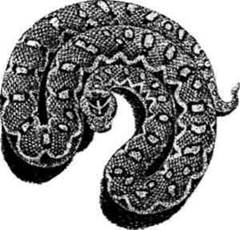
Fig. 2.68. Saw-scaled viper.
Viper venom contains hemotoxin. Symptoms of poisoning include local pain, Swelling, weakness, dizziness, impaired cardiac function, erythrocyte hemolysis, and hemorrhages. Hemorrhages in Internal Organs are life-threatening. In severe cases, death may occur even several days after the bite.
Prevention. When visiting areas with high snake populations, one must wear high boots, and never use hands to push aside grass, turn over stones, or dismantle fallen tree trunks. Treatment of victims must be immediate. The best method of treatment is the administration of antivenom serum, which neutralizes The Effect of the venom.
Last update: 08/08/2026
Editorial and Educational Adaptation: This material has been compiled based on the primary/original source text. The project team performed an editorial review, corrected technical inaccuracies, structured sections, and adapted the content for an educational format.
What was processed:
- elimination of formatting defects (OCR errors, structural breaks, corrupted characters);
- editorial organization of content;
- standardization of terminology in accordance with academic sources;
- verification of factual statements against the original source text.
All mentions of the author, publication year, and origin of the primary text have been preserved in accordance with the source.