Nephrology for the Family Physician - O.I. Bakaliuk 2003
Emergency Uro-Nephrology
Hematuria
The causes of Hematuria are discussed in the section «Leading Semeiotics of Renal Diseases».
When providing medical care to patients with hematuria (we emphasize this once again!), cystoscopy must be performed at the peak of bleeding to precisely determine the source. The only exceptions are hematuria caused by acute cystitis or prostatitis, where the Diagnosis is unambiguous.
Unfortunately, clinical practice often paints a different picture. The appearance of Blood in the urine prompts the patient to consult a general practitioner, who immediately attempts to «stop the bleeding». As for radiological examination (except for traumatic injuries requiring urgent information on the extent of damage and the condition of the contralateral Kidney), it is usually postponed for several days after the bleeding stops. This prevents misinterpreting a filling defect caused by a blood clot as a neoplasm. Renal angiography remains the method of choice in such cases.
If the bleeding is not life-threatening, standard hemostatic therapy is prescribed following cystoscopy (menadione, etamsylate, calcium chloride, aminocaproic acid). It should be noted that the efficacy of such Treatment is driven not only by the action of these drugs, but also by the fact that the bleeding (which is venous in nature) tends to be intermittent and generally stops spontaneously once local Hypertension decreases.
Emergency surgery is indicated only in cases of profuse bleeding or Urinary Bladder tamponade caused by blood clots. The surgical approach depends on the findings obtained during lumbotomy: nephrectomy for a renal tumor; nephroureterectomy with resection of the bladder segment along with the ureteral orifice for a renal pelvis tumor; pyelolithotomy or nephrolithotomy for a renal pelvis calculus; ignipuncture for Polycystic Kidney Disease; nephropexy for Nephroptosis or renal malrotation; renal decapsulation and nephrostomy for acute Pyelonephritis; wound closure and nephrostomy placement, partial resection of a renal pole, or nephrectomy for renal trauma; tumor electroexcision, bladder resection, or cystectomy for a bladder tumor; and adenomectomy for prostate tumors.
Class="center">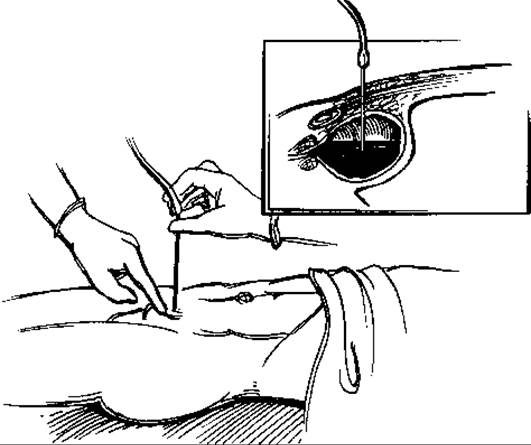
Fig. 105. Capillary puncture of the urinary bladder (after Yu.A. Pytel, 1985).
Last update: 08/08/2026
Editorial and Educational Adaptation: This material has been compiled based on the primary/original source text. The project team performed an editorial review, corrected technical inaccuracies, structured sections, and adapted the content for an educational format.
What was processed:
- elimination of formatting defects (OCR errors, structural breaks, corrupted characters);
- editorial organization of content;
- standardization of terminology in accordance with academic sources;
- verification of factual statements against the original source text.
All mentions of the author, publication year, and origin of the primary text have been preserved in accordance with the source.