THEORETICAL FOUNDATIONS OF FISH FARMING - I.M. Sherman - 2011
4. THEORETICAL FOUNDATIONS OF FISH REARING UNDER VARIOUS CONDITIONS
4.3. Theoretical foundations of pastoral aquaculture
The Selection/36.html">Biological essence of pastoral fish farming lies in the fact that fish rearing is based on the existing bioproductive potential, which forms a feed resource—in other words, hydrobionts that can be consumed by certain fish species. The bioproductive potential, comprising producers and consumers of various trophic levels, includes the available feed resource, which in turn encompasses flora and fauna represented by food organisms for the respective fish species.
To rationally utilize the feed resource and transform it into a food base, it is necessary to form an artificial ichthyocenosis, or polyculture of appropriate fish species whose nutritional requirements align with the feeding biology of the cultivated species. At the same time, The formation of an artificial ichthyocenosis cannot be arbitrary and requires sound justification. In pastoral aquaculture, the COMPOSITION OF THE artificial ichthyocenosis must, first of all, include fish species with compatible feeding habits to eliminate potential food competition; secondly, and no less importantly, it should include species capable of demonstrating high growth potential, excellent dietary and culinary qualities, and high consumer demand.
To conduct efficient pastoral aquaculture in fish farming using thermophilic fish species, it is necessary to ensure specific ecosystem parameters in ponds, natural Water bodies, and artificial reservoirs of various origins and purposes in order to maximize the yield of high-quality products per unit area of specific water bodies. When discussing pastoral aquaculture in classical, drainable fattening ponds, the term fish productivity should be used. For natural and artificial water bodies that are not classical fattening ponds—where water cannot be completely and arbitrarily drained and the entire fish stock harvested, and a certain portion inevitably remains—the term fish production is appropriate. Understanding the patterns of primary organic matter formation in hydroecosystems, and relying on existing patterns of transformation and cycling associated with the phenomenon under study, we must direct these processes in a way that ensures the desired composition of bioproductive potential with specific Qualitative and quantitative parameters. By influencing the dynamic processes inherent in the flora and fauna of hydrobionts, it is necessary to maintain abiotic environmental parameters at the level of industry standards for the artificial ichthyocenosis forming within the ecosystem.
Pastoral aquaculture in fish farming that utilizes classical fish ponds is somewhat of an anomaly and is temporary in nature; essentially, it is a forced measure caused by economic hardships. In the absence of such negative factors, operating classical ponds on a pastoral principle is impractical. Driven by objective logic, pastoral aquaculture is a promising direction in modern fish farming implemented on The basis of natural and artificial water bodies of various intended uses. Organizing fish farming in such water areas opens up additional and quite realistic opportunities to significantly increase The production of cheap, high-quality fish with minimal costs for stocking material, protection, and harvesting.
Pastoral aquaculture in ponds and water bodies adapted for market-size fish rearing can be oriented toward either traditional spring or autumn stocking. Accordingly, depending on the specific conditions, yearlings or fingerlings are used as stocking material.
When utilizing fattening areas represented by adapted water bodies of various origins and purposes, autumn stocking is preferred, using fingerlings as stocking material. When operating specialized commercial fattening farms or full-system fish farms equipped with wintering ponds, spring stocking of fattening areas is preferred, using yearlings, though fingerlings may be used under certain circumstances and considerations.
Special studies conducted in the early 21st century on a group of water bodies associated with the Black Sea and Sea of Azov basins, as well as
small river systems and return waters from irrigated agriculture, revealed a rather interesting feature demonstrating the astatic nature of water mineralization.
The studied water areas are fundamentally new to modern fish farming: on the one hand, they are distinct, and on the other, they are diverse. This becomes evident when taking an individualized approach to evaluating their Physical and Chemical environmental parameters. Quantitative and qualitative indicators of environmental parameters within a single water body vary considerably, creating a peculiar patchiness or mosaic Structure. These patches exhibit dynamic configurations and The ability to move across the water body, forming distinct local zones that migrate in time and space. These features are not typical of traditional fish farming, which historically evolved on the basis of ponds, reservoirs, and lakes. Consequently, solving this problem requires specialized research aimed at finding ways to increase fish farming efficiency under specific ecological conditions that have virtually never been studied from this perspective by scientific institutions.
A deep analysis of abiotic environmental parameters allows us to state the following:
- continental water bodies in southern Ukraine located in close proximity to the Azov and Black Sea basins are characterized by elevated levels of mineralization;
- the mineralization of these specific water bodies depends on the volume of incoming water, The Nature of underlying soils, the degree of connection with the sea, precipitation, evaporation, filtration, and Transpiration;
- small rivers, or return waters from irrigation systems, act as desalinating factors for this group of continental water bodies;
- the degree of connection with the sea and underlying soils influence water mineralization; this feature causes an astatic nature of mineralization in both quantitative and qualitative terms, while hydrological regime features explain the differences in water mineralization across different areas of the water bodies;
- sometimes, due to differences in the density of salt solutions in fresh water—particularly near the bottom—a specific mosaic pattern of mineralization is observed, which can persist for a long time during calm weather when intensive mixing of water masses ceases;
- the peculiarity of the hydrological regime and the mutual influence of desalination and salinization factors result in these waters being intermediate between saline marine and fresh continental waters;
- the level of water mineralization in these specific water bodies is unstable, fluctuating seasonally, throughout the year, and from year to year.
The conducted studies have shown that the physical and chemical parameters of the environment provide a solid basis for forming an artificial ichthyocenosis aimed at establishing efficient pastoral aquaculture in fish farming, thereby significantly expanding the pool of water bodies involved in commercial fish production.
The formulated concept, presented as Conclusions, asserts the fundamental possibility of coexisting with native ichthyofauna and other promising fish species capable of boosting fish production. At the same time, a clear understanding must be maintained regarding the feasibility of providing adequate quality and quantity of food for the Components of the forming polyculture.
The Study of dynamic processes based on the main indicators of bioproductive potential provides insight into the potential capabilities of fish farming under conditions of astatic water mineralization in rather specific water bodies. Based on the average annual biomass indicators of the main groups of feed hydrobionts—determined using well-known and generally accepted Methods in fish farming—and subsequent mathematical calculations, the organic matter production figures for the studied group of water bodies were obtained, as presented in Tables 4.1 – 4.3.
Khadzhibey Estuary is characterized by significant reserves of organic matter. This indicator is highest in Zone IV at 26,985.2 kg/ha with a water mineralization of 10 – 10.1 g/L. In Zone I, it is significantly lower at 15,713.8 kg/ha with a water mineralization of 5.9 – 6.1 g/L. The highest production regarding macrophyte development was observed in Zone II at 16,500 kg/ha with a water mineralization of 6.5 – 6.8 g/L. The highest phytoplankton production peak occurred in Zone IV, reaching 23,730 kg/ha. Regarding zooplankton, Zone II proved to be the most productive with a production rate of 1,194 kg/ha, while the lowest was recorded in Zone IV of the estuary at only 200 kg/ha. Total organic matter reserves in Khadzhibey Estuary amounted to 131,310 tons (Table 4.1). The state of feed resources and organic matter production confirm that Khadzhibey Estuary belongs to highly productive water bodies and can be effectively utilized in fish farming.
In Tiligul Estuary, the largest organic matter reserves are concentrated in Zone I, with a water mineralization of 11.1 – 11.3 g/L, amounting to 25,542.8 kg/ha; the smallest reserves are in Zone III, where at a water mineralization of 17.6 – 17.8 g/L, the average annual organic matter reserve did not exceed 18,232 kg/ha. In total, an average of 305,520 tons of organic matter is produced annually in Tiligul Estuary.
The water area of the Dofinivskyi Estuary was characterized by minor salinity fluctuations across individual zones, accompanied by stable dynamics in The Development of hydrobionts. Their average production over the study period reached 17,106 kg/ha in Zone I and 20,036 kg/ha in Zone II. The total amount of organic matter produced in the Dofinivskyi Estuary is 9,505 t.
Due to high water salinity, any fish species are completely absent in the Kuyalnyk Estuary. The organic matter reserves of benthic organisms reach 18,000 t, while *Artemia salina* can yield 2,750 t of high-quality fish feed.
According to the research findings, significant reserves of organic matter accumulate in the irrigation-connected lakes (see Table 4.20).
In Krugle Lake, this indicator averages 42,888 kg/ha in Zone I with a water mineralization of 1.2–1.3 g/L, 47,354 kg/ha in Zone II with a mineralization of 3.6–0.9 g/L, and peaks at 63,681 kg/ha in Zone III with a mineralization of 4.9–1.0 g/L; the total organic matter production is 7,280 t.
Class="center">Table 4.1. Feed resources and organic matter production in the estuaries of the Dnieper-Dniester interfluve
Zone |
Area ha |
Minerali zation, g/dm3 |
Macrophytes |
Phytoplankton |
Zooplankton |
Zoobenthos |
Organic matter production, kg/ha |
||||||||
P/B=1.1 |
P/B=130 |
P/B=20 |
Soft |
Hard |
|||||||||||
P/B=6 |
P/B=2 |
||||||||||||||
Mean annual biomass, g/m2 |
Production, kg/ha |
Mean annual biomass, g/m3 |
Production, kg/ha |
Mean annual biomass, g/m3 |
Production, kg/ha |
Mean annual biomass, g/m2 |
Production, kg/ha |
Mean annual biomass, g/m2 |
tsT І е § k Он |
||||||
Khadzhibey |
|||||||||||||||
I |
6000 |
5.9 - 6.1 |
252 |
2772 |
11.3 |
11865 |
3.2 |
960 |
18.7 |
112.2 |
2.3 |
4.6 |
15713.8 |
||
II |
500 |
6.5 - 6.8 |
1500 |
16500 |
7.5 |
7875 |
3.98 |
1194 |
21.0 |
126 |
5.2 |
10.4 |
25705.4 |
||
III |
150 |
19.6 -18.8 |
- |
- |
50.1 |
17535 |
1.79 |
178 |
40.2 |
241 |
5.0 |
100 |
18054 |
||
IV |
700 |
10-10.1 |
270 |
2970 |
33.9 |
23730 |
1.0 |
200 |
13.4 |
80.4 |
2.4 |
4.8 |
26985.2 |
||
V |
150 |
7.8-8.4 |
260 |
2860 |
14.2 |
14910 |
2.9 |
426 |
8.0 |
48 |
2.1 |
42 |
18286 |
||
Tylihul |
|||||||||||||||
I |
400 |
11.1-11.3 |
290 |
3190 |
16.7 |
17.535 |
3.2 |
960 |
16.3 |
97.8 |
188 |
3760 |
25542.8 |
||
II |
14000 |
18.6-19.0 |
212 |
2332 |
8.8 |
9.240 |
1.92 |
570 |
13.6 |
816 |
362 |
7240 |
20198 |
||
III |
600 |
17.6-17.8 |
352 |
3872 |
4.0 |
5.600 |
1.98 |
390 |
15 |
900 |
373.5 |
7470 |
18232 |
||
Dofinivskyi |
|||||||||||||||
I |
550 |
17.5-16.2 |
1000 |
11000 |
2.73 |
2.880 |
3.9 |
1170 |
23.1 |
1386 |
33.5 |
670 |
17106 |
||
II |
50 |
16.5-17.8 |
1200 |
13200 |
2.6 |
2.730 |
4.8 |
1440 |
28.6 |
1716 |
47.5 |
950 |
20036 |
||
Kuyalnyk |
|||||||||||||||
I |
50 |
113-116.9 |
- |
- |
1.11 |
2.9 |
37.2 |
2232 |
2232 |
||||||
II |
6450 |
105-121.5 |
- |
- |
2.42 |
2.4 |
47.7 |
2862 |
2862 |
||||||
Total area of the estuaries: Khadzhibey — 75,000 ha, Tylihul — 15,000 ha, Dofinivskyi — 600 ha, Kuyalnyk — 6,500 ha.
Table 4.2. Feed resources and organic matter production in irrigation-connected lakes
Zone |
Area, ha |
Minerali zation, g/dm3 |
Macrophytes |
Phytoplankton |
Zooplankton |
Zoobenthos |
Organic matter production, kg/ha |
||||||
P/B=1.1 |
P/B=130 |
P/B=20 |
Soft |
Hard |
|||||||||
P/B=6 |
P/B=2 |
||||||||||||
Mean annual biomass, kg/m2 |
Production, kg/ha |
Mean annual biomass, g/m3 |
Production, kg/ha |
Mean annual biomass, g/m3 |
Production, kg/ha |
Mean annual biomass, g/m2 |
Production, kg/ha |
Mean annual biomass, g/m2 |
Production, kg/ha |
||||
Krugle |
|||||||||||||
I |
15 |
1.2-1.3 |
450 |
4950 |
18.4 |
35880 |
6.4 |
1920 |
2.2 |
132 |
0.3 |
6.0 |
42888 |
II |
100 |
3.6-0.9 |
400 |
4000 |
21.4 |
41730 |
4.9 |
1470 |
2.4 |
144 |
0.5 |
10.0 |
47354 |
III |
30 |
4.9-1.0 |
250 |
2500 |
24.3 |
49450 |
3.9 |
11700 |
2.9 |
17.4 |
0.7 |
14.0 |
63681 |
Dovhe |
|||||||||||||
I |
30 |
3.6-4.1 |
- |
- |
14.7 |
28665 |
4.2 |
1260 |
0.5 |
30 |
- |
- |
29955 |
II |
127 |
7.8-54.6 |
- |
- |
15.0 |
29250 |
4.07 |
1221 |
12.2 |
732 |
- |
- |
31203 |
Kruhlozerne |
|||||||||||||
I |
20 |
3.6-4.2 |
- |
- |
26.1 |
5200 |
9.0 |
540 |
1.15 |
23 |
5763 |
||
II |
100 |
5.4-36.4 |
- |
- |
10.55 |
13715 |
22.5 |
4500 |
10.6 |
636 |
6.0 |
120 |
18971 |
Tafiya |
|||||||||||||
I |
30 |
0.8-1.2 |
380 |
4180 |
31.75 |
41275 |
5.4 |
1620 |
2.8 |
168 |
0.4 |
0.8 |
47243 |
II |
60 |
1.1-1.6 |
460 |
5060 |
35.35 |
45955 |
7.05 |
2115 |
4.5 |
270 |
1.5 |
3.0 |
53403 |
Ustrychne |
|||||||||||||
I |
50 |
15.9-18.1 |
340 |
3740 |
3.65 |
7117 |
1.8 |
540 |
0.7 |
4.2 |
2.7 |
5.4 |
11406 |
II |
650 |
13.2-16.2 |
290 |
3190 |
5.05 |
9847 |
2.45 |
735 |
0.9 |
5.4 |
4.0 |
8.0 |
13785 |
Total area of the lakes: Krugle — 145 ha, Dovhe — 154 ha, Kruhlozerne — 120 ha, Tafiya — 90 ha, Ustrychne — 700 ha.
Table 4.3. Feed resources and organic matter production in the Azov region lakes
Zone |
Area, ha |
Minerali zation, g/L |
Macrophytes |
Phytoplankton |
Zooplankton |
Zoobenthos |
Organic matter production, kg/ha |
||||||||||||||
P/B=1.1 |
P/B=130 |
P/B=20 |
Soft |
Hard |
|||||||||||||||||
P/B=6 |
P/B=2 |
||||||||||||||||||||
Mean annual biomass, kg/m2 |
Production, kg/ha |
Mean annual biomass, g/m3 |
Production, kg/ha |
Mean annual biomass, g/m3 |
Production, kg/ha |
Mean annual biomass, g/m2 |
Production, kg/ha |
Mean annual biomass, g/m2 |
Production, kg/ha |
||||||||||||
Krugle |
|||||||||||||||||||||
I |
0.7-0.5 |
367 |
40370 |
2.9 |
3770 |
6.0 |
1200 |
2.1 |
12.6 |
0.7 |
1.4 |
45354 |
|||||||||
II |
1.29-0.8 |
367 |
40370 |
4.1 |
5.330 |
6.6 |
1320 |
2.9 |
17.4 |
1.1 |
2.2 |
47039.6 |
|||||||||
III |
1.7-1.5 |
367 |
40370 |
6.25 |
8125 |
4.1 |
820 |
5.0 |
30 |
1.1 |
2.2 |
49347.2 |
|||||||||
Kupanka |
|||||||||||||||||||||
I |
8.4-7.9 |
180 |
19800 |
13.2 |
17160 |
9.5 |
1900 |
7.0 |
42 |
2.9 |
5.8 |
38907.8 |
|||||||||
II |
12.1-9.8 |
220 |
24200 |
15.4 |
20020 |
12.8 |
2560 |
7.3 |
44 |
3.0 |
6.0 |
46830 |
|||||||||
Krasnopere |
|||||||||||||||||||||
I |
17.5-10.4 |
90 |
9900 |
22.3 |
28990 |
7.7 |
1540 |
30.5 |
183 |
12.5 |
25 |
40638 |
|||||||||
II |
20.4-17.0 |
70 |
7700 |
29.3 |
42300 |
7.8 |
1560 |
35.4 |
212 |
8.5 |
17 |
51789 |
|||||||||
Dovhe |
|||||||||||||||||||||
I |
24.5-20.0 |
30 |
3300 |
29.9 |
38870 |
12.3 |
2460 |
30.3 |
181.8 |
5.0 |
10 |
44821 |
|||||||||
II |
28.1-22.9 |
60 |
6600 |
35.1 |
45630 |
19.3 |
3860 |
29.6 |
177.6 |
8.0 |
16 |
56283 |
|||||||||
Krasne |
|||||||||||||||||||||
I |
61.5-52.0 |
- |
- |
3.8 |
4940 |
49.2 |
9840 |
80.3 |
481.8 |
15261 |
|||||||||||
II |
75.6-58.5 |
- |
- |
3.1 |
4030 |
67.0 |
13400 |
89.7 |
538.2 |
17968 |
|||||||||||
Total area of the lakes: Krugle — 120 ha, Kupanka — 90 ha, Krasnopere — 140 ha, Dovhe — 220 ha, Krasne — 115 ha.
Due to high water mineralization, macrophytes do not reproduce in Dovhe Lake; the primary production is generated by phyto- and zooplankton forage groups. Total organic matter production in the lake reaches 4,859 t.
Due to salinization in recent years, Kruhlozerne Lake demonstrates productive potential exclusively through zooplankton and zoobenthos, whose mean annual reserves amount to 2,011 t.
In Tafiya Lake, at a water mineralization of 0.8–1.2 g/L, Zone I produces 47,243 kg/ha of organic matter, while Zone II, with a mineralization of 1.1–1.6 g/L, produces 53,403 kg/ha; total organic matter reserves equal 4,620 t.
Ustrychne Lake has negligible organic matter reserves: 11,406 kg/ha in Zone I, 13,785 kg/ha in Zone II, and 9,475 t across the entire area.
An Analysis of the productive capacities of the Azov region lakes (Table 4.3) has demonstrated that, within the general cascade, Krugle and Dovhe are the most productive, accumulating significant organic matter reserves throughout the season via phytoplankton, macrophytes, zooplankton, and soft zoobenthos. Specifically, Krugle Lake averages 45,354.0 kg/ha of organic matter in Zone I, 47,039.6 kg/ha in Zone II, and 49,347.2 kg/ha in Zone III. In Dovhe Lake, these values reach 44,821 and 56,283 kg/ha in Zones I and II, respectively.
Krasne Lake has the lowest productive potential. Due to high salinity, macrophytes are practically absent. The mean annual organic matter production is 15,261 and 17,968 kg/ha in Zones I and II, respectively.
During special studies, attempts were made to estimate detritus reserves as the primary food component in the diet spectrum of mullets (Mugilidae). The thickness of the most productive detrital layer in the studied water bodies varied over a wide range and did not exceed 5 mm.
Along with this, based on relevant studies, we calculated detritus reserves in the Khadzhibey Estuary: Zone I — 28.8, Zone II — 30, Zone III — 36, Zone IV — 27.6, Zone V — 24 t/ha of organic matter; in the Tylihul Estuary: Zone I — 33.6, Zone II — 30, Zone III — 24 t/ha; in the Dofinivskyi Estuary: Zone I — 18, Zone II — 16.8 t/ha.
In the irrigation-connected lakes, organic matter reserves in the form of detritus are as follows: in Krugle Lake, Zone I — 30, Zone II — 27.6, Zone III — 19.2 t/ha; in Dovhe Lake, Zone I — 21.6, Zone II — 15.6 t/ha; in Kruhlozerne Lake, Zone I — 19.2, Zone II — 18 t/ha; in Tafiya Lake, Zone I — 26.4, Zone II — 30 t/ha; in Ustrychne Lake, detrital mass reserves are negligible, amounting to 18 t/ha in Zone I and 12 t/ha in Zone II.
Within the group of Azov region lakes, detritus reserves range from 14.4 to 30 t/ha, peaking in Krugle and Kupanka lakes, which can be attributed to their proximity to the Mouth of the Berda River, which supplies substantial organic masses.
The biomass of producers and consumers across various trophic levels can be considered residual as a first approximation. This is supported by the practical absence of a sufficient number of effective consumers among the ichthyofauna in the studied water bodies, which leads to the accumulation of substantial forage reserves. Therefore, the opinion regarding the feasibility and rationale of purposefully managing the ichthyofauna composition—whose valuable accumulations can efficiently transform forage resources into a proper food base—is unquestionable.
The reviewed Features of the studied water bodies demonstrate their potential for cultivating specific fish species based on the principles of pasture aquaculture.
As is clear from the above, astatic and simultaneously elevated water mineralization cannot be an obstacle to the ESTABLISHMENT AND DEVELOPMENT of fish farming. Under fundamentally new conditions that have objectively emerged in the studied group of water bodies, aquaculture shares many common features with traditional fish farming while also possessing a distinct individuality. Therefore, when developing aquaculture technology for such water bodies, it is necessary to consider both the general Stages of the technological process and the Specific features of individual water bodies. This approach allows for the utilization of vast areas and bioproduction potential for fish farming without additional alienation of land and water resources, while the resulting commercial fish products do not require extra feed and fertilizers. The environmental benefits of such a food product, i.e., fish grown on naturally occurring feeds, are undeniable and are further accompanied by resource conservation.
Along with the aforementioned, the proposed technology minimizes human negative impact on the environmental quality of the cultivated object, which typically arises from The Use of certain intensification elements, thereby enhancing appeal due to the significant greening of production.
Water bodies with elevated and astatic mineralization are characterized by a diversity of abiotic and biotic environmental parameters, as well as the Abundance and biomass of flora and fauna representatives, which include species of both marine and freshwater origin. Furthermore, it has been confirmed that certain hydrobionts are capable of living in water bodies with both brackish and marine water.
Based on the research findings, an attempt has been made to classify the water bodies of southern Ukraine with astatic water mineralization according to the level of development of Major Groups of food hydrobionts and fish productivity indicators (Table 4.4). It was established that, based on phytoplankton production out of 31,497 ha of studied water bodies, 64.6% (201,317 ha) belong to highly productive ones according to the trophic Classification proposed by S.P. Kitaev, whereas very low-productive water bodies are represented by areas with mineralization exceeding 25 g/m.
The productivity of water bodies in terms of zooplankton is different. Low-productive ones account for 69.2%, followed by very high-productive ones,
represented by water areas with water mineralization exceeding 25 g/dm, and very low-productive ones with mineralization of 8-25 g/m2. It should be noted that in terms of soft zoobenthos production, 30,152 ha (95.5%) of water bodies belong to very high-productive ones. The average biomass of benthic organisms in them exceeds 16 g/m, while medium-productive ones account for 2.8%.
The distribution of water bodies with astatic water mineralization according to the biomass of food hydrobionts is presented in Table 4.4.
Table 4.4. Distribution of continental water bodies with astatic water mineralization by biomass of food hydrobionts
Mid-season biomass, g/m2 |
Mineralization, g/m |
Total |
||||||
1-5 |
5-8 |
8-12 |
12-25 |
>25 |
area |
|||
Water body productivity class |
Area, ha |
ha |
% |
|||||
Phytoplankton |
||||||||
Very low-productive |
<2 |
— |
— |
— |
— |
6450 |
6450 |
21.2 |
Low-productive |
2-4 |
35 |
— |
— |
650 |
165 |
850 |
2.7 |
Medium-productive |
4-8 |
85 |
500 |
— |
1400 |
— |
1985 |
6.5 |
Highly productive |
8-16 |
20 |
6227 |
— |
14125 |
— |
20592 |
67.6 |
Very highly productive |
>16 |
265 |
— |
110 |
55 |
200 |
630 |
2 |
Zooplankton |
||||||||
Very low-productive |
<2 |
— |
— |
700 |
800 |
— |
1500 |
4.7 |
Low-productive |
2-4 |
30 |
6500 |
550 |
14700 |
— |
21780 |
69.2 |
Medium-productive |
4-8 |
355 |
127 |
690 |
— |
1172 |
3.8 |
|
Highly productive |
8-16 |
— |
— |
70 |
40 |
— |
110 |
0.3 |
Very highly productive |
>16 |
20 |
100 |
— |
— |
— |
6935 |
22 |
Zoobenthos |
||||||||
Very low-productive |
<1.5 |
30 |
30 |
— |
— |
— |
60 |
0.3 |
Low-productive |
1.5-3 |
150 |
— |
— |
— |
150 |
0.6 |
|
Medium-productive |
3-6 |
95 |
60 |
— |
700 |
— |
855 |
2.8 |
Highly productive |
6-12 |
40 |
— |
220 |
20 |
— |
280 |
0.8 |
Very highly productive |
>16 |
— |
6727 |
1100 |
15405 |
6920 |
30152 |
95.5 |
According to the level of potential fish productivity, out of 24,452 ha of water bodies, 6,440 ha belong to the first class (very highly productive), of which 6,000 ha are within Odesa Region, 165 ha in Kherson Region, and 275 ha in Zaporizhzhia Region; 17,132 ha belong to the second class (highly productive), of which 16,500 ha are in Odesa Region, 337 ha in Kherson Region, and 295 ha in Zaporizhzhia Region; 700 ha belong to the third class (medium-productive) (Kherson Region); and 180 ha belong to the fourth class (low-productive) (Kherson Region) (Table 4.5).
Table 4.5. Classification of continental water bodies with astatic mineralization by fish productivity, kg/ha
Water body productivity class |
Fish productivity, kg/ha |
Region |
Total area, ha |
||
Odesa |
Kherson |
Zaporizhzhia |
|||
Area, ha |
|||||
Very |
>800 |
6000 |
165 |
275 |
6440 |
highly productive |
|||||
Highly productive |
500-800 |
16500 |
337 |
295 |
17 |
Medium-productive |
200-500 |
700 |
132 |
||
Low-productive |
<200 |
180 |
700 |
||
Existing commercial fish production technologies in fresh and salt waters are considered quite well-developed, yet they cannot be applied to the group of continental water bodies with elevated and simultaneously astatic water mineralization. Therefore, it is necessary to develop theoretical foundations for a technology capable of ensuring efficient fish farming under specific conditions.
The practical aspects of the conducted research allow us to propose provisions that form the basis of the technology for commercial fish production in water areas with elevated and astatic water mineralization. We consider it appropriate to present them in The sequence of the technological chain, where individual links are formally separated.
Operation |
Content of work |
Execution schedule |
Determination of the number and areas of salinity "patches" (zones) |
Chemical samples are taken, and total water mineralization is determined using standard methods |
Depending on the Specifics of the water body, during the period of maximum salinity |
Determination of the bioproduction potential of each individual zone |
Hydrobiological samples are taken, the quantitative and qualitative state of the main groups of food hydrobionts is determined, and the production capabilities of each zone are calculated |
Throughout the year |
Fishing |
Carried out using fine-mesh seines to suppress the development of low-value ichthyofauna species, while simultaneously studying the quantitative and qualitative composition of native ichthyofauna |
“ |
Installation of fish protection structures |
Where possible, fish protection structures are installed to prevent fish from entering the water supply source or adjacent water bodies, as well as to prevent valuable fish from leaving the water area |
In spring |
Formation of pasture fish polyculture |
Water bodies with astatic mineralization are recommended to be stocked in autumn or spring depending on the availability of stocking material. The individual mass of the stocking material should be 40 — 50 g, and its species and quantitative composition depend on the area of the respective mineralization Zones of the water bodies. At a mineralization of 1.1 — 8 -5 g/dm, recommended cultivated species are grass carp, common carp, and mullets. -5 In zones with a mineralization of 12.1 — 25 g/dm, it is advisable to use mullet and flounder as stocking material. Stocking material should be transported in closed tanks depending on the Location OF THE zone |
In spring or autumn |
Monitoring abiotic parameters of water areas |
Physical and chemical water indicators are studied. Oxygen content, pH, hardness, alkalinity, and total water mineralization are determined |
Quarterly |
Monitoring biotic parameters of water areas |
The development of phytoplankton, macrophytes, zooplankton, and zoobenthos is continuously monitored to determine the dynamics of the water body's production capabilities in relation to the cultivation of certain commercial fish species |
Monthly |
Test fishing |
Carried out to monitor the condition of the fish. Size, condition factor, feeding habits, degree of dietary overlap, etc., are determined. Test fishing is performed using fine-mesh seines |
“ |
Fish harvesting |
Fish are harvested using active and passive fishing gears, as well as electric shockers. Mesh size should be 50 x 50 mm. Preference should be given to active fishing gears |
Year-round |
Protection |
Carried out by brigades together with police officers, fish inspection staff, and public fish inspectors around the clock |
Daily |
Pasture-based fish farming involves not only increasing commercial fish production volumes but also economic feasibility capable of ensuring the profitability of the industry. In this regard, preliminary calculations of the economic efficiency of commercial fish cultivation in continental water bodies of southern Ukraine with astatic water mineralization were performed. These calculations are based on the criteria specified in previous chapters, namely: average mass of commercial fish, volume and stocking rate by fish species, fish productivity or fish production, yield, or commercial return. When calculating production costs, the following indicators are taken into account: cost of stocking material, transportation expenses, wages with payroll Taxes, repair costs for machinery and equipment, and depreciation of fixed assets.
As a result, it was established that water bodies with a water mineralization of 1-8 g/m are the most economically efficient for commercial fish production, with a total fish productivity of 3,282.6 t. Meanwhile, revenue from fish product sales reaches UAH 17 million 716.8 thousand at a cost of production of UAH 13 million 143.2 thousand. Net income from commercial fish production in these water areas at a 40% commercial return can amount to UAH 4 million 573.6 thousand, with a profitability level of 34.8%.
In water areas with a water mineralization of 8-12 g/dm, a net income of UAH 188.8 thousand is possible at a profitability of 16%, while at a mineralization of 12-25 g/dm, it will amount to UAH 2 million 807 thousand at a profitability of 14% (Table 4.6).
Table 4.6. Economic efficiency of commercial fish production in water areas with astatic mineralization
Indicator |
Mineralization, g/m2 |
Fish species |
Total |
||||||
Grass carp |
Black carp |
Silver carp |
Bighead carp |
Common carp |
Mullet |
Flounder |
|||
Introduction volume, thousand spec. |
573.8 |
175.0 |
1702.7 |
1154.2 |
160.9 |
3402.8 |
7169.4 |
||
Average mass of commercial fish, g |
700 |
700 |
800 |
800 |
500 |
500 |
|||
Fish production, t |
1-8 |
229.2 |
49 |
1363.7 |
953.3 |
35.5 |
651.9 |
3282.6 |
|
Production costs, thousand UAH |
802.2 |
196 |
4772.9 |
3336.5 |
124.2 |
3911.4 |
13143.2 |
||
Value of commercial products, thousand UAH |
1146 |
245 |
6818.5 |
4766.5 |
177.5 |
4563.3 |
17716.8 |
||
Profit, thousand UAH |
1-8 |
3.5 |
4.0 |
3.5 |
3.5 |
3.5 |
6.0 |
4573.6 |
|
Profitability, % |
34.8 |
||||||||
Introduction volume, thousand spec. |
76.8 |
14.3 |
22.7 |
0.76 |
560.3 |
83.6 |
763.6 |
||
Average mass of commercial fish, g |
600 |
600 |
600 |
500 |
600 |
||||
Fish production, t |
8-12 |
18.4 |
4.6 |
5.4 |
0.14 |
134.3 |
11.6 |
174.4 |
|
Production costs, thousand UAH |
64.4 |
16.1 |
18.9 |
0.49 |
805.8 |
69.6 |
975.2 |
||
Value of commercial products, thousand UAH |
92 |
23 |
27 |
0.79 |
940.1 |
81.2 |
1164.0 |
||
Guided by the above, we propose a conceptual framework focused on the fundamentals of commercial fish production technology in continental water areas with elevated and astatic water mineralization in time and space, vertically and horizontally, which is associated with ecological aspects.
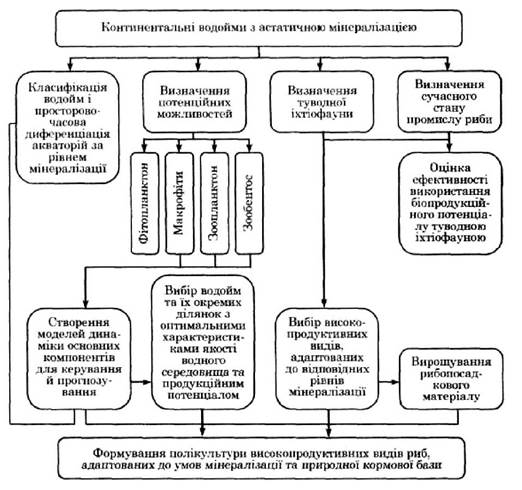
Commercial fish production technology scheme
The authors consider the proposed developments merely as a foundation that requires further research. The latter, in turn, will allow for the final elaboration of A number of provisions and necessary elements to create a comprehensive fish farming technology in conditions and water areas that have hitherto been practically unused in aquaculture.
As a result of the conducted research, information was obtained that made it possible to formulate the provisions given below.
- Continental water bodies of southern Ukraine located in the immediate vicinity of the Azov and Black Seas are characterized by elevated water salinity levels and astatism, which exhibits seasonal, annual, and long-term dynamics.
- The presence of waters with varying degrees of mineralization and, accordingly, different densities determined by the nature of dominant natural processes leads to the formation of distinct salinity «patches» within the same water body, which are capable of migrating across the water area, as well as increasing or decreasing in surface area.
- It has been established that the hydroecosystems formed as a result of the genesis of the studied water areas are characterized by varying degrees of water mineralization. According to the proposed classification, the first class includes water bodies with a mineralization of 1.1 - 8.0 g/m (7132 ha), the second class — 8.1 - 12.0 g/ m (1420 ha), the third class — up to 25.0 g/ m (16 230 ha), and the fourth class — over 25 g/ m (6815 ha).
- Based on the development level of producers and consumers (excluding fish) during the Development of the classification, continental water bodies with astatic water mineralization were categorized by the biomass of major hydrobiont groups. Highly productive water bodies with a mid-season phytoplankton biomass of 8.0 — 16.0 g/m include those with a water mineralization of 5.0 - 8.0 g/ m covering an area of 2059 ha (67.6 %), while low-productive water bodies in terms of zooplankton biomass cover an area of 21780 ha (62.9 %). In terms of zoobenthos production, continental
water bodies with astatic mineralization are the most productive. Highly productive water bodies with a mid-season biomass production exceeding 16.0 g/m account for 95.5% of the studied group of water bodies, covering an area of 30152 ha.
- The composition of the ichthyofauna in coastal water bodies indicates that it is represented by marine fish species that enter these unique ecosystems as a result of temporary channels connecting them to the Azov-Black Sea basin or during storms, as well as freshwater species originating from small rivers and irrigation systems.
- The water bodies feature a significant biological production potential, represented by producers and consumers across various trophic levels, which currently remains largely unrealized due to a combination of objective and subjective factors.
- The potential capacity of continental water bodies, given the composition of their native and spontaneously formed ichthyofauna, cannot be fully realized due to the lack of effective consumers capable of converting food resources into a reliable forage base.
- Due to the lack of conditions for the natural reproduction of many valuable fish species in the studied water areas, it is advisable to initiate large-scale reproduction and rearing of appropriate stocking material to support fish farming technologies based on the pasture aquaculture model.
Summarizing the above, It is worth noting that amidst a genuine scarcity of land and water resources, pasture aquaculture can be implemented beyond specialized ponds alone. It is both feasible and promising to integrate water bodies of diverse origins and designated purposes into fishery operations for pasture aquaculture, including freshwater, brackish water, and water characterized by astatic mineralization.
This perspective on the objectively existing global challenge of land and water resources will significantly broaden the horizons of pasture aquaculture in fish farming.
Last update: 08/08/2026
Editorial and Educational Adaptation: This material has been compiled based on the primary/original source text. The project team performed an editorial review, corrected technical inaccuracies, structured sections, and adapted the content for an educational format.
What was processed:
- elimination of formatting defects (OCR errors, structural breaks, corrupted characters);
- editorial organization of content;
- standardization of terminology in accordance with academic sources;
- verification of factual statements against the original source text.
All mentions of the author, publication year, and origin of the primary text have been preserved in accordance with the source.