BOTANY WITH BASICS OF HYDROBOTANY (AQUATIC PLANTS OF UKRAINE) - B.Ye. Yakubenko - 2011
VI. THE PLANT WORLD SYSTEM
LOWER SPORE PLANTS
GENERAL CHARACTERISTICS AND FEATURES
Order Nostocales
Combines multicellular, often colonial heterocystous algae with an optimally developed dense mucilage and unbranched trichomes inhabiting continental water bodies, seas, and soils; capable of fixing atmospheric nitrogen and playing a rather important role in the overall nitrogen cycle; some species are causative agents of water "blooms". Characteristic features include the type and nature of filaments and trichomes, the presence of branching and mucilaginous sheaths, and the specifics of colony formation (Fig. 13).
Genus Anabaena - Anabaena (Fig. 13) - free-floating, planktonic, and benthic, occasionally soil-dwelling filamentous forms that act as causative agents of Water "blooms" in slow-flowing water bodies. Filaments are straight or multidirectionally curved, single or in clusters, unbranched, symmetrical and uniform along their entire length, consisting of rounded or barrel-shaped vegetative Cells, as well as intercalary heterocysts, often with akinetes. Vegetative cells contain gas vacuoles, making them appear dark; heterocysts are thick-walled, colorless, with a homogeneous content; akinetes have thickened walls and granular content with nutrient reserves. Reproduction occurs via hormocytes and hormogonia formed As a result of filament fragmentation at the site of heterocysts.
Class="center">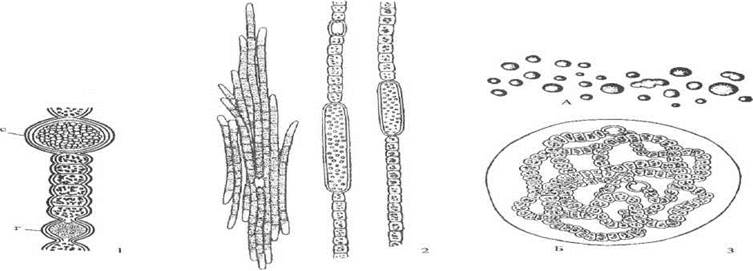
Fig. 13. General appearance of the thallus in representatives of Nostocales:
1 - Anabaena sp., 2 - Aphanizomenon flos-aquae, 3 - Nostoc commune: A - macroscopic colonies; B - microscopic Structure OF THE colony
Some species are dangerous causative agents of water "blooms" (Anabaena flos-aquae, A. scheremetievi, A. spiroides) and are toxic. At the same time, most species are capable of fixing atmospheric nitrogen and are used in soil algolization.
Genus Aphanizomenon - Aphanizomenon - free-floating planktonic forms that cause water "blooms" in slow-flowing water bodies, occasionally in seas, forming filament clusters in the form of needle-like structures, bundles, or crusts, and reaching macroscopic sizes. Filaments are straight or curved, with pronounced Cell Differentiation. Apical cells are colorless, elongated, and tapered, while central vegetative cells are filled with numerous gas vacuoles, appear dark, and alternate with single intercalary heterocysts and akinetes.
Species of this genus are dangerous causative agents of water "blooms" (typically Aphanizomenon flos-aquae) and are toxic. They are important producers of organic matter in water bodies. In fish pond aquaculture, their growth is stimulated by the application of potassium and phosphorus fertilizers to the water.
Genus Nostoc - Nostoc (Fig. 13) - mucilaginous colonial forms, sometimes reaching macroscopic sizes (up to several centimeters), widely distributed in freshwater bodies and on soil. Colonies are formed by multidirectionally intertwined or radially arranged trichomes embedded in a homogeneous mucilage. Vegetative cells are symmetrical and uniform along their entire length, rounded or barrel-shaped, noticeably constricted near the septa, lacking gas vacuoles, but possessing intercalary heterocysts. Reproduction occurs through hormogonia, akinetes, budding, and colony fragmentation.
Edible species (e.g., Nostoc flagelliforme) and nitrogen-fixing species are known. The spherical plum-like nostoc (Nostoc pruniforme) often develops on the bottom of water bodies, while common nostoc (Nostoc commune) is a typical representative of epigeic growths.
Last update: 07/08/2026
Editorial and Educational Adaptation: This material has been compiled based on the primary/original source text. The project team performed an editorial review, corrected technical inaccuracies, structured sections, and adapted the content for an educational format.
What was processed:
- elimination of formatting defects (OCR errors, structural breaks, corrupted characters);
- editorial organization of content;
- standardization of terminology in accordance with academic sources;
- verification of factual statements against the original source text.
All mentions of the author, publication year, and origin of the primary text have been preserved in accordance with the source.