BOTANY WITH THE BASICS OF HYDROBOTANY (AQUATIC PLANTS OF UKRAINE) - B.Ye. Yakubenko - 2011
X. SEED PLANTS
Rush Family (Juncaceae)
Perennials, rarely annuals; leaves linear or cylindrical, sheathing. Inflorescence a corymb, panicle, HEAD, or cyme. Perianth 6-merous, membranous or coriaceous. Stamens 6 or 3; gynoecium of 1 or 3 carpels; Ovary superior. Floral formula: *Р3+3А3+3(3)G10. Fruit a capsule.
The flora of Ukraine includes two genera, of which only one genus, the rush (Juncus), is found in bogs.
Rush (Juncus) is the largest genus, with over 250 species worldwide, and 27 species in Ukraine. Rushes are mostly perennials with thickened, cylindrical, flat, or subulate leaves. Leaves have open sheaths. The inflorescence is terminal, racemose or cymose. The fruit is a three-sided, many-seeded capsule. Rushes mostly grow in floodplain and mountain meadows, bogs, along the shores of Water bodies, and some on salt marshes and saline soils. In places, they form dense stands, but only the bulbous rush is of practical importance.
Bulbous rush (J. bulbosus L.). A plant with an erect or ascending stem, branched in the upper part, 2-15 (40) cm tall, bulbously thickened at the base, forming small tufted clumps (Fig. 189). Leaves are cylindrical, basal ones shorter than stem leaves, 3-11 cm long. Upper leaves have a thin blade, 0.5 mm wide. Sheath leaves have long, obtuse auricles. There are one or two stem leaves, which are shorter than the inflorescence. Flowers are clustered on the inflorescence branches, bisexual; tepals are light brown or greenish. Stamens three. Bracts are membranous, slightly longer than the perianth; it flowers in May–June. The fruit is an oblong capsule with a short beak.
Class="center">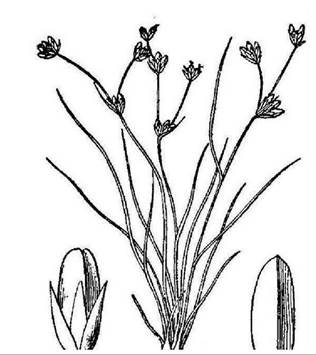
Fig. 189. Bulbous rush
It grows in forest bogs, marshy meadows, ditches, and small ponds. Sensitive to desiccation. Sporadically distributed in Polissia, rarely in Transcarpathia. Listed in the Red Data Book of Ukraine.
An ornamental, forage, and shore-protecting plant. All rushes are of low forage quality for aquatic fauna; in the absence of other food plants, they may be consumed during bog flooding by some fish, particularly grass carp.
Other rush species distributed in Ukraine are of low economic value: jointed rush (J. jamprocarpus Ehrh. et Hoffm), distinguished by its shiny nutlets and cylindrical cauline and basal leaves; round-fruited rush (J. compressus Jacg), which has a loose umbel-like inflorescence; compact rush (J. conglomeratus L), a tall plant with a capitate inflorescence; hard rush (J. inflexus L) with a ridged, easily compressible stem; soft rush (J. Effuses L.) with leafless, smooth, soft, sometimes decumbent stems; sand rush (J. tenageia Ehrh. et L) which has sheath leaves with two auricles at the base and channeled, linear-subulate leaf blades; and dark-flowered rush (J. aratus Krock) with dark brown, shiny tepals.
Last update: 07/08/2026
Editorial and Educational Adaptation: This material has been compiled based on the primary/original source text. The project team performed an editorial review, corrected technical inaccuracies, structured sections, and adapted the content for an educational format.
What was processed:
- elimination of formatting defects (OCR errors, structural breaks, corrupted characters);
- editorial organization of content;
- standardization of terminology in accordance with academic sources;
- verification of factual statements against the original source text.
All mentions of the author, publication year, and origin of the primary text have been preserved in accordance with the source.