BOTANY WITH BASICS OF HYDROBOTANY (AQUATIC PLANTS OF UKRAINE) - B.Ye. Yakubenko - 2011
X. SEED PLANTS
Family Mare's Tail (Hippuridaceae)
Perennial semi-submerged or fully submerged, occasionally terrestrial plants with a creeping, jointed rhizome giving rise to numerous hollow, sturdy, unbranched stems. Phyllotaxy is whorled. Leaves are linear, entire, 1-9 cm long, up to 1-2 mm wide, arranged in whorls of 6-12. Flowers are bisexual, rarely unisexual, extremely small, sessile, solitary in the leaf axils. The calyx is green, petals are absent, and There is a single stamen. The Ovary is inferior, unilocular, with a single style. The fruit is a drupe, oval with a truncate apex, about 2 mm long and 1 mm wide. The stamen and styles persist near the fruit. Floral formula: for bisexual flowers - *P4A1G(2), for unisexual flowers - ♀G(2), ♂А1.
It comprises three species belonging to a single genus, distributed across Europe, Asia, Australia, North America, and Greenland; only one species occurs in Ukraine.
Common mare's-tail (Hippuris lanceolata Retz., H. vulgaris L.). A perennial herbaceous plant, 10-45 cm tall, half-submerged in Water, glabrous; hydro-ochthophyte, anemophilous, hydrochore, ornithochore (Fig. 142). The rhizome is hypogeogenic, plagiotropic, creeping, jointed, rooting at the nodes. Flowers are solitary in the leaf axils, sessile, small, bisexual or unisexual (lower flowers are pistillate, upper ones are staminate).
Class="center">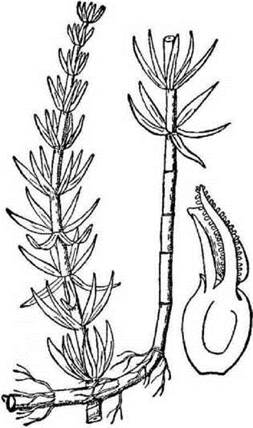
Fig. 142. Common mare's-tail
Petals are developed. The ovary is inferior, unilocular; the style is filiform, and the stigma is red. It blooms from June to August. It reproduces by rhizomes and seeds.
Two forms are known: f. fluviatilis (Hoffm.) Guss. et Germ. – a semi-submerged or fully submerged plant, and f. terrestris Schwarz. – a terrestrial plant.
An ornamental (for ponds) and medicinal (in folk medicine) plant. It serves as a food source for freshwater gastropods and lepidopteran insects.
It grows in marshes, rivers, lakes, ponds, and damp meadows throughout Ukraine, except for the Wormwood Steppe zone. In Crimea, it is rare as an introduced plant (Staryi Krym, Sutash pond).
Last update: 07/08/2026
Editorial and Educational Adaptation: This material has been compiled based on the primary/original source text. The project team performed an editorial review, corrected technical inaccuracies, structured sections, and adapted the content for an educational format.
What was processed:
- elimination of formatting defects (OCR errors, structural breaks, corrupted characters);
- editorial organization of content;
- standardization of terminology in accordance with academic sources;
- verification of factual statements against the original source text.
All mentions of the author, publication year, and origin of the primary text have been preserved in accordance with the source.