BOTANY WITH BASICS OF HYDROBOTANY (AQUATIC PLANTS OF UKRAINE) - B.Ye. Yakubenko - 2011
X. SEED PLANTS
Family Water-milfoil (Haloragaceae)
Perennial aquatic, marsh, or terrestrial herbs with simple, occasionally branched, tubular stems densely covered with leaves.
Phyllotaxy is whorled. Leaves are pectinate-pinnatifid, with opposite, filiform, mostly entire segments. Flowers are small, unisexual (plants monoecious) and bisexual, alternate, solitary or in whorls, arranged in terminal interrupted spike-like inflorescences that emerge above the Water surface during flowering. The terminal flowers in the inflorescence are staminate, the middle ones bisexual, and the lower ones pistillate. There are four sepals and petals, and four to eight stamens. The Ovary is inferior, four-locular, with four stigmas. Floral formula: bisexual - *K4C4A4-8O(4), unisexual - ♀*K4C4C(4), * ♂K4 C4A4-8. The fruit is drupaceous, breaking down into four nutlets.
The family comprises 7 genera and about 130 species, distributed globally in aquatic habitats, especially in Australia. In Ukraine, the family is represented by three species of a single genus.
Alternate-flowered water-milfoil (Myriophyllum alterniflorum DC.). A perennial herb, 30-200 cm long, hydrophyte, anemophile, barochore, hydrochore. Rhizome plagiotropic, slender. Stems slender, unbranched or rarely sparingly branched, light green, with sparse brown warts, densely leafy. Submerged leaves are pectinate-pinnatifid, with Hair-like, smooth, entire segments arranged in whorls of four; aerial bracteal leaves are entire and alternate. The spike-like inflorescence is 0.5-3 cm long, nodding before flowering, with alternately arranged unisexual small flowers. The lower flowers in the inflorescence are pistillate, arranged in whorls or opposite, while the upper ones are staminate and alternate. Petals are pink, deciduous. In staminate flowers, petals are up to 2.5 mm long, 5-6 times longer than the calyx; in pistillate flowers, they are about 0.5 mm long. The fruit is a four-locular drupe, smooth, about 1.5 mm long. Flowers near the water surface from June to September. It reproduces predominantly vegetatively, and less frequently by seeds.
Extremely rare in Polissia and the Forest-Steppe regions. It grows in oligotrophic and mesotrophic, freshwater, standing and slow-flowing waters at a depth of 50-100 (150) cm.
Class="center">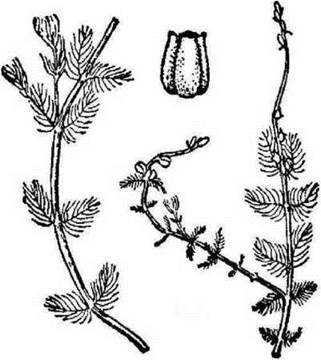
Fig. 141. Spiked water-milfoil
Whorled water-milfoil (Myriophyllum verticillatum L.). A perennial herb, 10-150 (300) cm long, anemophile, barochore, hydrochore (Fig. 141). Rhizome plagiotropic, up to 20 cm long, with numerous adventitious fine rootlets. Stems simple or sparingly branched, yellowish or brownish-green, fragile. Leaves 20-40 cm long, in whorls of (four) five to six, pectinate-pinnate, with filiform oppositely arranged segments. Bracts resemble the leaves, pectinate-pinnatifid, one adjacent to each flower. Lower bracts are longer than the flowers, while upper ones equal them in length. Inflorescence is a spike-like, interrupted raceme, 5-16 cm long. Flowers are small, arranged in whorls of four to six; unisexual and bisexual, the upper ones staminate, the middle ones pistillate-staminate, and the lower ones pistillate. Petals of the upper staminate and lower pistillate flowers are white or greenish, while those of the middle bisexual flowers are white or pink. The fruit is drupaceous, 2-2.5 mm long, rounded, smooth, with a small tubercle at the base. It flowers above the water surface from June to August. It reproduces vegetatively via rhizome fragments, vegetative shoots capable of forming adventitious roots, and turions, and less frequently by seeds.
The plant serves as a food source for stem nematodes (tylenchids), gastropod Mollusks (mileniids), and weevils.
It grows in freshwater standing and slow-flowing water bodies, lakes, rivers, and marshes at a depth of 20-150 (200) cm, often forming dense thickets. When water bodies dry up, it produces terrestrial forms on damp soils and banks. It is widespread throughout Ukraine, except for the Wormwood Steppe regions.
Spiked water-milfoil (Myriophyllum spicatum L.). A perennial herb, submerged and anchored to the bottom of the water body, 30-150 (300) cm long, anemophile, barochore, hydrochore. Rhizome creeping, branched, up to 30 cm long, producing white filiform adventitious roots at the lower nodes. Stem erect, terete, flexible, branched, whitish or light green, up to 4 mm in diameter, densely leafy. Leaves are pinnatifid, 15-30 mm long, with filiform segments. Phyllotaxy is whorled, with four (five) leaves per whorl. The inflorescence is spike-like, 3-10 cm long, polygamous, interrupted, with spaced flowers, emerging above the water surface during flowering. Flowers are small. Bracts number three per flower: those near the upper staminate flowers are entire and shorter than the flowers. Flower petals are pale pink. The fruit is drupaceous, tuberculate, 2.5-3 cm long. It flowers from June to August.
The plant contains a high amount of silica and is used for polishing. It serves as food for freshwater crustaceans, gastropod mollusks (pond snails), amphipods, leaf beetles, micromoths, cyprinid fish, and nutrias.
It grows in freshwater and slightly mineralized standing and slow-flowing waters, in ponds and lakes, at a depth of 25-200 cm, occasionally forming dense thickets. It is widespread across Ukraine, while in the Crimean region it occurs only in the steppe areas near the Sivash.
Last update: 07/08/2026
Editorial and Educational Adaptation: This material has been compiled based on the primary/original source text. The project team performed an editorial review, corrected technical inaccuracies, structured sections, and adapted the content for an educational format.
What was processed:
- elimination of formatting defects (OCR errors, structural breaks, corrupted characters);
- editorial organization of content;
- standardization of terminology in accordance with academic sources;
- verification of factual statements against the original source text.
All mentions of the author, publication year, and origin of the primary text have been preserved in accordance with the source.