BOTANY WITH BASICS OF HYDROBOTANY (AQUATIC PLANTS OF UKRAINE) - B.Ye. Yakubenko - 2011
X. SEED PLANTS
Primrose Family (Primulaceae)
Perennial, more rarely annual herbaceous plants, and very rarely shrubs or trees. Leaves simple, without stipules, often gathered in a basal rosette. Inflorescence an umbel. Flowers bisexual, actinomorphic, mostly pentamerous (rarely tetramerous or heptamerous), sympetalous, often heterostylous, entomophilous; with bracts or an involucre around the umbels, occasionally sessile. Corolla sympetalous, rarely almost parted to the base, with a long tube and a distinct limb. Stamens five, located in the tube or throat of the corolla, positioned opposite the lobes of the limb, free or united by filaments into a ring. Sometimes stamens alternate with staminodes that have the shape of Teeth or scales. Ovary superior, occasionally semi-inferior, unilocular with numerous ovules. Style simple, stigma capitate. Floral formula: *K(5)C(5)A5G(5). Fruit a capsule.
The family comprises 25 genera and over 1,000 cosmopolitan species, which are predominantly distributed in the temperate zone of the Northern Hemisphere. In Ukraine, the family is represented by 14 genera and 35 species.
Yellow loosestrife (Lysimachia vulgaris L.). A perennial plant, 50-120 cm tall; uliginosophyte, entomophile, barochor (Fig. 119).
Rhizome creeping, with long subterranean shoots. Stem erect, unbranched in the upper part, leaf arrangement whorled (three to four leaves per whorl) or opposite. Leaves short-petiolate, ovate-lanceolate, entire, acute at the apex, pubescent on the lower side, 6-10 cm long, 1-1.5 cm wide.
Inflorescence a pyramidal panicle. Flowers bisexual, actinomorphic, perianth double, pentamerous. Sepals ovate-lanceolate, dark brown along the margin, short-Ciliate; corolla yellow, 20-33 mm in diameter, non-glandular along the margin, with a small tube and a rotate limb. Androecium monadelphous, stamens connate by the base of their filaments. Fruit a globose capsule, dehiscing by Valves. Flowers in June-July.
Grows on banks and in shallow waters of rivers, lakes, ponds, reservoirs, in marshes, waterlogged meadows, and alder swamps throughout Ukraine.
An ornamental, honey-producing, and medicinal plant. It serves as food for leaf beetles, weevils, fish of the carp family (Cyprinidae), and beavers.
Garden yellow loosestrife (Lysimachia punctata L.). A perennial plant, 30-100 cm tall (Fig. 120). Leaves three to four in whorls, ovate-lanceolate or lanceolate, acute, sessile or with extremely short petioles. Flowers in axillary whorls, two to four on short pedicels. Flowers in June-August. Grows in damp meadows, forest clearings, and along riverbanks in Transcarpathia, the Right-Bank Ukraine, and occasionally in parks of Khmelnytskyi, Vinnytsia, and Kyiv Oblasts.
Class="center">Water/water.files/image120.jpg" width="231"/>
Fig. 119. Yellow loosestrife
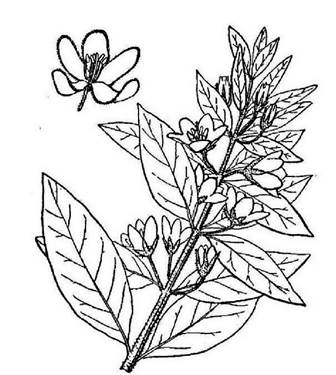
Fig. 120. Garden yellow loosestrife
Tufted loosestrife (Naumburgia thyrsiflora (L.) Reichenb.). A perennial herbaceous plant, 30-60 cm tall; uliginosophyte, entomophile, anemochor, hydrochor. Rhizome with long subterranean shoots, hypogeogenous, creeping, branched. Thanks to the rhizome, it easily propagates vegetatively, forming dense thickets. Stem erect, pubescent with sparse reddish hairs or glabrous. Leaves 5-10 cm long, 0.5-1.5 cm wide, sessile, entire, narrow-lanceolate, stem-clasping, with dark dots, pubescent on the lower side along the midrib, which decurrently extends onto the stem with reddish hairs. In the lower part of the stem, leaves are reduced to membranous scales. Leaf arrangement opposite.
Inflorescence dense racemes, 1.5-3 cm long, located in the leaf axils in pairs in the middle part of the SHOOT. Flowers bisexual, actinomorphic, perianth double, calyx and corolla divided to the base into five (six to seven) narrow lobes. Sepals linear. Corolla petals golden-yellow, 4-5 mm long, with five to seven linear lobes. Flowers in June-July. Fruit a globose capsule, dehiscing by valves. Propagates by rhizomes and seeds.
Grows in bogs, along marshy riverbanks, in waterlogged meadows, and in ditches in Polissia and the Forest-Steppe zone.
Water violet (Hottonia palustris L.). A perennial, submerged herbaceous plant, 20-60 (200) cm tall (Fig. 121). Rhizome plagiotropic, branched, up to 20 cm long. Photosynthetic shoots ascending, 2.5-5 mm in diameter. Leaves whorled, pectinately pinnatisect into narrow-linear, acute segments that gradually decrease in size toward both the apex and the Base of the leaf blade.
Flowers bisexual, actinomorphic, with a double perianth, pentamerous, 15(20) mm in diameter. Calyx five-toothed, persistent in fruit. Corolla funnel-shaped, white or pale pink, with a yellow throat and elongated obtuse lobes. Stamens five; gynoecium syncarpous, composed of five carpels; heterostyly pronounced. Flowers arranged in groups of three to six in whorls, gathered into racemes at the apex of a leafless scape. Fruit a capsule, 5 mm long, 3 mm wide, dehiscing by valves. Flowers above the water surface in June-July.
The plant can form a terrestrial growth form if water bodies dry up. In such a form, the leaf whorls are closer together, and the leaf segments are thicker. Propagates vegetatively (via rhizomes, overwintering buds) and by seeds. Vegetative propagation predominates.
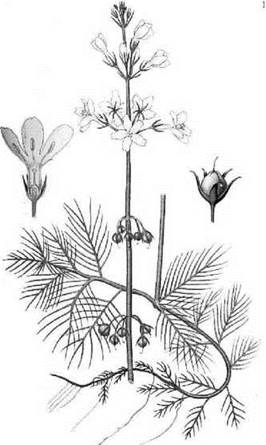
Fig. 121. Water violet
Water violet is consumed by gastropod Mollusks (pond snails, Physidae, ramshorn snails, river snails, Hydrobiidae, Melanopsidae), amphipods, and narrow-winged moths.
Grows in waterlogged floodplain forests, streams, drainage channels, and lakes in Polissia, the Forest-Steppe (sporadically), Prykarpattya, Transcarpathia, and the Steppe (rarely).
Last update: 07/08/2026
Editorial and Educational Adaptation: This material has been compiled based on the primary/original source text. The project team performed an editorial review, corrected technical inaccuracies, structured sections, and adapted the content for an educational format.
What was processed:
- elimination of formatting defects (OCR errors, structural breaks, corrupted characters);
- editorial organization of content;
- standardization of terminology in accordance with academic sources;
- verification of factual statements against the original source text.
All mentions of the author, publication year, and origin of the primary text have been preserved in accordance with the source.