BOTANY WITH THE BASICS OF HYDROBOTANY (AQUATIC PLANTS OF UKRAINE) - B.Ye. Yakubenko - 2011
X. SEED PLANTS
Family Pink Family (Caryophyllaceae)
Perennial herbs or subshrubs, less commonly annuals. Leaves sessile, rarely petiolate. Phyllotaxy opposite, rarely alternate. Flowers regular, with a double 5-merous perianth, petals notched or bifid at the apex, inflorescence a dichasium. Stamens ten (sometimes five); pistil formed of two to five carpels, Ovary superior. Fruit usually a capsule, less frequently a nutlet or berry.
Comprises 70 genera and over 2000 species, distributed mainly in the temperate zone. In the flora of Ukraine, the family is represented by 35 genera and 212 species.
Fleshy Starwort (Stellaria crassifolia Ehrh.). Perennial herbaceous plant, 20-70 cm tall; uliginosophyte, entomophilous, hydrochore, anemochore, zoochore (Fig. 114). Rhizome plagiotropic. Stems numerous, weakly branched, prostrate or ascending. Phyllotaxy opposite. Leaves ovate- or elliptic-lanceolate, acute, thickish, glabrous, 5-15 mm long, 2-5 mm wide.
Flowers bisexual, solitary or two per peduncle, occasionally in a dichasial inflorescence. Perianth double, actinomorphic, calyx and corolla 5-merous. Sepals 2-3.5 mm long, petals 1.5 times longer than the sepals, bifid almost to the base. Androecium of ten stamens, gynoecium of three fused carpels. Floral formula: *K5C5A10G(3). Fruit a capsule, ovate-oblong, 4-5 mm long. Blooms in June–August. Propagates vegetatively and by seeds.
Occurs in wet meadows and bogs, sporadically in Polissia and the Forest-Steppe; rare in the Steppe.
Marsh Stitchwort (Stellaria palustris Retz.). Perennial herbaceous plant, 20-40 cm tall; uliginosophyte, entomophilous, hydrochore, anemochore (Fig. 115). Rhizome plagiotropic, slender, long. Stems orthotropic, quadrangular, simple. Leaves linear-lanceolate, gray-green, glabrous, narrow, 20-30 mm long, 3-4 mm wide.
Class="center">Water/water.files/image115.jpg" width="244"/>
Fig. 114. Fleshy Starwort

Fig. 115. Marsh Stitchwort
Inflorescence a dichasium. Flowers bisexual, perianth double, actinomorphic. Petals longer than the sepals, rarely equal to them. Anthers red. Fruit an oblong-ovate capsule, up to 5 mm long. Blooms in June–August. Propagates vegetatively and by seeds.
Grows in wet meadows, peat bogs. In Ukraine, it occurs in Polissia and the Forest-Steppe; rare in the Steppe.
Water Chickweed (Myosoton aquaticum (L.) Moench). Perennial herbaceous plant, 20-70 cm tall; uliginosophyte, entomophilous, hydrochore, anemochore, zoochore (Fig. 116).
Rhizome plagiotropic, slender. Stems prostrate or ascending, fork-branched, glandular-pubescent. Phyllotaxy opposite. Lower leaves short-petiolate, upper sessile, cordate-ovate, acute. Plants glabrous below, glandular-pubescent toward the apex.
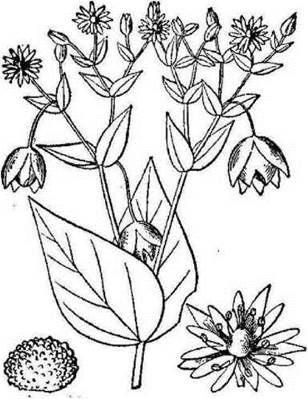
Fig. 116. Water Chickweed
Inflorescence a dichasium. Flowers bisexual. Perianth double, 5-merous, actinomorphic, sepals obtuse, glandular-pubescent, 4-6 mm long. Corolla of five white petals, cleft twice to the base, one and a half to two times longer than the sepals. Androecium of ten stamens, gynoecium syncarpous, of five carpels. Stigma trifid.
Pedicels reflexed after flowering. Floral formula: *K5C5A10G(5). Fruit a capsule opening with five bifid Teeth. Blooms in June–September.
The plant serves as food for leaf beetles, gastropod Mollusks, particularly pond snails.
Grows along the banks of water bodies, wet and waterlogged meadows, bogs across almost all of Ukraine, rare in Transcarpathia and the Carpathians.
Last update: 07/08/2026
Editorial and Educational Adaptation: This material has been compiled based on the primary/original source text. The project team performed an editorial review, corrected technical inaccuracies, structured sections, and adapted the content for an educational format.
What was processed:
- elimination of formatting defects (OCR errors, structural breaks, corrupted characters);
- editorial organization of content;
- standardization of terminology in accordance with academic sources;
- verification of factual statements against the original source text.
All mentions of the author, publication year, and origin of the primary text have been preserved in accordance with the source.