BOTANY WITH THE BASICS OF HYDROBOTANY (AQUATIC PLANTS OF UKRAINE) - B.Ye. Yakubenko - 2011
VIII. BASICS OF PLANT MORPHOLOGY AND ANATOMY
Features of angiosperm reproduction
Fruits and their classification
A fruit is a Water/141.html">Generative or reproductive organ associated with the function of sexual reproduction; it is an organ of seed propagation. The fruit develops from the Ovary. Fruits formed solely from the ovary are called true fruits. If not only the ovary, but also other flower elements participate in fruit formation, they are called accessory (false) fruits.
The pericarp (fruit wall) develops from the walls of the ovary. It is differentiated into three layers: the outer layer - the exocarp; the middle layer - the mesocarp; and the inner layer - the endocarp. The exocarp appears as a thin Skin in tomatoes, cherries, apples, and plums. The endocarp also forms a thin layer: it is stony in stone fruits (drupes) and leathery in pome fruits. The greater part of the fruit is occupied by the mesocarp. This very part of succulent fruits, formed by the mesophyll of the ovary walls, accumulates nutrients and is consumed by humans and animals.
The pericarp contains varying amounts of moisture. Depending on its content, dry and succulent fruits are distinguished. Dry fruits are those in which the hygroscopic moisture content in the pericarp is up to 15%, whereas if it is 15-95%, such fruits are considered succulent.
Based on their Structure, simple and aggregate (complex) fruits are distinguished. The former develop from a flower with a single pistil and ovary (sweet cherry, plum). If a flower contains several or many pistils, and consequently Ovaries, each forming a separate fruitlet, an aggregate fruit develops from it (raspberry, blackberry, buttercup, hound's-Tongue, marsh marigold).
When fruits are formed not from a single flower, but from an entire inflorescence, multiple fruits (infructescences) are produced (mulberry, pineapple, beet glomerules). Here, all the fruitlets grow together, forming a compact cluster.
Fruit Classification. According to morphological classification, fruits are divided into dry and succulent, simple and aggregate.
Dry fruits. These are characterized by a dry, woody, leathery, or membranous pericarp. Simple dry fruits are dehiscent, indehiscent, and schizocarpic.
Dehiscent dry fruits are those containing at least two seeds. Upon ripening, the fruits open, and the seeds shed from them. These include the following fruits (Fig. 87):
Follicle - a unilocular fruit formed by the participation of a single carpel. The fruit opens along a single suture (the ventral suture). Follicles are frequently found in Ranunculaceae (larkspur, aconite, peony).
Legume (pod) - a unilocular fruit formed by the participation of a single carpel. It opens by two Valves along the ventral and dorsal sutures, of which only the ventral one is true (common bean, pea).
Class="center">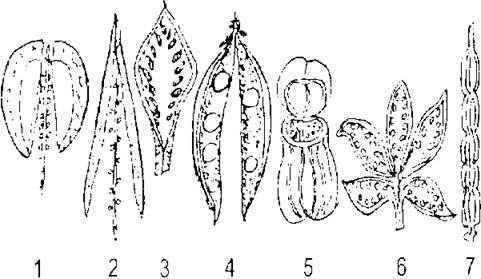
Fig. 87. Dehiscent and breaking fruits:
1 - silicle, 2 - silique, 3 - follicle, 4 - legume, 5 - capsule, 6 - aggregate follicle,
7 - jointed silique.
Silique - a bilocular, multi-seeded fruit formed by two carpels. The length of the silique is several times greater than its width. The fruit is divided by a false septum. It is formed from the fundamental tissue of the ovary walls rather than the carpel walls. Numerous seeds are attached to the septum. The silique opens from bottom to top by two valves (rapeseed, treacle mustard, wallflower, stock, rockcress).
Silicle - a fruit similar to a silique, but its length and width are equal or its width is 3/4 of its length (shepherd's purse).
Capsule - a multi- or unilocular fruit formed by two to many carpels. It has the following adaptations for seed dispersal: pores (poppy), a lid (henbane), valves (datura), Teeth (stichwort). Indehiscent dry fruits (Fig. 88).
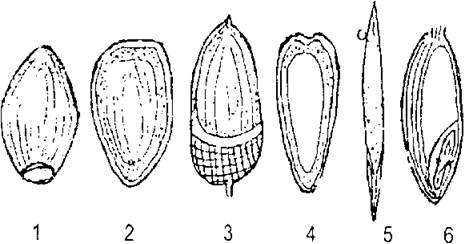
Fig. 88. Simple dry indehiscent fruits:
1 - nut, 2 - nut in cross-section, 3 - acorn, 4 - achene, 5 - samara, 6 - caryopsis
Achene - a single-seeded, unilocular fruit formed predominantly from two carpels. Its characteristic feature is that it forms a leathery pericarp that does not fuse with the seed coat (sunflower, dahlia).
A caryopsis is a single-seeded fruit also formed by two carpels, which differs from an achene in that the membranous pericarp fuses with the seed coat. Such fruits are characteristic of many cereal crops.
A nut is a single-seeded fruit formed with the participation of two carpels. The pericarp is stony or woody and does not fuse with the seed coat (e.g., in hazelnuts). If the nut is surrounded by a cupule formed from fused bracts, the fruit is called an acorn (e.g., in oaks).
A nutlet is a single-seeded fruit similar to a true nut, but much smaller in size (found in buckwheat, linden, and sorrel).
A samara is a single-seeded fruit that develops from one or two carpels. The pericarp is dry, leathery, or membranous, forming a wing-like structure that AIDS in seed dispersal, occurring either singly (as in ash) or as a disamara (as in maple).
Simple fleshy fruits. Their pericarp contains about 95% hygroscopic moisture. These include the following types (Fig. 89):
Fig. 89. Fleshy fruits:
1 - drupe: a - exocarp, b - mesocarp, c - endocarp, d - seed,
2 - berry, 3 - aggregate drupe, 4 - pome, 5 - false fruit of rose hips.
A drupe is a single-seeded, single-loculed fruit formed from one or more carpels. The pericarp is differentiated: the exocarp is thin and leathery; the mesocarp is well-developed and fleshy; the endocarp is thin, woody, and composed of sclerenchymatous stone Cells. Hence, these are commonly referred to as stone fruits. An exception is the walnut fruit, in which the outer layer is fleshy and deciduous.
A berry is a fleshy, multi-seeded fruit in which both the endocarp and mesocarp are fleshy, while the exocarp is leathery (e.g., in grapes, tomatoes, and currants). The pericarp develops from one or multiple carpels.
A pepo is a fleshy, multi-seeded fruit formed from three carpels. Similar to a berry, its mesocarp and endocarp are fleshy, whereas the exocarp is colored, hard, and frequently woody (as in pumpkins and watermelons).
A pome is an accessory multi-seeded fruit formed by several carpels. The pericarp is differentiated into a leathery exocarp, a fleshy mesocarp, and a cartilaginous (pearly) endocarp (found in apples). The bases of the androecium and perianth also take part in forming the fruit.
Aggregate, or multiple fruits. These develop from flowers that possess multiple pistils and, consequently, multiple ovaries.
Dry aggregate fruits. An aggregate follicle is a fruit formed from an apocarpous flower where each separate ovary develops into a simple follicle (as in globeflowers and larkspurs).
An aggregate nutlet is a multi-seeded apocarpous fruit in which each individual nutlet is formed by a single carpel within a multi-pistil flower (e.g., buttercup).
An aggregate achene is a multi-seeded apocarpous fruit in which each individual achene is formed by a separate carpel on a shared receptacle (e.g., cinquefoil).
Fleshy aggregate fruits. An aggregate drupe (or etaerio of drupelets) is a multi-seeded apocarpous fruit in which individual drupelets are formed by separate carpels on a shared convex receptacle (e.g., raspberries and blackberries).
An aggregate achene (accessory fruit) is a multi-seeded, false fleshy fruit in which simple achenes, formed from individual carpels, are embedded in an enlarged, fleshy receptacle (e.g., strawberries).
Schizocarps are fruits in which the ovary splits longitudinally along the locules during maturation, producing two or more mericarps. Examples include a schizocarpic diachene (carrot), a tetranutlet (bugloss, hound's-tongue), and a disamara (maple).
Lomentaceous (segmented) fruits are those that develop from a single ovary and break apart into individual one-seeded segments upon ripening (e.g., radish). They feature constrictions that divide the fruit into single-seeded articles as it matures.
Last update: 07/08/2026
Editorial and Educational Adaptation: This material has been compiled based on the primary/original source text. The project team performed an editorial review, corrected technical inaccuracies, structured sections, and adapted the content for an educational format.
What was processed:
- elimination of formatting defects (OCR errors, structural breaks, corrupted characters);
- editorial organization of content;
- standardization of terminology in accordance with academic sources;
- verification of factual statements against the original source text.
All mentions of the author, publication year, and origin of the primary text have been preserved in accordance with the source.