BOTANY WITH THE BASICS OF HYDROBOTANY (AQUATIC PLANTS OF UKRAINE) - B.Ye. Yakubenko - 2011
VIII. BASICS OF PLANT MORPHOLOGY AND ANATOMY
Morphology and Anatomy of the Stem and Shoot
Stem Branching
Due to stem growth, accumulation of nutrients, and the need to increase the photosynthesizing leaf surface, the stem acquires The ability to branch. On the main trunk (axis of the first order), stems of the second order are formed by means of axillary buds, and on them – stems of the third order, and so on. As a result, axes of various orders can be distinguished in the crown of trees, shrubs, or perennial grasses. Branching follows certain regularities. There are four MAIN TYPES OF stem branching (Fig. 65).
Class="center">Water/water.files/image066.jpg" width="517"/>
Fig. 65. Diagram of branching types:
1 - sympodial, 2 - false-dichotomous, 3 - monopodial,
4 - dichotomous
Dichotomous branching is a type of branching in which the growing point divides into two new ones, giving rise to two stems whose apical growing points likewise fork into two new ones, initiating subsequent stems. Such branching can be repeated multiple times and is characteristic of clubmosses, Algae, and Fungi.
False-dichotomous branching is a type in which the growing point of the main axis (first order) is consumed in The formation of a flower or dies off, and stem branching occurs with the help of lower-positioned opposite lateral buds. The stems of such plants branch in this manner (mistletoe, lilac, chestnut, chickweed).
Monopodial branching is a type in which the apical bud of the first-order axis ensures the unlimited growth of the stem, which stands out in height and vigor among the mass of lateral branches (spruce).
Sympodial branching is characterized by the fact that the first-order axis terminates in Flower Formation or dies off, and stem growth is continued by the second-order axis, which arises from a lower-positioned bud. Upon its cessation, stem growth is continued by the third-order axis, which develops from a lower-positioned bud, and so on. This forms a zig-zag stem composed of axes, or sympudia, of the first, second, third, and subsequent orders (apple, plum, tomato, raspberry).
A special type of SHOOT branching is tillering in grasses. According to their tillering types, grasses are distinguished into: dense-tufted (mat-grass), loose-tufted (meadow grass), and rhizomatous (couch grass). In dense-tufted grasses, renewal buds on the tillering node are located above the soil surface or at its level and are closely spaced, resulting in a dense, tussocky sod due to The Emergence of numerous above-ground shoots. In loose-tufted grasses, the buds on the tillering node are located in the near-surface soil layer and spaced at an angle to each other, causing the above-ground shoots to form a loose tuft. In rhizomatous grasses, buds on the tillering node are freely distributed along a long horizontal rhizome located at varying depths in the near-surface soil layer. Therefore, the resulting shoots form at a certain distance from one another and do not form any significant dense sod (Fig. 66).
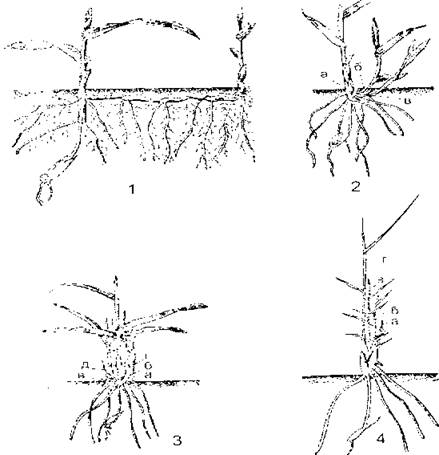
Fig. 66. Tillering of grasses:
1 - rhizomatous grass with adventitious and above-ground shoots; 2 - tillering diagram of a loose-tufted grass: a - first-order node, б - second-order node, в - third-order node; 3 - tillering diagram of a dense-tufted grass with shoots outside the leaf sheath: а, б, в, г, д - sequence of shoot formation; 4 - tillering diagram of a dense-tufted grass with shoots inside the leaf sheath: а, б, в, г - sequence of shoot formation
Last update: 07/08/2026
Editorial and Educational Adaptation: This material has been compiled based on the primary/original source text. The project team performed an editorial review, corrected technical inaccuracies, structured sections, and adapted the content for an educational format.
What was processed:
- elimination of formatting defects (OCR errors, structural breaks, corrupted characters);
- editorial organization of content;
- standardization of terminology in accordance with academic sources;
- verification of factual statements against the original source text.
All mentions of the author, publication year, and origin of the primary text have been preserved in accordance with the source.