BOTANY VOLUME 2 - PLANT PHYSIOLOGY - 2007
6. PHYSIOLOGY OF METABOLISM
6.14. Synthesis of Purines and Pyrimidines
Purines and Pyrimidines, the bases of Nucleic Acids (see Fig. 1.3), are synthesized as nucleoside monophosphates in Plastids and probably also in other compartments. The purine ring is formed step by step in this process (Fig. 6.110); its synthesis begins with 5-phosphoribosyl-1-pyrophosphate, which is also
a structural element of Tryptophan (see Fig. 6.107) and Histidine. Two of the four nitrogen atoms in the purine ring are supplied by glutamine (transamidation), one by aspartate (which is thereby converted into fumarate), and one is incorporated together with the carbon Skeleton of Glycine. One of the remaining carbon atoms in the ring is supplied by carboxybiotin (see Fig. 6.102), derived from CO2. The other two carbon atoms come from the primary C1 carrier, tetrahydrofolic acid, in the form of N10-formyltetrahydrofolate. Alongside formyl groups (—CHO), tetrahydrofolate also transfers methyl (—CH3) and hydroxymethyl (—CH2OH) groups for numerous other biosynthetic reactions, for instance, for the Synthesis of the Amino Acids Serine (see 7.5.6) and Methionine, as well as Alkaloids (see 6.16.3).
Class="center">Fig. 6.110. Biosynthesis of the purine ring and the sugar phosphate of adenosine-5’-monophosphate and guanosine-5'-monophosphate from inosine-5’-monophosphate (THF — tetrahydrofolic acid)

In Purine Biosynthesis, inosine-5'-monophosphate (IMP) is formed first. Through oxidation following transamidation, it is converted into guanosine-5'-monophosphate (GMP), or through transamidation alone into adenosine-5'-monophosphate (AMP) (see Fig. 6.110). Nucleoside mono- and nucleoside diphosphate Kinases generate triphosphates, ATP and GTP, from monophosphates via intermediate diphosphate formation. Deoxynucleotides are synthesized by ribonucleotide diphosphate reductase at the diphosphate stage. Electrons are supplied via a dithiol-disulfide transition. The enzyme is re-reduced by means of NADPH + H+ and thioredoxin (a similar reaction is shown in Fig. 6.71).
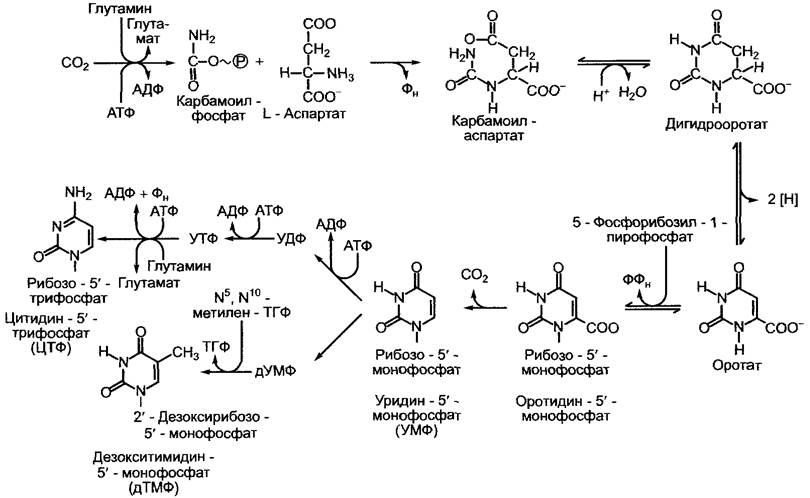
During pyrimidine biosynthesis (Fig. 6.111), the Condensation of carbamoyl phosphate and aspartate first yields orotic acid (orotate), which is converted into 5'-mononucleotide under the action of 5-phosphoribosyl-1-pyrophosphate. Decarboxylation yields uridine-5'-monophosphate (UMP). The latter is first converted into the triphosphate (UTP) and, following the exchange of oxygen at the C4 atom for an amino group (amide nitrogen of glutamine), becomes cytidine-5'-triphosphate (CTP). The synthesis of the nucleic base thymine, which occurs exclusively in DNA, begins with 2'-deoxyuridine-5'-monophosphate (dUMP), onto the C5 atom of which a methyl group is transferred. The methyl group donor is the same tetrahydrofolic acid (N5, N10-methylenetetrahydrofolate).
Fig. 6.111. BIOSYNTHESIS OF PYRIMIDINE (THF — tetrahydrofolic acid)
Last update: 07/08/2026
Editorial and Educational Adaptation: This material has been compiled based on the primary/original source text. The project team performed an editorial review, corrected technical inaccuracies, structured sections, and adapted the content for an educational format.
What was processed:
- elimination of formatting defects (OCR errors, structural breaks, corrupted characters);
- editorial organization of content;
- standardization of terminology in accordance with academic sources;
- verification of factual statements against the original source text.
All mentions of the author, publication year, and origin of the primary text have been preserved in accordance with the source.