PLANT BIOPHYSICS - Y. I. Posudin - 2004
II. TRANSPORT PROCESSES IN THE SOIL-PLANT-ATMOSPHERE SYSTEM
7. GAS TRANSPORT
7.2. MEASUREMENT OF TRANSPIRATION
Plants are capable of controlling carbon dioxide uptake from the environment (assimilation) and Water evaporation (Transpiration) through Stomata. Thus, stomata play a crucial role in balancing water loss and carbon gain, thereby regulating biomass productivity. For this reason, measuring the size of the stomatal pore (aperture) or the resistance to CO2 and H2O transport between the atmosphere and the internal leaf Tissues is extremely important for ensuring biomass productivity [Beadle et al., 1986].
Class="center">7.2.1. Measurement of Stomatal Aperture
Cell/15.html">Microscopy. Typically, the length and depth of stomata in a given leaf remain constant, unlike their width, which is affected by environmental conditions. The width of the stomatal pore is assessed using microscopy.
Organic solvent infiltration. This method involves preparing a mixture of organic Solvents with varying viscosities, which determines The rate of solvent infiltration (penetration) into the leaf. The infiltration process depends on the degree of stomatal opening. Consequently, a calibration curve of infiltration intensity versus stomatal pore width can be constructed to estimate the latter.
7.2.2. Measurement of Evaporation Rate
Cobalt chloride paper. When impregnated with cobalt chloride, the paper turns blue when dry and pink when wet. Such paper is placed on the leaf surface, and the time required for the color change is recorded. This time serves as a criterion for the rate of transpiration.
Mass flow porometers. The operating principle of these devices is based on measuring the resistance (conductance) of the leaf epidermis to the flow of water vapor or gases. Devices of this type are called porometers (from the Greek word poros — pore). The mass flow porometer is based on measuring the rate of viscous gas flow through the leaf driven by a pressure gradient. The gas flow passes through the stomata on one side of the leaf, the intercellular spaces, and the stomata on the other side of the leaf. The volumetric flow rate thus depends on the resistances of the two epidermal layers and the intercellular space connected in series. The resistance Ω to mass flow is determined by the expression:

where φ is the pressure gradient (kg·m·s-2), and J is the air flow through the leaf (m3·s-2).
The advantages of this method are its simplicity, low cost, and lack of complex electronics. Disadvantages include the tendency to yield relative rather than absolute measurements, suitability only for amphistomatous leaves (with stomata on both sides), and air leakage from the device, which leads to measurement errors. The main problem encountered during these measurements is that viscous flow through the stomata is evaluated, whereas in a real situation, water vapor transport occurs not only through the stomata but also through the cuticle.
A Modification of the mass flow porometer involves The Use of a hypodermic syringe (0.1 cm3 capacity) in tight contact with the leaf surface. Rapid withdrawal of the plunger creates a vacuum inside the leaf. Outside air penetrates into the leaf and, consequently, into the syringe. The plunger is released and returns to its original position. The speed at which it returns to its initial state depends on the mass of air that has entered the leaf.
Diffusion porometers. The operating principle of this type of device is based on estimating the rate of water vapor loss by a leaf placed in a chamber. Depending on how the rate of water vapor loss is evaluated, Two Types of diffusion porometers are distinguished.
The transit-time porometer is used to measure the transient time required to reach a specific water vapor pressure in the chamber; this exact time is proportional to the diffusion resistance. The transit-time porometer is equipped with a humidity sensor (lithium chloride, sulfonated polystyrene, thin semiconductor films) located within the chamber. In terms of design, the chamber can be constructed without a fan (Fig. 7.2, a), with a fan circulating air over the entire chamber including the sensor (Fig. 7.2, b), or circulating air only through the chamber space while bypassing the sensor (Fig. 7.2, c). Calibration of the transit-time porometer involves the use of model samples—metal plates with holes of known diameter, number, and consequently, resistance. At a certain Temperature, the rate of humidity increase to a specific level (e.g., 20–30% relative humidity) is measured for a sample with a known resistance. The dependence of transit time on diffusion flow resistance with increasing humidity is shown in Fig. 7.3. To measure stomatal resistance, the following relation is used:

where Δt is the transit time, tga is the slope of the curve representing the dependence of transit time on resistance, and R0 is the resistance corresponding to zero transit time.

Fig. 7.2. Operating principle of the transit-time porometer: a - chamber without a fan, b - chamber with a fan blowing over the entire chamber along with the sensor; c - chamber with a fan blowing only through the chamber space while bypassing the sensor; 1 - leaf, 2 — sensor.
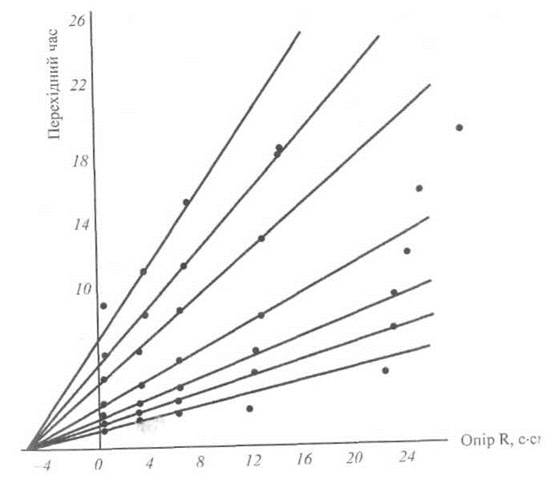
Fig. 7.3. Dependence of transit time on diffusion flow resistance with increasing humidity.
The non-aspirated porometer (which lacks a fan in the chamber) is simple, inexpensive, and can be used with broad-leaved samples. The disadvantage of this device is The complexity of the calibration Procedure and the dependence of measurement results on humidity changes that occur at high temperatures due to moisture Condensation on the chamber walls or the leaf surface. The latter two designs (aspirated porometers) exhibit higher sensitivity compared to the non-aspirated porometer, which allows them to accommodate needle-like and small leaves as samples.
Gas diffusion porometers. These instruments are based on measuring the rate of diffusion of gases (other than water vapor) through a leaf. Working gases can include hydrogen, nitrous oxide, helium, and radioactive argon and krypton. When using radioactive gases, a gas concentration meter is placed on the lower side of the leaf, and a Geiger counter on the upper side. The measurement procedure involves estimating the time required for the concentration in the lower part of the chamber to reach a certain fraction of the gas concentration in the upper part of the chamber.
A common drawback of diffusion porometers is the temperature dependence of their measurement results. During measurements, the temperature difference between the leaf and the sensor must not exceed 1 °C, and the temperature measurement accuracy should be within 0.1 °C.
Null-balance porometer. The leaf is placed in the chamber with its upper surface facing the atmosphere. The relative humidity inside the chamber is set to match the ambient humidity. Water vapor leaves the leaf via transpiration, increasing the humidity of the chamber's internal space. A flow of dry air (0% humidity) is directed across the lower surface of the leaf and adjusted until the humidity inside the chamber returns to the ambient level, thereby reaching the null-balance point. A schematic diagram of a null-balance porometer is shown in Fig. 7.4. The advantage of this type of porometer is The ability to maintain constant humidity throughout the measurements. The impact of temperature fluctuations within the chamber is minimized due to the rapid response time of the measurement process and the instrument's reliable thermal insulation. All calculations are performed by a microprocessor, which eliminates errors caused by subjective factors. A disadvantage of the null-balance porometer is that the temperature of the leaf surface inside the chamber during measurements does not equal the temperature of plant leaves under natural conditions, as the boundary layer on the leaf surface is disrupted inside the chamber.
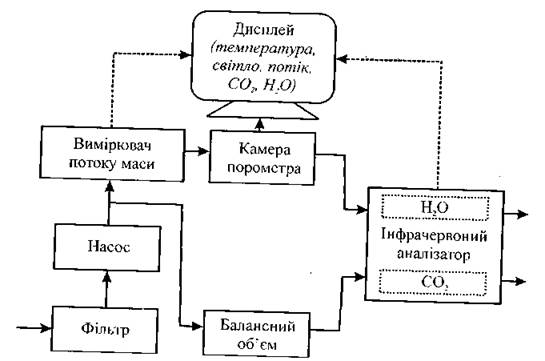
Fig. 7.4. Schematic diagram of a null-balance porometer.
Last update: 07/08/2026
Editorial and Educational Adaptation: This material has been compiled based on the primary/original source text. The project team performed an editorial review, corrected technical inaccuracies, structured sections, and adapted the content for an educational format.
What was processed:
- elimination of formatting defects (OCR errors, structural breaks, corrupted characters);
- editorial organization of content;
- standardization of terminology in accordance with academic sources;
- verification of factual statements against the original source text.
All mentions of the author, publication year, and origin of the primary text have been preserved in accordance with the source.