BIOLOGY Volume 3 - A Guide to General Biology - 2004
21. REPRODUCTION
21.5. Sexual Reproduction in Flowering Plants
21.5.3. Development of Pollen Grains
Each stamen consists of an anther, which contains four pollen sacs that produce pollen, and a filament containing a vascular bundle that supplies the anther with nutrients and Water. Fig. 21.21 shows the Internal Structure of an anther with its four pollen sacs containing pollen mother Cells. Each pollen mother Cell undergoes Meiosis to form four pollen grains (Fig. 21.22). Fig. 21.23 shows their microscopic appearance.
Immediately following meiosis, young pollen grains can be seen grouped in fours; such groups are called tetrads. Each pollen grain develops a thick wall, The surface of which is often intricately sculpted, with the pattern being specific to a particular species or genus. The outer wall, or exine, is composed of a waterproof substance called sporopollenin. This is one of the most durable and resilient substances found in nature, allowing pollen grain walls to remain unchanged for long periods of time, sometimes millions of years. This circumstance, combined with the relative ease of identifying the genus or species of the plant from which a pollen grain originated, has given rise to an entire science known as palynology, or pollen analysis. By studying pollen grains from a specific time and place, researchers can determine what plants grew there and obtain information about the ecosystems (including animal life) and climate of that region. Peat, which accumulates in thick layers over long periods in bogs, serves an especially abundant source of pollen grains.
The Nucleus of the pollen grain divides mitotically to form a generative nucleus and a tube nucleus (Fig. 21.22).
Class="center">
Fig. 21.21. Mature anther (transverse section) before and after dehiscence.

Fig. 21.22. Development of pollen grains.
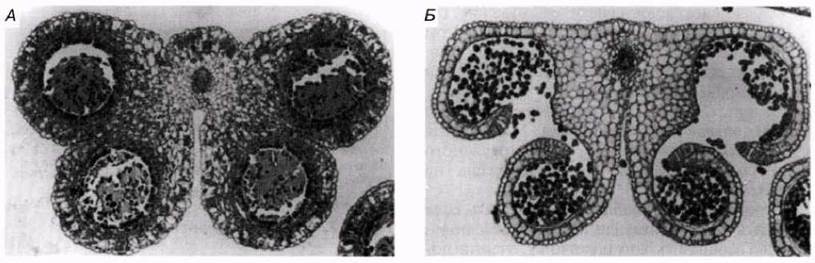
Fig. 21.23. Transverse sections of a lily anther before (A) and after (B) dehiscence.
21.1. How can pollen grains be used to determine
a) the past climate of a given region, and
b) human activity during that time?
Last update: 06/08/2026
Editorial and Educational Adaptation: This material has been compiled based on the primary/original source text. The project team performed an editorial review, corrected technical inaccuracies, structured sections, and adapted the content for an educational format.
What was processed:
- elimination of formatting defects (OCR errors, structural breaks, corrupted characters);
- editorial organization of content;
- standardization of terminology in accordance with academic sources;
- verification of factual statements against the original source text.
All mentions of the author, publication year, and origin of the primary text have been preserved in accordance with the source.