BIOLOGY Volume 3 - A Guide to General Biology - 2004
20. EXCRETION AND OSMOREGULATION
20.9. Kidney Diseases and Their Treatment
20.9.2. Haemodialysis
There are two distinct forms of dialysis. Extracorporeal Methods, known as haemodialysis, make use of artificial semipermeable membranes housed in an external unit connected to the body, called a dialyser. The second approach (Section 20.9.3) relies on a natural filtering membrane within the patient's own body—the Peritoneum—and is termed peritoneal dialysis (from the Greek peritonaion, meaning stretched over).
The first successful application of an extracorporeal dialyser (the artificial Kidney) dates back to the early 1950s. Today, these devices are routinely used by 2,500 people per year in the UK, although supply unfortunately still falls short of demand. Patients can learn to operate the dialyser themselves and keep the unit at home. They usually connect themselves to the machine overnight so that the Procedure is complete by morning.
The artificial kidney operates on the same basic principle as a natural one. Blood is diverted from the body, passed through a system of membranes that filter out waste products, and then returned to the patient. The layout of the apparatus is illustrated in Fig. 20.29.
Class="center">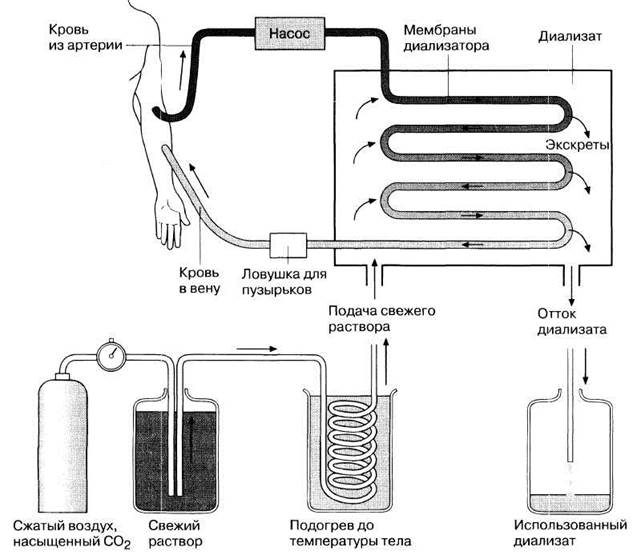
Fig. 20.29. A haemodialysis machine. Blood is drawn from an artery through a coiled tube and returned to a vein. The coil consists of a semipermeable membrane and is immersed in a dialysis fluid (dialysate), into which excretory products diffuse from the blood.
The patient is connected to the dialyser via catheters—flexible tubes, one of which is inserted into an artery (for blood extraction) and the other into a vein (for blood return). Blood Vessels in the arm or leg are typically used for this purpose. If dialysis is performed frequently, short catheters can be left permanently in place, with the tubing leading to the machine attached periodically.
The patient's arterial blood is pumped through a system of artificial semipermeable membranes, across which only ions, small molecules, and Water can pass via passive diffusion, while Proteins and formed elements remain in the blood. Heparin is added to the blood just before it enters the vein to prevent clotting. Flowing in the opposite direction on the outside of the membrane is a fluid that:
1) is maintained at body Temperature;
2) contains a balanced composition of ions at appropriate concentrations, specifically Na+, К+, Сl-, Mg2+, Са2+, and HCO3- (in the form of an organic anion, acetate);
3) contains nutrients at precisely calculated concentrations, such as glucose, to maintain an adequate osmotic potential;
4) has an appropriate pH and buffering capacity.
Exchange between the blood and the dialysis fluid (dialysate) continues until equilibrium is reached. As a result, unwanted components such as urea and excess sodium and potassium are removed from the blood, while beneficial substances are retained. This process is simpler than that occurring in a normal kidney because no ultrafiltration takes place and there is no need for reabsorption.
The procedure lasts 6–8 hours and is typically performed at least twice a week. Despite The addition of glucose, the osmotic potential of the dialysate is kept less negative (its water potential higher) than that of the blood. Consequently, water would tend to move into the blood; however, this is counteracted by increasing the blood pressure through partial constriction of the venous catheter. The higher the hydrostatic pressure, the more water is forced out into the dialysate (or prevented from entering the blood). In this way, fluid balance is regulated.
The acetate present in the dialysate is metabolised by the body into bicarbonate. This helps restore the blood's natural buffering capacity, which gradually declines between dialysis sessions.
Last update: 06/08/2026
Editorial and Educational Adaptation: This material has been compiled based on the primary/original source text. The project team performed an editorial review, corrected technical inaccuracies, structured sections, and adapted the content for an educational format.
What was processed:
- elimination of formatting defects (OCR errors, structural breaks, corrupted characters);
- editorial organization of content;
- standardization of terminology in accordance with academic sources;
- verification of factual statements against the original source text.
All mentions of the author, publication year, and origin of the primary text have been preserved in accordance with the source.