BIOLOGY Volume 2 - A Guide to General Biology - 2004
12. MICROBIOLOGY AND BIOTECHNOLOGY
12.10. Large-Scale Production
12.10.3. Scaling Up Production
Any new biotechnological production process must first be tested on a laboratory scale. Following preliminary studies using standard laboratory equipment, a pilot plant is set up. This utilizes a relatively small fermenter with a volume ranging from 2 to 200 dm3 (Fig. 12.14). A fermenter is a vessel in which the process takes place. To maximize product yield, it is essential to determine the optimal physical conditions and nutrient requirements.
Class="center">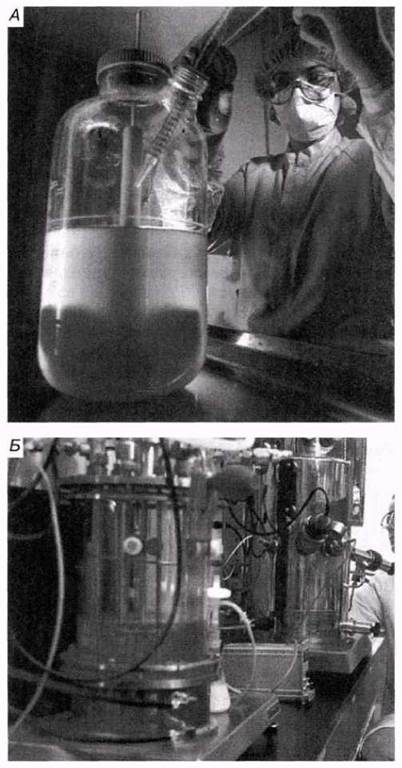
Fig. 12.14. A. A vessel containing a starter culture of mammalian Cells used for The production of Monoclonal Antibodies. Hybridoma cells are cultured in the vessel and subsequently used to inoculate a fermenter to produce antibodies. B. A pilot plant for commercial Fermentation in a biotechnology laboratory.
When scaling up a process from pilot-scale to full-scale production, where volumes reach thousands of dm3 (Fig. 12.15), new factors come into play. In some cases, such a transition may simply prove impossible. Some of the most critical factors are listed below.
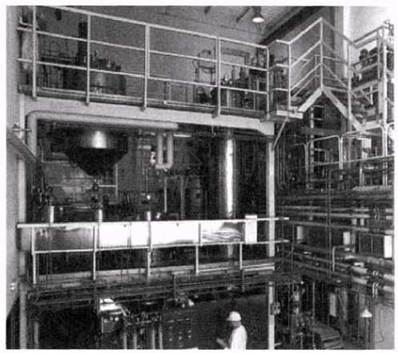
Fig. 12.15. A large-scale fermenter (2000 dm3) used for the commercial production of monoclonal antibodies.
1. Maintaining sterile conditions is the primary challenge. It is easy to contaminate both the inputs entering the fermenter and the outputs being withdrawn from it. Engineering techniques have improved with experience, and the PRODUCTION OF SINGLE-Cell protein known as prutin (Section 12.12.3) serves as an excellent example of the successes achieved in applying aseptic Methods.
2. The greatest difficulties in scaling up arise from physical factors, such as medium mixing and aeration, as well as overheating Prevention. These problems are addressed by chemical engineers. Several of these issues are discussed below.
3. To ensure an adequate oxygen supply for large-scale cultures, the medium must be aerated, as simple laboratory shaking is insufficient. Small bubbles are more effective than large ones, so a sparger (a pipe with small holes) is used to introduce air. To increase turbulence and the efficiency of oxygen dissolution in Water, baffling plates are built into the vessel walls, which increases the residence time of air bubbles within the fermenter.
4. Antifoaming agents must be used to reduce the foaming caused by agitation and aeration.
5. The intense METABOLIC ACTIVITY OF microorganisms in large-scale production generates significant amounts of heat. Therefore, cooling water must circulate around the fermenter.
6. In large-scale production, maintaining constant environmental conditions—such as nutrient and oxygen concentrations, as well as pH—is much more difficult. Sophisticated setups are required for monitoring and control. Attempts to bypass these difficulties, for instance by agitating the medium, can lead to unforeseen consequences, such as alterations in the DISTRIBUTION OF MICROORGANISMS throughout the culture. In prutin production, the initial product yield was significantly lower than predicted based on experiments conducted under laboratory and pilot-plant conditions. This was found to be related to The addition of methanol to the fermenter as the sole source of carbon and energy for the Bacteria. Because methanol was added at a single specific point in the fermenter, the circulating bacteria experienced alternating cycles of "feast and famine," as a single Circulation cycle took several minutes. When methanol was added at multiple points across the fermenter, production rose to the expected level.
7. Microorganisms can alter their METABOLISM in response to environmental conditions, and on a large scale, it is much more difficult to precisely control these conditions. Any minor alterations in the product could prove hazardous to humans or animals consuming it.
8. The more complex the equipment and Procedures, the greater the likelihood of defects or accidents, the economic consequences of which can be catastrophic. Therefore, it is crucial to assess these risks in advance when determining the economic feasibility of a project.
9. Large-scale production requires the delivery, sterilization, and disposal of massive volumes of water.
10. Raw Materials consumed in large quantities must be readily available, stable, and easy to handle and store. Chemical alterations and microbial contamination of stored materials must be kept to a minimum. Initial reactants must be inexpensive, as cost is a major factor in production.
11. Microbial strains selected for a fermentation process sometimes readily revert (via mutation) back to low-producing strains that grow much faster. When scaling up production, the probability of such an occurrence increases significantly.
12. Powdery substances handled in large quantities can pose health hazards to workers.
13. The materials used to construct the fermenter must be corrosion-resistant to prevent contamination by trace metals. Furthermore, they must be non-toxic to microorganisms and withstand high-pressure steam sterilization.
14. Large-scale fermentation, particularly when utilizing genetically modified organisms, presents additional hazards. These stem from the potential for a much greater impact on humans—both from the cultured microorganism itself and from its biologically active product—compared to standard laboratory scale.
Last update: 06/08/2026
Editorial and Educational Adaptation: This material has been compiled based on the primary/original source text. The project team performed an editorial review, corrected technical inaccuracies, structured sections, and adapted the content for an educational format.
What was processed:
- elimination of formatting defects (OCR errors, structural breaks, corrupted characters);
- editorial organization of content;
- standardization of terminology in accordance with academic sources;
- verification of factual statements against the original source text.
All mentions of the author, publication year, and origin of the primary text have been preserved in accordance with the source.