BIOLOGY Volume 2 - A Guide to General Biology - 2004
19. HOMEOSTASIS
19.2. Regulation of Blood Glucose Levels
Glucose is one of the most vital metabolites found in the Blood. Its concentration (level) must be strictly controlled, as Glucose serves as the primary substrate for tissue Respiration and must be continuously supplied to the Cells. Brain cells are particularly sensitive to glucose deficiency, as they are incapable of using any other metabolites as an energy source. A lack of glucose leads to unconsciousness. The normal blood glucose ("sugar") level is approximately 90 mg per 100 ml (90 mg%), though it can safely fluctuate for a human from 70 mg% on an empty Stomach to 150 mg% after a meal. The sources of blood glucose and its interrelationships with other metabolites will be discussed in Section 19.6.2.
The Regulation of Blood glucose levels is a prime example of a complex, endocrine-controlled homeostatic mechanism involving the coordinated secretion of at least six Hormones and two negative feedback loops. An increase in blood glucose levels (hyperglycemia) stimulates Insulin secretion (Section 17.6.6), while a drop in these levels (hypoglycemia) suppresses insulin release and triggers the secretion of Glucagon (Section 17.6.6) along with Other Hormones, such as adrenaline, which raise blood glucose levels. The General scheme of this regulatory system is shown in Fig. 19.4.
Class="center">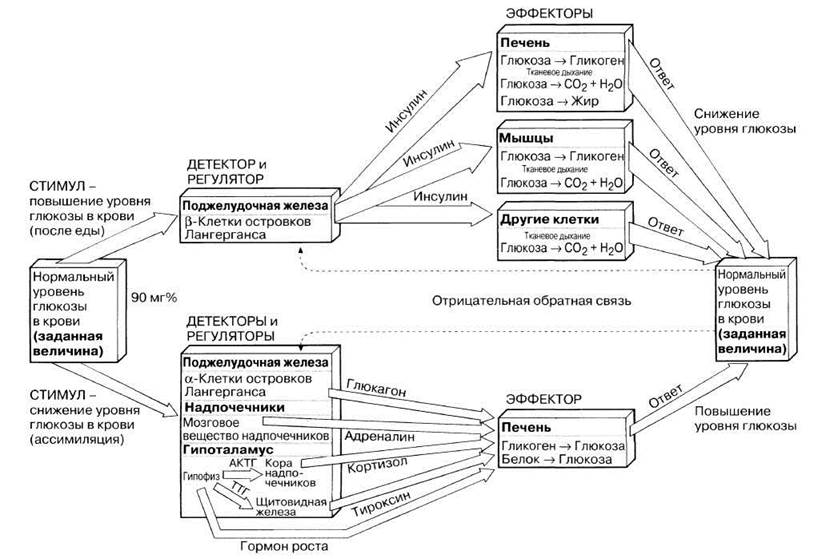
Fig. 19.4. Regulation of blood glucose levels. ACTH — adrenocorticotropic hormone (corticotropin); TSH — thyroid-stimulating hormone.
Last update: 06/08/2026
Editorial and Educational Adaptation: This material has been compiled based on the primary/original source text. The project team performed an editorial review, corrected technical inaccuracies, structured sections, and adapted the content for an educational format.
What was processed:
- elimination of formatting defects (OCR errors, structural breaks, corrupted characters);
- editorial organization of content;
- standardization of terminology in accordance with academic sources;
- verification of factual statements against the original source text.
All mentions of the author, publication year, and origin of the primary text have been preserved in accordance with the source.