BIOLOGY Volume 2 - A Guide to General Biology - 2004
18. ANIMAL SKELETAL AND MUSCULAR SYSTEMS
18.6. Locomotion in vertebrates
18.6.2. Forward propulsion in fish
In animals such as annelid worms and insects, discussed in previous sections, the body is clearly segmented. Vertebrates also exhibit a segmented Structure, although this is clearly visible only in a few animals, notably in fish. The axial musculature of fish on both sides of THE Vertebral Column is divided into segmental blocks of antagonistic Muscles called myotomes, which provide forward propulsion in Water. Externally, each myotome has a zigzag shape, while internally it is attached to two adjacent vertebrae. The vertebral column as a whole acts as a long, flexible rod that bends easily when the myotomes lying on one side of it contract. The myotomes on either side of the vertebral column contract and relax alternately, with contractions starting at the HEAD and propagating toward the tail. These contractions produce undulating waves, the number of which increases as the body becomes thinner and longer.
1. In fish with a very compact body, such as Ostracium (trunkfish), undulating Movements of the entire body are virtually impossible, and forward movement relies for approximately 80% on the bending of the tail and caudal fin. This mode of locomotion is known as ostraciiform locomotion.
2. More elongated forms, such as sharks and most teleost fish, are characterized by scombriform locomotion. In these fish, undulating movements are performed by the posterior half of the body.
3. Anguilliform locomotion is typical of fish with a very long body (e.g., eels); such fish move by means of body undulations.
These types of locomotion are illustrated in Fig. 18.28.
Forward movement of the body is generally the result of movements of the tail and caudal fin. With each stroke of the tail, the fish is propelled through the water, while its head deflects in the direction opposite to the tail movement. This generates lateral resistance. However, this lateral movement is counteracted by the inertia of the water surrounding the relatively massive anterior part of the body (compared to the tail) and the large surface area of the dorsal fin. Displacing the body sideways in water would require considerably more force than pushing it forward. The magnitude of the force with which the tail and caudal fin push against the water depends on: 1) the speed of their movement; 2) their surface area; and 3) the angle they form relative to the water flow.
Class="center">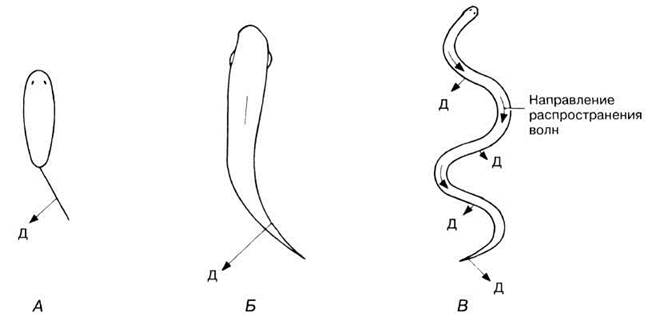
Fig. 18.28. Comparison of ostraciiform (A), scombriform (B), and anguilliform (C) types of locomotion. Д — pressure of the tail against the water.
Last update: 06/08/2026
Editorial and Educational Adaptation: This material has been compiled based on the primary/original source text. The project team performed an editorial review, corrected technical inaccuracies, structured sections, and adapted the content for an educational format.
What was processed:
- elimination of formatting defects (OCR errors, structural breaks, corrupted characters);
- editorial organization of content;
- standardization of terminology in accordance with academic sources;
- verification of factual statements against the original source text.
All mentions of the author, publication year, and origin of the primary text have been preserved in accordance with the source.