Biochemistry in Tables, Schemes, and Graphs - S.D. Zhamsaranova 2009
Transmembrane Signal Transduction
Translation
The process occurs in three stages: initiation, elongation, and termination.
Class="center">Main Components of THE PROTEIN-SYNTHESIZING SYSTEM AND THEIR Functions IN Translation
Required components |
Functions |
Substrates for Protein Synthesis |
|
tRNA molecules act as adapters. They interact with amino acids via their acceptor stem and with the mRNA codon via their anticodon |
|
Each aminoacyl-tRNA synthetase catalyzes the specific binding of one of the 20 amino acids to its corresponding tRNA |
|
mRNA |
The template containing a linear sequence of codons that determines the Introduction/19.html">Primary Structure of Proteins |
Ribonucleoprotein subcellular structures that serve as the site of protein synthesis |
|
ATP, GTP |
|
Protein factors of initiation, elongation, termination |
Specific non-ribosomal proteins required for the translation process (12 initiation factors: eIF; elongation factors: EF1, EF2; termination factors: RF1, RF2, RF3) |
Magnesium ions |
Cofactor that stabilizes the ribosomal structure |

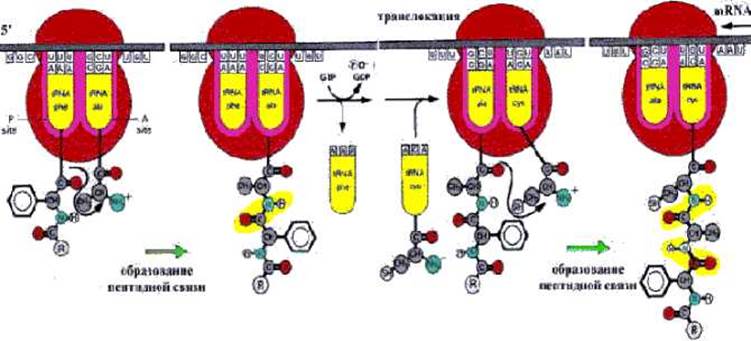
ELONGATION
Last update: 06/08/2026
Editorial and Educational Adaptation: This material has been compiled based on the primary/original source text. The project team performed an editorial review, corrected technical inaccuracies, structured sections, and adapted the content for an educational format.
What was processed:
- elimination of formatting defects (OCR errors, structural breaks, corrupted characters);
- editorial organization of content;
- standardization of terminology in accordance with academic sources;
- verification of factual statements against the original source text.
All mentions of the author, publication year, and origin of the primary text have been preserved in accordance with the source.