BIOCHEMISTRY - L. Stryer - 1984
VOLUME 3
Part IV INFORMATION
CHAPTER 24 DNA: THE GENETIC ROLE, STRUCTURE, AND REPLICATION
24.5. Complementary Strands Serve as Templates for Each Other in DNA Replication
The model of the DNA double helix immediately suggested a mechanism for METABOLISM/36.html">DNA Replication. Watson and Crick published their hypothesis a month after presenting the Introduction/20.html">DNA Structure model, in a remarkably concise and elegant paper.
“It has not escaped our notice that the specific pairing we have postulated immediately suggests a possible copying mechanism for the genetic material. Once the precise sequence of bases in one chain is known, the exact sequence of bases in the other chain can be deduced, as specific pairing is required. Thus, each of the strands is complementary to the other, and it is this property that suggests how a deoxyribonucleic acid molecule might undergo duplication.
Previous discussions of self-duplication have always relied on THE CONCEPT OF some kind of template or mould. It was assumed that the template either directly copied itself, or that it had to form a ‘negative’ which in turn acted as a template to form the original ‘positive’. In neither case was a detailed explanation proposed as to how this could happen at the atomic and molecular level.
In our model of deoxyribonucleic acid, there is essentially a pair of templates, with each strand being complementary to the other. We suggest that prior to duplication, the Hydrogen Bonds break, and the two strands unwind and separate. Each strand then serves as a template for The formation of a new complementary strand, so that ultimately there will be two pairs of strands where previously there was only one. Moreover, this method of replication ensures that the base-pair sequence is precisely duplicated.”
24.6. DNA Replication is Semiconservative
Watson and Crick hypothesized that one strand of each daughter DNA molecule is newly synthesized, while the other is derived from the parent DNA molecule. This mode of distribution of parental molecule atoms is termed semiconservative. Matthew Meselson and Franklin Stahl designed a landmark experiment to test this hypothesis. Parental DNA was labeled with the heavy nitrogen isotope 15N to make it denser than normal DNA. To achieve this, E. coli were grown for many generations in a medium containing 15NH4Cl as the sole nitrogen source. The Bacteria were then rapidly transferred to a medium containing the stable 14N nitrogen isotope. This experiment was designed to reveal how 14N and 15N isotopes are distributed among DNA molecules during subsequent cycles of replication.
The distribution of 14N and 15N in the progeny was analyzed using the newly developed method of equilibrium density-gradient centrifugation. A small amount of DNA is dissolved in a concentrated cesium chloride solution with a density close to that of DNA (~1.7 g/cm3). This solution is centrifuged almost to equilibrium. Under the opposing forces of sedimentation and diffusion, a cesium chloride concentration gradient forms within the centrifuge Cell. As a result, a stable density gradient ranging from 1.66 to 1.76 g/cm3 is established. Driven by centrifugal force, DNA molecules migrate to the region of the gradient where the solution density matches their own buoyant density. High-molecular-weight DNA forms a sharp band, detected by ultraviolet Light absorption. 14N-DNA and 15N-DNA molecules are well-resolved in such a gradient because their densities differ by approximately 1% (Fig. 24.14).
Class="center">Fig. 24.14. Separation of 14N- and 15N-DNA by density-gradient centrifugation. A - ultraviolet photomicrograph of the centrifuge cell; B - densitometric absorption scan obtained from the photograph shown in A

DNA was isolated from bacteria at various time intervals after transfer from the 15N medium to the 14N medium. Density-gradient centrifugation analysis of these samples showed that after one round of replication, the DNA formed a single band (Fig. 24.15). The density of this band was exactly halfway between the densities of 15N-DNA and 14N-DNA. The absence of 15N-DNA indicated that the integrity of the parental DNA is disrupted during replication. The absence of 14N-DNA demonstrated that a portion of the atoms in all daughter DNA molecules originated from the parental DNA. The ratio of 14N to 15N in the daughter molecules must be 1:1, as the density of the hybrid DNA molecules was intermediate between 14N- and 15N-DNA.
Fig. 24.15. Evidence for semiconservative replication in E. coli Cells using density-gradient centrifugation. THE POSITION OF the DNA band depends on its 14N and 15N content. After 1.0 generation, all DNA molecules are hybrids containing equal amounts of 14N and 15N. Parental DNA (15N) is not detected after 1.0 generation

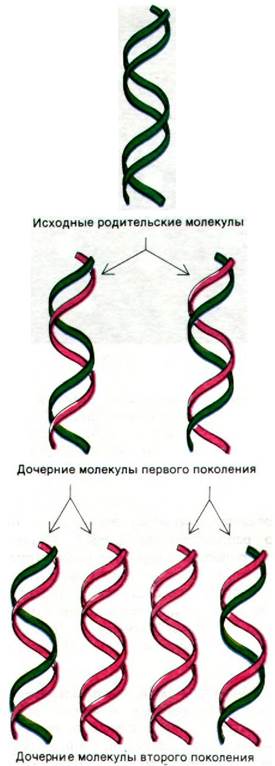
After two rounds of replication, the DNA was distributed equally between two bands. One of these was hybrid DNA, and the other was 14N-DNA. From these compelling experiments, Meselson and Stahl concluded "that the nitrogen of a DNA molecule is divided equally between two physically distinct subunits; that upon duplication each daughter molecule receives one of these subunits; and that these subunits remain intact through many generations." These findings were in remarkable agreement with the Watson-Crick model of DNA replication (Fig. 24.16).
Fig. 24.16. Schematic of semiconservative replication. Parental DNA is shown in green, and newly synthesized DNA in red
Last update: 06/08/2026
Editorial and Educational Adaptation: This material has been compiled based on the primary/original source text. The project team performed an editorial review, corrected technical inaccuracies, structured sections, and adapted the content for an educational format.
What was processed:
- elimination of formatting defects (OCR errors, structural breaks, corrupted characters);
- editorial organization of content;
- standardization of terminology in accordance with academic sources;
- verification of factual statements against the original source text.
All mentions of the author, publication year, and origin of the primary text have been preserved in accordance with the source.