BIOCHEMISTRY - L. Stryer - 1984
VOLUME 2
PART II GENERATION AND STORAGE OF METABOLIC ENERGY
CHAPTER 15. THE PENTOSE PHOSPHATE PATHWAY AND GLUCONEOGENESIS
15.2. Two Molecules of NADPH Are Generated in the Conversion of Glucose 6-Phosphate to Ribulose 5-Phosphate
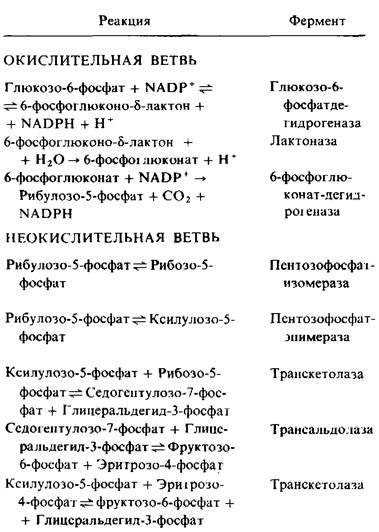
The Pentose Phosphate Pathway begins with the dehydrogenation of glucose 6-phosphate at C-1, a reaction catalyzed by glucose 6-phosphate dehydrogenase (Fig. 15.1). The enzyme is highly specific for NADP+; the Km for NAD+ is approximately a thousand times higher than that for NADP+. The reaction product is 6-phosphoglucono-δ-lactone, an intramolecular ester with an ester linkage between the C-1 carboxyl group and the hydroxyl at C-5. The next step is the Hydrolysis of 6-phosphoglucono-δ-lactone by a specific lactonase, yielding 6-phosphogluconate. This six-carbon sugar then undergoes Oxidative decarboxylation by 6-phosphogluconate dehydrogenase to form ribulose 5-phosphate. NADP+ again serves as the electron acceptor.
Class="center">Fig. 15.1. The oxidative branch of The pentose phosphate pathway. These three reactions are catalyzed by glucose 6-phosphate dehydrogenase, lactonase, and 6-phosphogluconate dehydrogenase.

15.3. Ribulose 5-Phosphate Is Isomerized to Ribose 5-Phosphate with an Enediol Intermediate
The final step in the synthesis of ribose 5-phosphate is the isomerization of ribulose 5-phosphate by phosphopentose isomerase. This reaction is analogous to the glycolytic reactions:
Glucose 6-Phosphate ⇄ Fructose 6-Phosphate
and
Dihydroxyacetone Phosphate ⇄ Glyceraldehyde 3-Phosphate.
All three ketose-aldose isomerizations proceed via an enediol intermediate.

15.4. The Pentose Phosphate Pathway and Glycolysis Are Linked by Transketolase and Transaldolase
The preceding reactions generate two molecules of NADPH and one molecule of ribose 5-phosphate for each oxidized molecule of glucose 6-phosphate. However, many Cells require more NADPH for reductive biosyntheses than is needed for the incorporation of ribose 5-phosphate into NUCLEOTIDES and Nucleic Acids. In such cases, ribose 5-phosphate is converted into glyceraldehyde 3-phosphate and fructose 6-phosphate through the action of transketolase and transaldolase. These Enzymes establish a reversible link between the pentose phosphate pathway and Glycolysis by catalyzing the following three reactions:
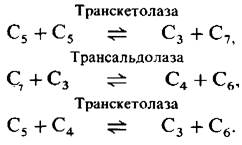
The net yield of the three reactions is The formation of two hexoses and one triose from three pentoses.
The Essence of these processes is The transfer of a two-carbon unit by transketolase and a three-carbon unit by transaldolase. The donor of the two- and three-carbon units is typically a ketose, and the acceptor is an aldose.
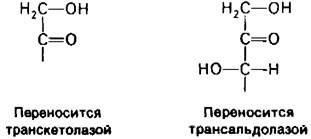
The first of the three reactions linking the pentose phosphate pathway and glycolysis involves the Formation of glyceraldehyde 3-phosphate and sedoheptulose 7-phosphate from two pentoses.
The donor of the two-carbon unit in this reaction is xylulose 5-phosphate, an epimer of ribulose 5-phosphate. A ketose can serve as a substrate for transketolase only if its hydroxyl group at C-3 has the configuration of xylulose rather than ribulose. Ribulose 5-phosphate is converted by phosphopentose isomerase into the corresponding epimer, which then enters the transketolase reaction.
Table 15.1. The Pentose Phosphate Pathway
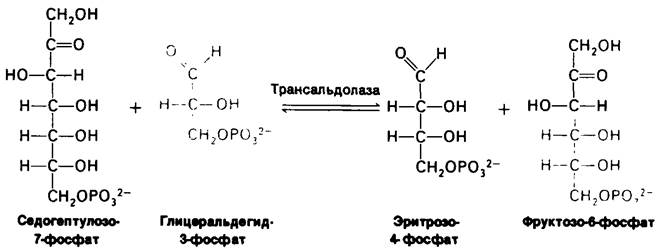
Next, glyceraldehyde-3-phosphate and sedoheptulose-7-phosphate interact to form fructose-6-phosphate and erythrose-4-phosphate. This synthesis of four- and six-carbon sugars is catalyzed by transaldolase.
In the third reaction, transketolase catalyzes the synthesis of fructose-6-phosphate and glyceraldehyde-3-phosphate from erythrose-4-phosphate and xylulose-5-phosphate.
Summing up these reactions, we obtain
2Ксилулозо-5-фосфат + Рибозо-5-фосфат ⇄ 2-фруктозо-6-фосфат + Глицеральдегид-3-фосфат.
Xylulose-5-phosphate can be formed from ribose-5-phosphate through the sequential action of pentose phosphate isomerase and pentose phosphate epimerase. Thus, the overall reaction starting from ribose-5-phosphate is as follows:
3 Рибозо-5-фосфат ⇄ 2фруктозо-6-фосфат + Глицеральдегид-З-фосфат.
Thus, excess ribose-5-phosphate produced in the pentose phosphate pathway can be quantitatively converted into glycolytic intermediates.
Last update: 06/08/2026
Editorial and Educational Adaptation: This material has been compiled based on the primary/original source text. The project team performed an editorial review, corrected technical inaccuracies, structured sections, and adapted the content for an educational format.
What was processed:
- elimination of formatting defects (OCR errors, structural breaks, corrupted characters);
- editorial organization of content;
- standardization of terminology in accordance with academic sources;
- verification of factual statements against the original source text.
All mentions of the author, publication year, and origin of the primary text have been preserved in accordance with the source.